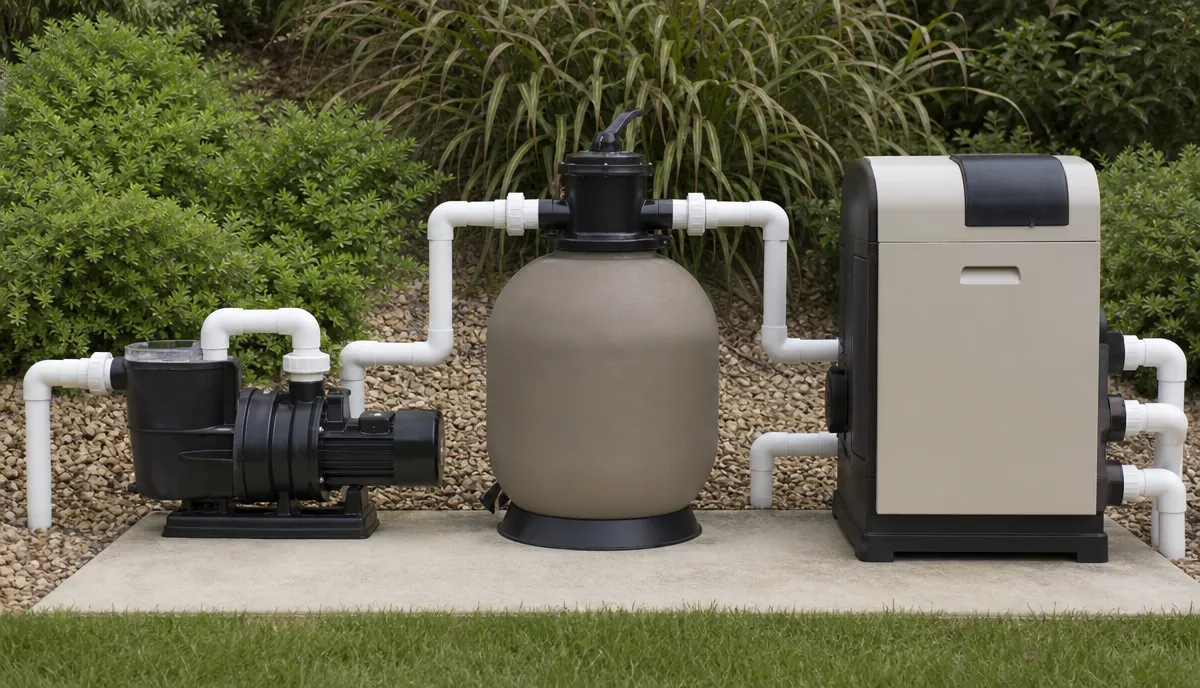

February is the month this costs least to find out. A heater diagnosed now is a planned decision; the same heater diagnosed in the second week of May is a decision made with a full pool and a family waiting.
So here are five signs a heater is genuinely finished — and three that look terminal and usually are not.
Five Signs It Is Finished
1. It is heating the equipment pad instead of the pool
The clearest one, and the reason it comes first. If the cabinet and the area around the heater get noticeably warm while the pool does not, the heat is not going where it should.
That points at the heat exchanger — the one component whose failure changes the conversation, because on an older unit its cost can approach a replacement heater.
2. It weeps or drips water when it runs, and stops when it does not
Same conclusion, different evidence. Water escaping only under operation is water leaving the circuit it is supposed to stay in.
Worth ruling out first: a union, a bypass valve or a pressure-switch tapping, all of which are plumbing rather than heater. If those are dry and it still weeps when running, that is the exchanger.
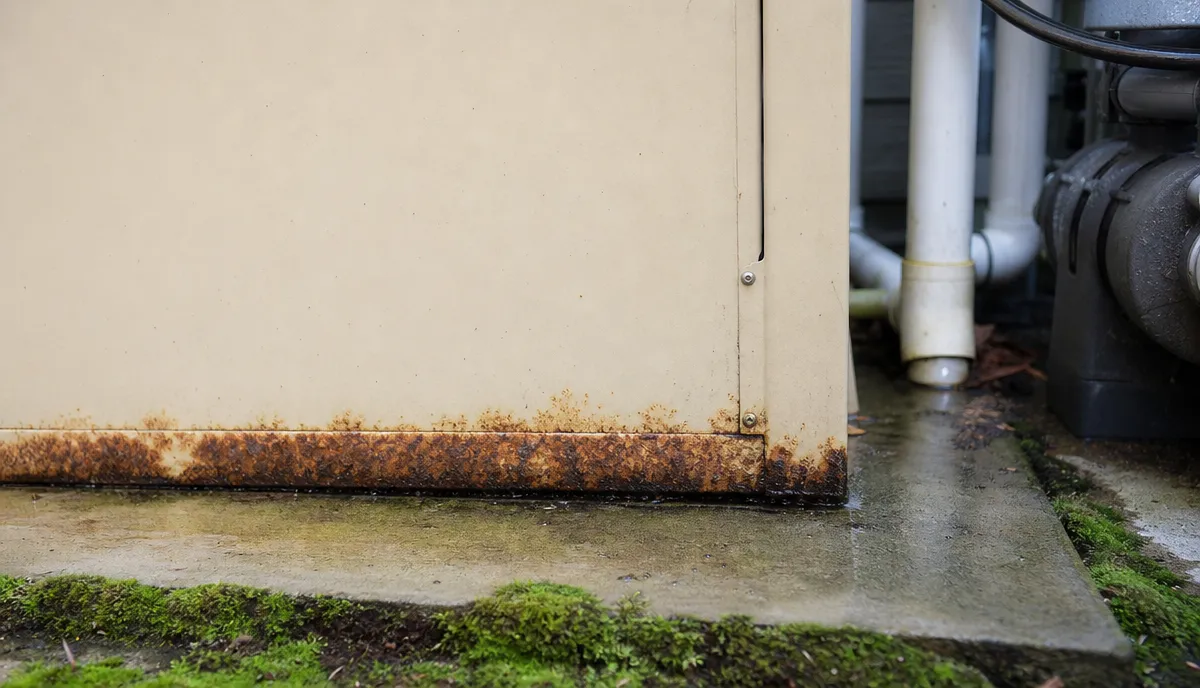
3. Rust through the base of the cabinet
Structural, and it does not get better. A heater sitting on a pad in Ohio weather for enough years eventually rusts from the bottom, and once the base has gone there is nothing sound to mount the internals to.
A rusty panel is cosmetic. A rusty base is the end.
4. Parts are no longer available
Not a symptom, but it decides the answer. A discontinued unit is a repair you may not be able to make twice — which changes whether making it once is sensible.
It is worth asking about early rather than after a part has been ordered.
5. It was never the right size for the pool
Fixing an undersized heater gives you back an undersized heater.
The tell is behavioural rather than mechanical: it holds temperature on a mild September afternoon and loses the argument on a cold October night — which is the night you bought it for. Sizing depends on surface area, the temperature you want to hold, wind exposure and whether the pool is covered when it is not in use, not on volume alone. See pool heaters.
Three Signs That Look Terminal And Usually Are Not
Published alongside the list above, because a post that only lists reasons to replace things is an advertisement.
It will not fire at all
Most often a flow problem, and it is designed to behave this way. A heater has a switch that must see adequate flow before the burner lights, and it refuses rather than risk itself.
So the first questions are about water: is the filter loaded, is a valve part-closed, is the water level low enough that the skimmer draws air, is the pump actually moving water — and on a variable-speed pump, is it running fast enough? A speed chosen for quiet filtration can sit below what the heater's switch needs. That one is common and looks exactly like a dead heater. The full order of checks is on the diagnostic sequence.
It lights and shuts off after a few seconds
Usually flame sensing rather than gas. The heater proves it has a flame by passing a small current through it and measuring what returns — so a dirty sensor rod, or a corroded ground path, leaves the board unable to see a flame that is perfectly good. It then shuts the gas off on purpose.
A dirty sensor is a cleaning job, and a repeat failure shortly after a sensor replacement usually means the ground path was the actual cause. See gas and ignition faults.
It takes much longer to warm the pool than it used to
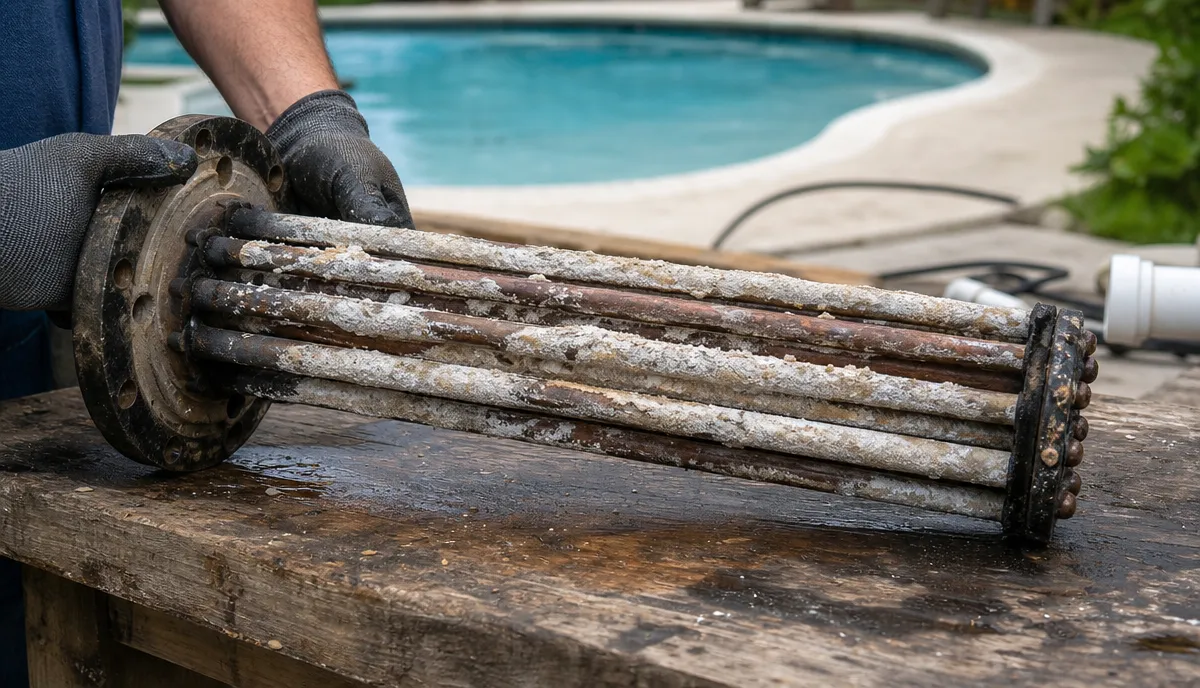
Usually scale, not age. Calcium comes out of solution on the hottest surface in the system — the inside of the exchanger tubes — and scale insulates, so the heater burns the same gas to move less heat into the water.
Where the unit is otherwise sound the water side can be de-limed rather than replaced. Where the tubes have been running hot behind deposit for years, there is no sound metal under it and the exchanger is already spent. See what kills an exchanger.
If It Lights And Then Drops Out Under Load, Read This Twice
That specific pattern — fine at first, fails when it asks for full output, or misbehaves on the first cold morning when the house furnace is drawing hard — is usually the gas supply rather than the heater.
A pool heater is often the largest gas appliance on a domestic property and the last one added, so the line may not carry what a bigger unit asks for. People spend years replacing igniters over this.
Our boundary, plainly: we do not run or alter gas lines. That is a licensed gas fitter's work. We will read the supply at the appliance, document it and hand it over. And if you can smell gas, do not call us first — leave the area and call your gas utility or the fire service.
What To Do In February
Get it diagnosed, not replaced on principle. A $150 service call covers up to the first hour of diagnosis on site, with parts and further labour quoted before we do them. See pool heater repair.
If the answer is a component, February is a quiet month to fit one.
If the answer is the exchanger on an older unit, three questions decide it: which part failed, whether the cause of the failure is still present, and whether the rest of the unit is sound. A new exchanger in the same water is on the same timetable as the old one. See repair or replace.
And if it is a replacement, the supply question wants answering before you choose a unit rather than after — that is one of four separate costs, set out on the four costs. See also pool heater replacement.