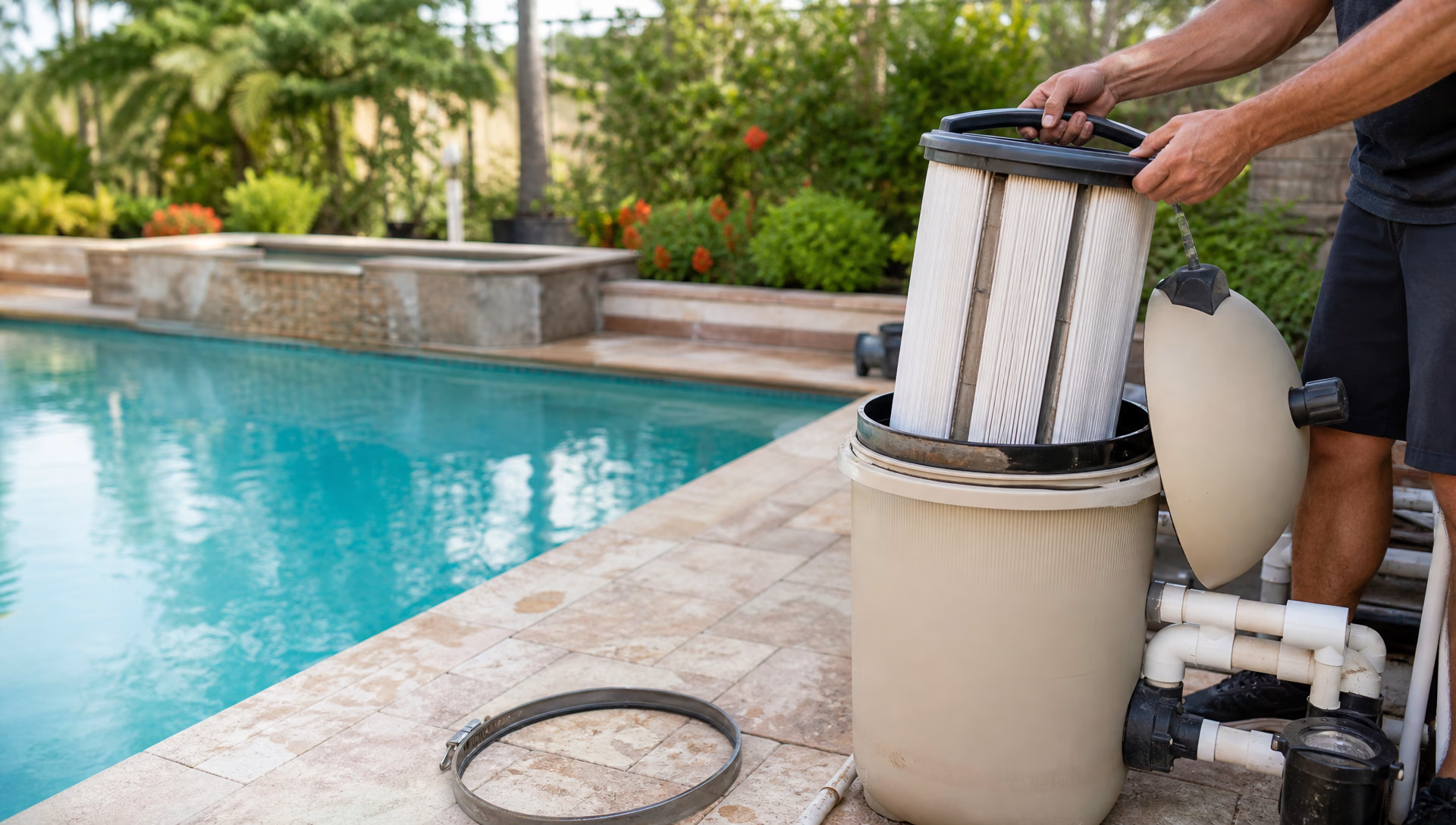

Sand, cartridge and DE filters — repaired, rebuilt and properly cleaned. Offsite cartridge cleaning $125, $150 service call. Serving Twinsburg, Solon, Hudson and the Route 91 corridor.
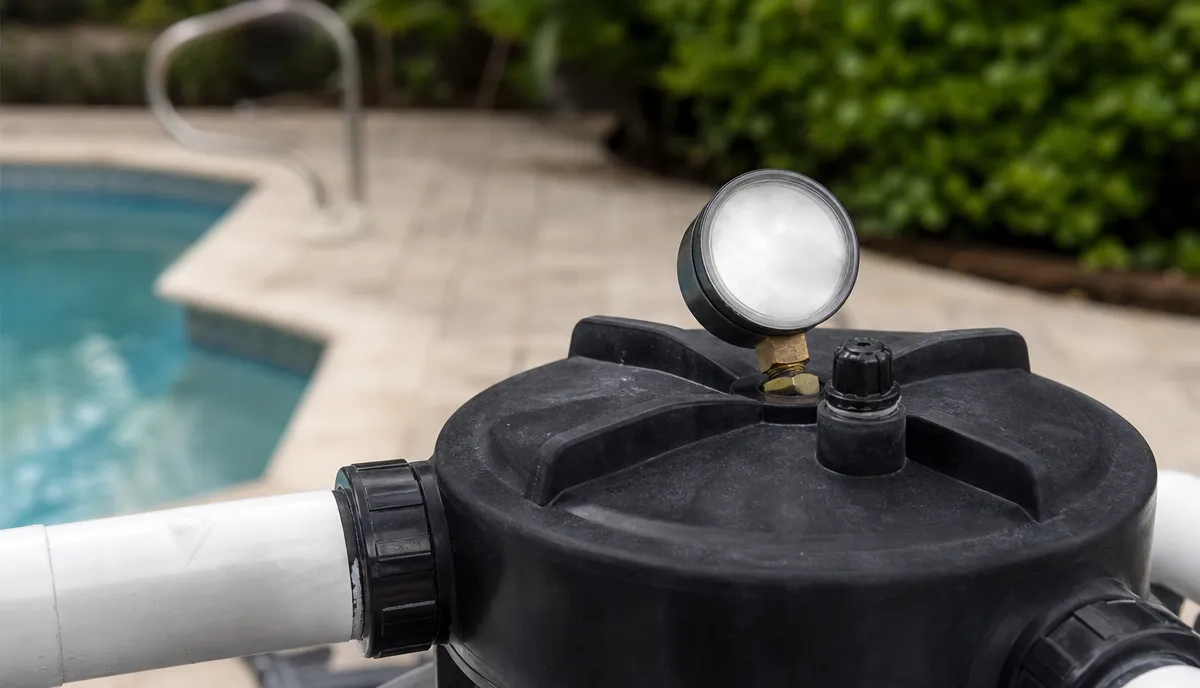
The gauge on your filter is the most useful diagnostic instrument on the pad, and most pool owners never learn to read it. It is worth five minutes.
First, know your clean baseline. Straight after a filter is cleaned or backwashed, note the pressure. That number — not any number off the internet — is your pool's normal. Everything below is relative to it.
Pressure rising above baseline. The filter is loading up with debris, which is what it is meant to do. Rising pressure means restricted flow, and restricted flow starves everything downstream: the heater's flow-switch may refuse and shut it down, a salt cell may stop registering flow, and the pump works harder against the restriction. When it has climbed meaningfully above baseline, clean it.
Pressure that will not come down after cleaning. This is the important one. If you backwash or rinse and the pressure stays high, the medium itself is the problem — sand that has channelled or calcified, or a cartridge whose fibres are loaded with oils and fine particulate that water will not shift. That is not a cleaning problem, it is a media problem.
Pressure falling below baseline. Counter-intuitive but usually worse news, because it means less water is arriving at the filter. Look upstream, not at the filter: a blocked skimmer or pump basket, a clogged suction line, a pump losing prime or starting to cavitate, or a low water level. See pool pump repair.
Pressure that jumps around. Air in the system. There is a suction-side leak somewhere — a lid o-ring, a drain plug or a union.
And one on variable speed pumps: if you have fitted one, your baseline changes with speed. Note the baseline at your normal filtration speed, or the gauge tells you nothing useful. See variable speed pool pumps.
This is the honest explanation behind the $125, and it is worth understanding before deciding it is an unnecessary expense.
A cartridge traps debris in pleated fabric. Rinsing with a hose removes what is sitting on the surface — which is why the cartridge looks clean afterwards and the pressure barely moves.
What stays behind is the part causing the restriction: body oils, sunscreen, lotions and fine mineral particulate, worked deep into the fibres. Oils in particular are not water-soluble, so no amount of hose pressure lifts them. They gradually blind the fabric until water cannot pass.
A proper clean means soaking the cartridge in a cleaning solution to break down the oils and dissolve mineral scale, then pressure washing the pleats out. That takes hours of soak time, which is why it happens offsite rather than at your pool.
So the boundary is:
Included in a chemical and equipment check: on-site rinsing or swapping of cartridge elements, up to once a month, plus backwashing sand and DE filters as needed.
Chargeable at $125: the offsite soak-and-pressure-wash that actually recovers flow.
If your cartridge has been hosed for two seasons and the pressure never quite returns to baseline, that is what is happening, and a proper clean will often restore a cartridge you were about to replace.
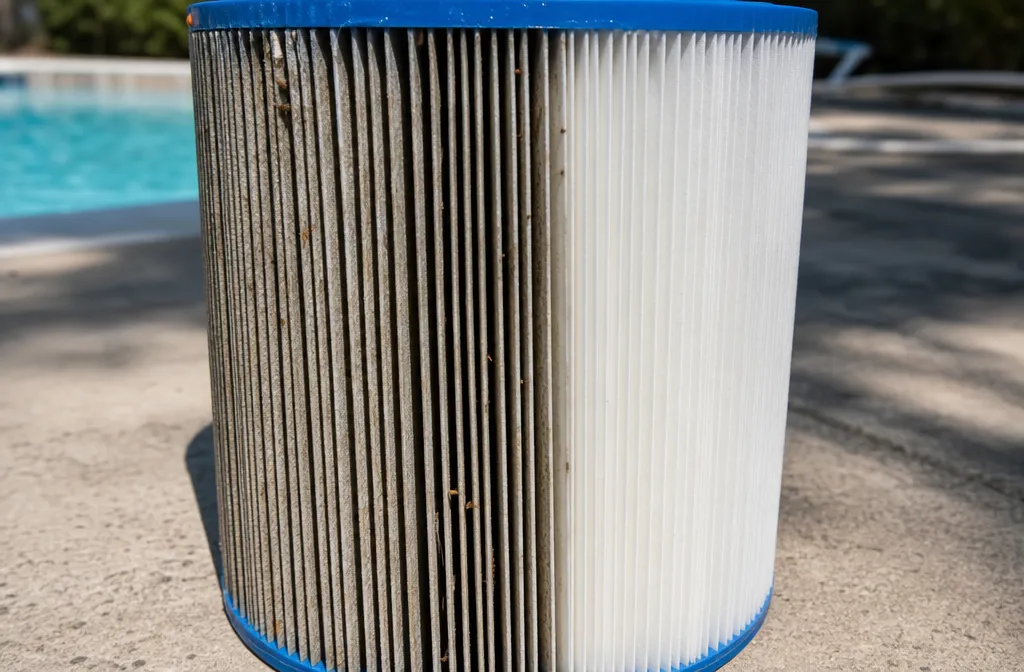
A dirty pool filter cartridge
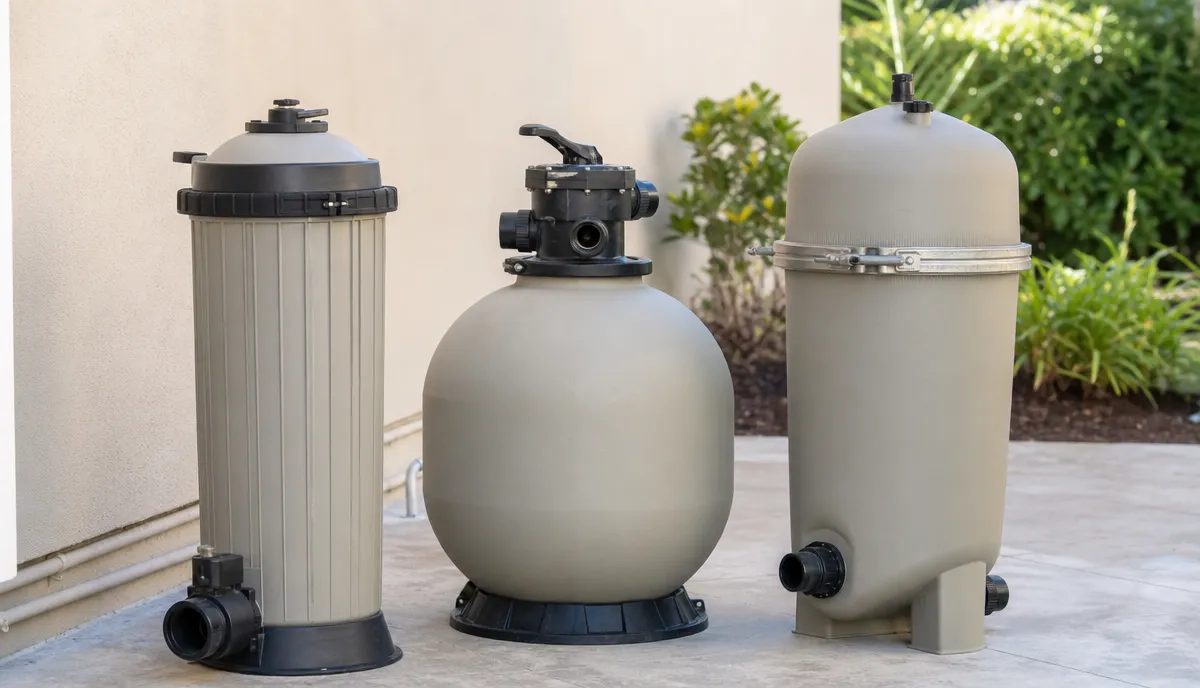
They are not interchangeable and they do not behave alike.
Sand. Cleaned by backwashing — reversing the flow to lift the debris bed and send it out of the waste line. Simple and forgiving. The sand itself does eventually need replacing: after years of service it channels, and calcification cements it so water runs through paths rather than through the bed. A sand filter whose pressure will not drop after a backwash usually needs sand, not repair.
Cartridge. No backwash line, so nothing goes down the drain — an advantage where waste water is awkward to dispose of. Filters finer than sand. The trade is the cleaning regime described above, and elements that eventually need replacing when the pleats break down.
DE (diatomaceous earth). The finest filtration of the three. A powder coats internal grids and is recharged after each backwash. Best water clarity, most involved maintenance, and the grids themselves tear and need replacing.
Which is best depends on what you value. What matters more than the type is whether it is maintained — a neglected DE filter delivers worse water than a well-kept sand one.
DE grids and manifolds
The commonest filter repair there is. Spider gaskets, diverters, handles and the valve body. A multiport that leaks to waste in the filter position, or will not seat between positions, is usually a gasket
And internal laterals — the slotted fingers at the base that let water out and hold sand in. A cracked lateral sends sand back into the pool, which is diagnostic in itself
Plus the offsite clean at $125
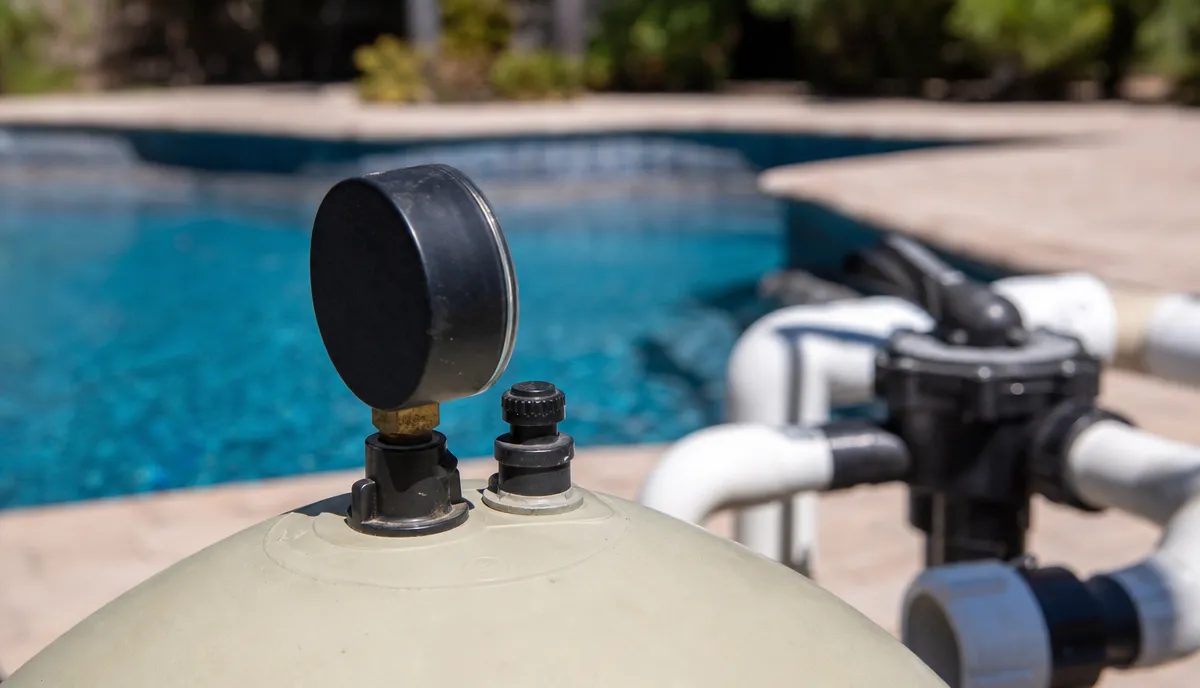
Clamp bands, lids, o-rings, air relief valves, pressure gauges. A gauge that reads wrong is worth replacing on principle, because everything above depends on it
Which are a replacement rather than a repair
At the filter
A $150 service call covers up to the first hour of diagnosis or repair.
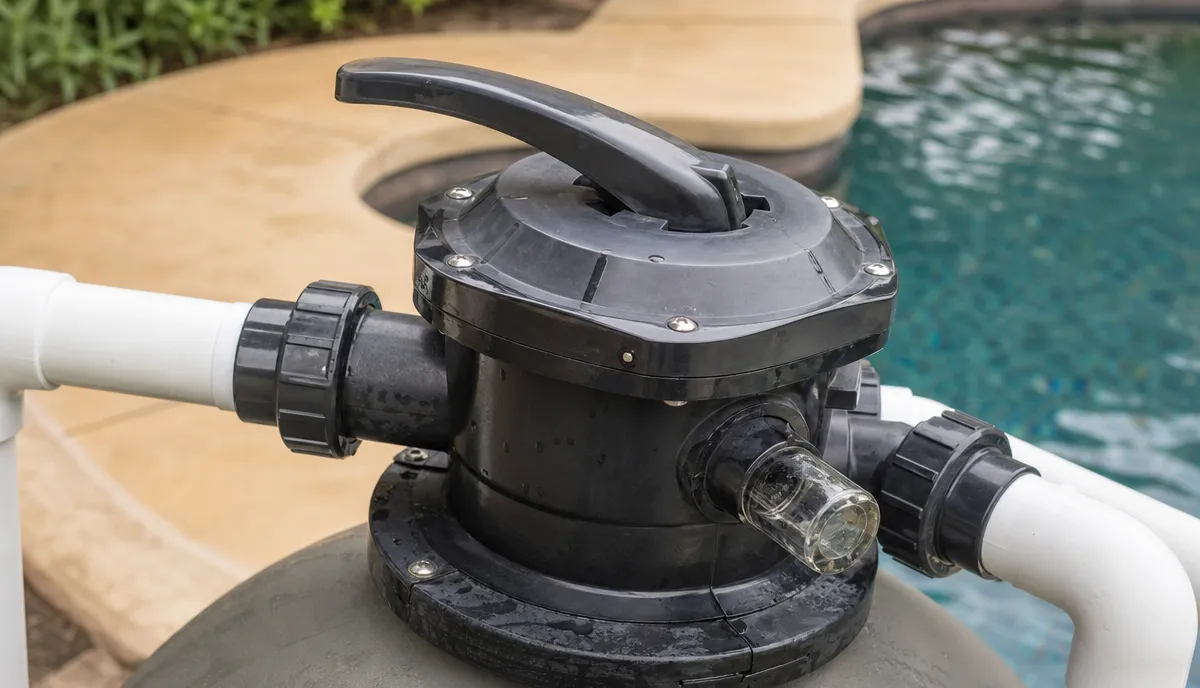
The multiport valve on a sand filter
A filter tank is a rigid vessel full of water, which makes it a textbook freeze casualty.
A tank that is not drained splits. Water expands as it freezes and a filter tank is not designed to accommodate it. That is a replacement, not a repair — and it is not a warranty matter, because it follows from how the pool was closed. A proper close drains the tank and purges it rather than assuming it empties itself.
Multiport valves are the other classic. The valve body holds water in its passages, and a valve left full and frozen cracks internally in ways that are not visible from outside. It shows up at opening as a valve that leaks between positions.
Freeze-thaw cycling works on the clamp band and lid o-rings. This region crosses freezing repeatedly rather than freezing once, so the seals take repeated cycles and give up in spring.
And five idle months stiffen everything rubber. Spider gaskets, o-rings and diaphragms all take a set. That is why filter leaks so often appear on the first start rather than during the season — see pool openings and closings.
“The crew is super knowledgeable and courteous.”
That is usually the medium rather than the filter — worth diagnosing before replacing anything.
We service, repair and replace filters from Hayward, Pentair, Jandy, Sta-Rite, Fluidra and Zodiac across sand, cartridge and DE. On commercial systems we also work with BECS, Stenner, Blue-White and Chemtrol controllers and feeders. The full list is on brands we service.
Products we install carry the full manufacturer's warranty, which varies by manufacturer and generally runs between one and three years. We do not offer a separate workmanship guarantee, and nothing on this page should be read as one.
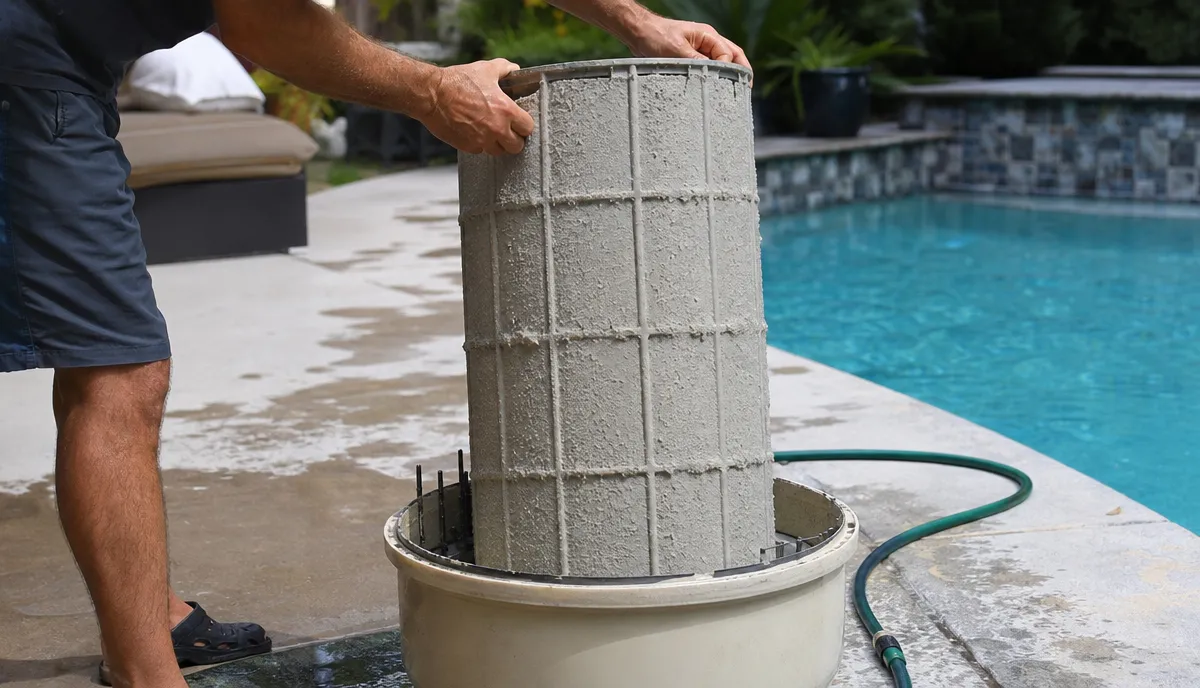
A DE filter grid coated with filter powder
M & G Pools services in-ground pools exclusively. We do not service, repair or supply equipment for above-ground pools, and we do not service hot tubs or spas.
The filter is loaded with debris and flow is restricted, which starves everything downstream — a heater may shut itself down on low flow and a salt cell may stop registering. Clean or backwash it. If the pressure does not come back down to your usual clean baseline afterwards, the medium itself is the problem rather than the debris.
Because hosing removes what is on the surface, which is why the cartridge looks clean and the pressure barely moves. What causes the restriction is body oils, sunscreen and fine mineral particulate worked into the fibres — and oils are not water-soluble, so hose pressure does not lift them. A proper clean means hours of soaking in cleaning solution plus pressure washing, which is why it happens offsite. On-site rinsing or swapping up to once a month is included in a chemical and equipment check.
Usually because less water is reaching the filter, so look upstream rather than at the filter — a blocked skimmer or pump basket, a clogged suction line, a low water level, or a pump losing prime or starting to cavitate. Low pressure generally means a bigger problem than high pressure.
Most likely a cracked lateral — one of the slotted fingers at the base of the tank that lets filtered water out and holds the sand in. It can also be a failed standpipe. Either way the tank needs opening, and running the filter meanwhile keeps putting sand in the pool.
Less often than the internet suggests, but it is not never. Sand eventually channels and calcifies so water runs through paths instead of the bed, and the sign is pressure that will not return to baseline after a backwash. That is a media replacement rather than a repair, and we will tell you when yours is at that point.