
Gas heaters and heat pumps diagnosed properly — including what your fault code actually means. $150 service call across Twinsburg, Solon, Hudson, Chagrin Falls and the Route 91 corridor.
If your heater is showing a code, that code is telling you something specific. Three of the common ones, as published in Hayward's own troubleshooting documentation:
IF — ignition failure. The heater tried to ignite and did not confirm a flame. Gas supply is the first thing to establish: a closed valve, an empty propane tank, or a gas pressure problem. After that, the igniter itself, or the flame sense circuit failing to detect a flame that is actually there. Worth knowing: a heater that faults on IF has usually shut itself down correctly rather than broken.
LO — pressure switch. A water pressure or flow fault. This is very often not the heater at all — it is the filter or the pump. A filter that needs a backwash, a pump losing prime, or a variable speed pump running too slowly for the heater's flow-switch to accept will all produce LO. Check the filter pressure before anyone quotes you a heater part.
AO — vacuum switch. An airflow or venting fault. The heater is not satisfied that combustion air and exhaust are moving as they should — a blocked or restricted vent, a failed blower, or the switch itself.
Before you reset it. Most Hayward heaters let you clear a fault and try again, and one reset is a reasonable thing to do — a single lockout can follow a transient like a brief gas pressure dip. But a heater that faults again on the same code is telling you the condition is still there, and repeatedly cycling the reset just repeats the unsafe start it shut down to avoid. Two attempts, then call.
A note on completeness: these are three of the codes, not all of them, and displays differ across Hayward's heater families. The definitive list for your specific unit is in Hayward's own documentation for that model. If yours is showing something not listed here, tell us the code when you call — it genuinely shortens the visit.
And the useful pattern across all three: two of these three common codes are frequently caused by something other than the heater. That is the single most valuable thing to understand about heater faults — the heater is often the component reporting the problem rather than the component with the problem.
Straight answer, because this page ranks alongside Hayward's own dealer locator and you deserve to know where we stand.
Warranty repairs generally have to be carried out through the manufacturer's authorized network to keep the coverage intact. Tell us the unit's age when you call and we will tell you straight if that is your situation — it is not in your interest for us to do a paid repair on a heater that Hayward would have covered.
Which is most of the heaters we see, authorization is not relevant to the work. What matters is whether the technician can diagnose it.
Carry the full manufacturer's warranty, which varies by manufacturer and generally runs between one and three years. That is a fact about the product, not a claim about our relationship with anyone.
We are not a Hayward Authorized Service Center. We service, repair and replace Hayward pool heaters — that is ordinary work on equipment a customer owns, and we have been doing it for years — but we hold no authorization from Hayward and we will not imply otherwise.
What follows from that, practically:
We do not offer a separate workmanship guarantee, and nothing on this page should be read as one.
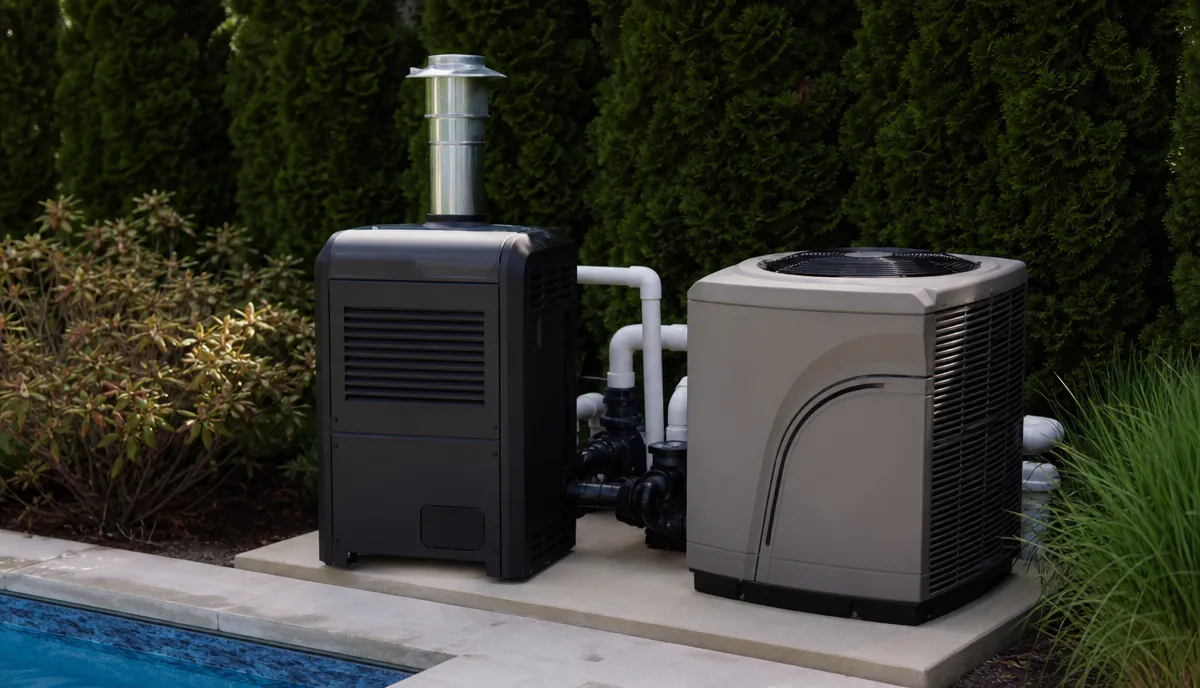
A gas heater and a heat pump side by side on one pad
It matters, because the two types fail differently and suit different seasons.
Gas heaters burn natural gas or propane to heat water directly. They heat fast and they heat regardless of how cold the air is. Faults cluster around ignition, gas supply, venting, the heat exchanger, and scale — a heater that has lost output with no other change usually needs a de-lime rather than a part. Gas units are also BTU-rated for a given volume and temperature rise, so a heater that never quite reaches setpoint may simply be undersized for the pool rather than faulty. And a gas heater run at too low a return temperature will condense flue gas inside the cabinet, which corrodes it from the inside out — visible as rust streaking below the burner tray, and a sign the install or the operation needs attention as much as the unit does.
Heat pumps move heat out of the outside air into the water. They are efficient in warm weather and their output falls as air temperature falls. Faults cluster around the compressor, the reversing valve, refrigerant, fan motors and defrost behaviour.
If you are not sure which you have: a gas heater has a gas line running to it and a flue; a heat pump looks like an air-conditioning unit with a large fan on top and no gas connection.
We do not use an age threshold. Depending on its age and condition, a heater may be worth repairing or may need replacing, and the way to find out is to run a diagnostic and decide from what it says. A $150 service call covers up to the first hour of diagnosis or repair.
The part that usually decides it is the heat exchanger, and its condition is set by water chemistry rather than by years. A heater that spent its life on well-balanced water can be sound at ten years; one that ran at low pH can be finished at five. Scale and corrosion are what kill exchangers, and both are chemistry.
Where a repair will hold, we repair. Where the exchanger is gone, no repair is worth doing and we will say so rather than sell you the same repair twice. See pool heater replacement.
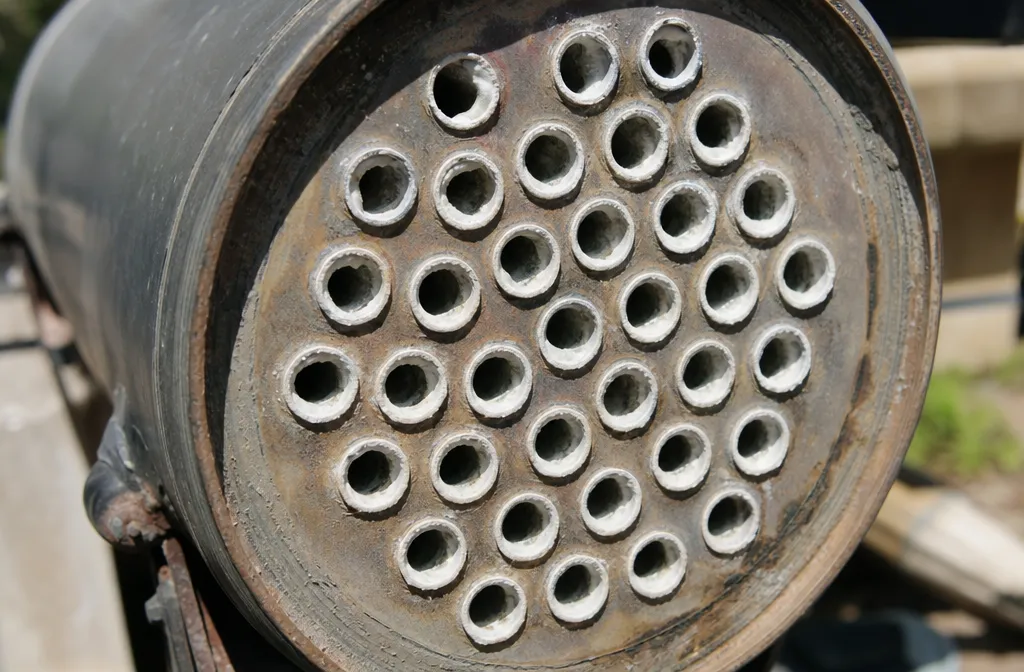
Scale narrowing the tubes of a heat exchanger
Most Hayward heater advice online is written where the season never really ends. Two things are different here.
A heat pump has an ambient floor. Because it moves heat out of the air, its output falls with air temperature and effectively floors out in cold weather — which here is April and October, the exact two months most people bought a heater to use. A Hayward heat pump is a good choice for holding temperature through June to August at low running cost. For genuinely extending the season, gas does something a heat pump physically cannot.
Winterizing decides whether it survives. A heater with water left in the exchanger over a Northeast Ohio winter splits it, and a split exchanger is a replacement rather than a repair. It is also not a warranty matter, because it is a consequence of how the pool was closed. A proper close purges the heater rather than assuming it drains itself. That is why so many heater faults appear at opening — the unit was fine in October.
See pool heaters for the full gas-versus-heat-pump comparison and sizeing.
“M&G has serviced our in ground pool for the past 10+ years. Seasonal opening & closing, replacing heaters, pumps and a number of aggravating repairs that Matt & his crew have handled correctly at a fair price. Recommend highly.”
Tell us what it says when you call — it usually narrows the job before we arrive.
We service, repair and replace Hayward equipment across the pad, not just heaters — see Hayward pool pump repair.
We also work on Pentair, Raypak, Jandy, Sta-Rite, Fluidra and Zodiac: Pentair pool heater repair, Raypak pool heater repair, and the full list on brands we service.
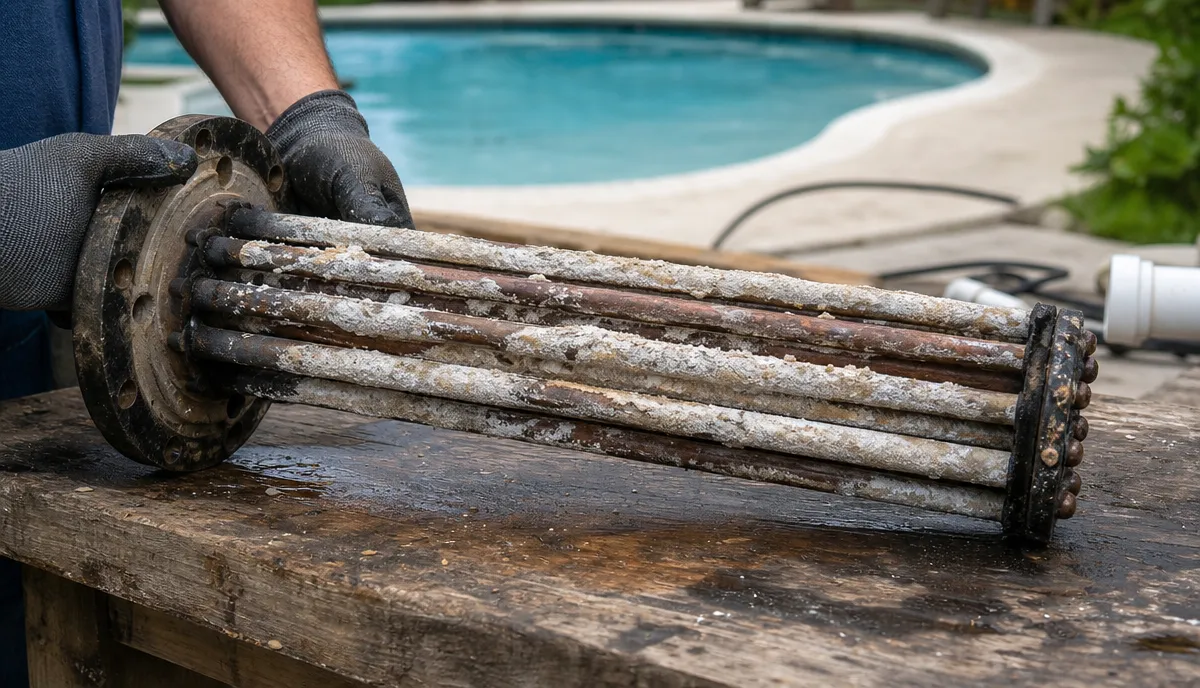
A heat exchanger tube bundle furred with calcium scale
Two checks that occasionally solve it, and always shorten the visit:
Read the code and write it down. Also note whether the heater is trying to fire and failing, or not trying at all.
Check the filter pressure. If the pressure is high, a backwash may clear an LO fault entirely — see pool filter repair. This is the single most common cause of a heater that looks broken and is not.
Then check the obvious: is the set-point above the current water temperature, is the breaker on, and has anything on the pad been switched or re-plumbed recently.
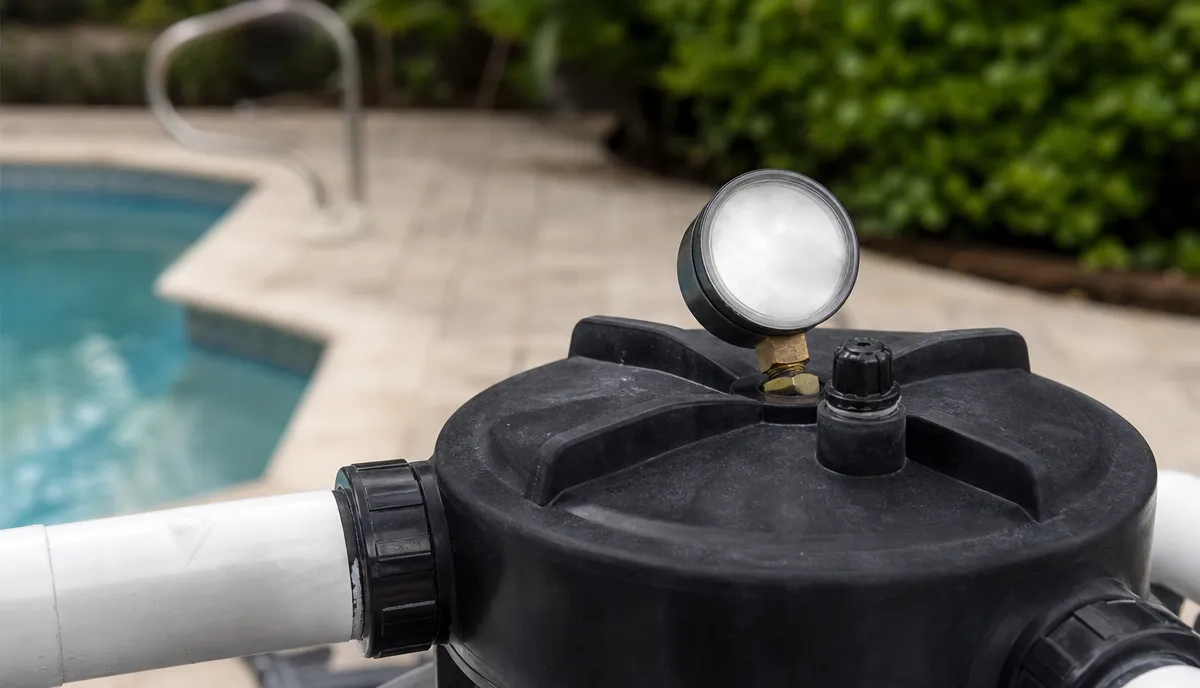
A pool filter pressure gauge and air relief valve
M & G Pools services in-ground pools exclusively. We do not service, repair or supply equipment for above-ground pools, and we do not service hot tubs or spas.
Ignition failure — the heater tried to ignite and did not confirm a flame. Start with gas supply: a closed valve, an empty propane tank, or a gas pressure problem. After that it is usually the igniter or the flame sense circuit. A heater showing IF has generally shut itself down correctly rather than broken.
A water pressure or flow fault — and very often it is not the heater. A filter needing a backwash, a pump losing prime, or a variable speed pump running too slowly for the heater's flow switch will all produce LO. Check your filter pressure before anyone quotes you a heater part.
No. We service, repair and replace Hayward pool heaters as ordinary work on equipment you own, and we have done for years — but we hold no authorization from Hayward and we will not imply otherwise. If your heater is still under manufacturer warranty, warranty repairs generally have to go through the manufacturer's own service network to keep coverage intact; tell us the unit's age when you call and we will tell you straight if that is your situation.
It depends on the heat exchanger, and its condition is set by water chemistry rather than age — a heater on well-balanced water can be sound at ten years while one that ran at low pH can be finished at five. A $150 service call covers up to the first hour of diagnosis, and we decide from what the diagnostic finds rather than from a rule about age.
For holding temperature through June to August at low running cost, yes. For extending the season, less so — a heat pump moves heat out of the outside air, so its output falls as the air cools and effectively floors out in April and October, which are the months most people want a heater for. Gas does something a heat pump physically cannot in cold weather.