
Full spring startup for in-ground pools — equipment reassembled, systems started and checked, water shocked and balanced. From $495 plus chemicals across Twinsburg, Solon, Hudson and the Route 91 corridor.
From $495 plus chemicals, and here is what the visit covers.
Chemicals are billed separately. What moves the starting figure is pool size, what is on the equipment pad, how much is in the water when we arrive, and access.
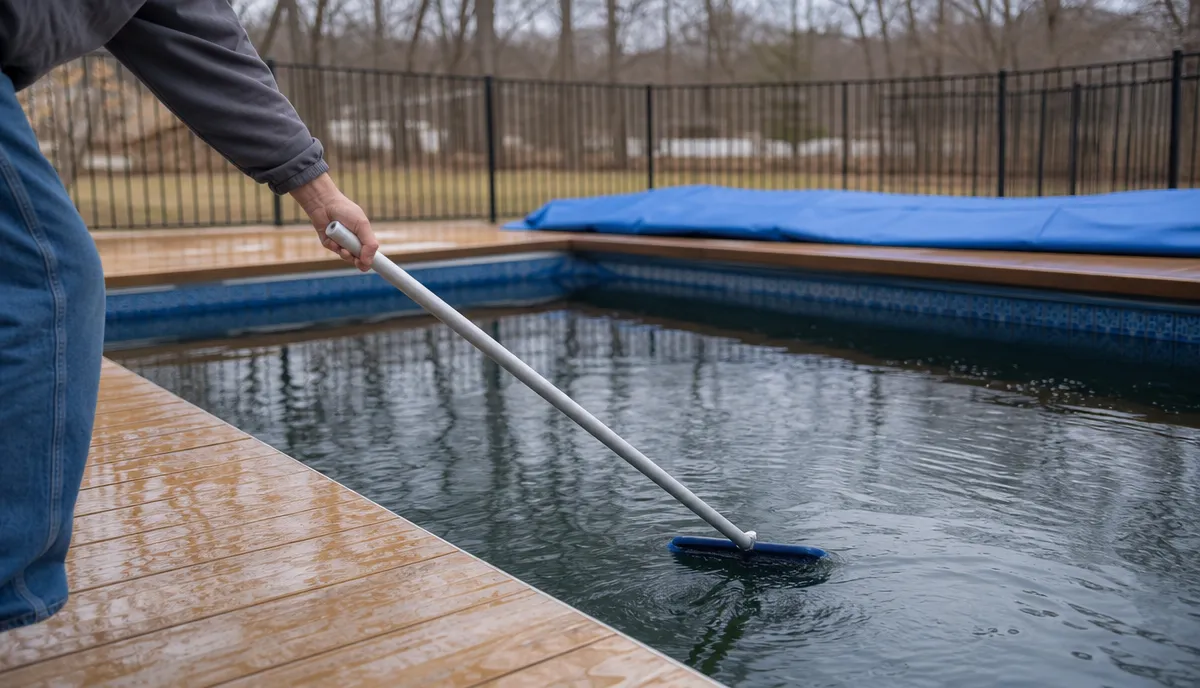
Brush off, remove and fold the winter cover for storage on the property, and lower the cover anchors flush into the deck.
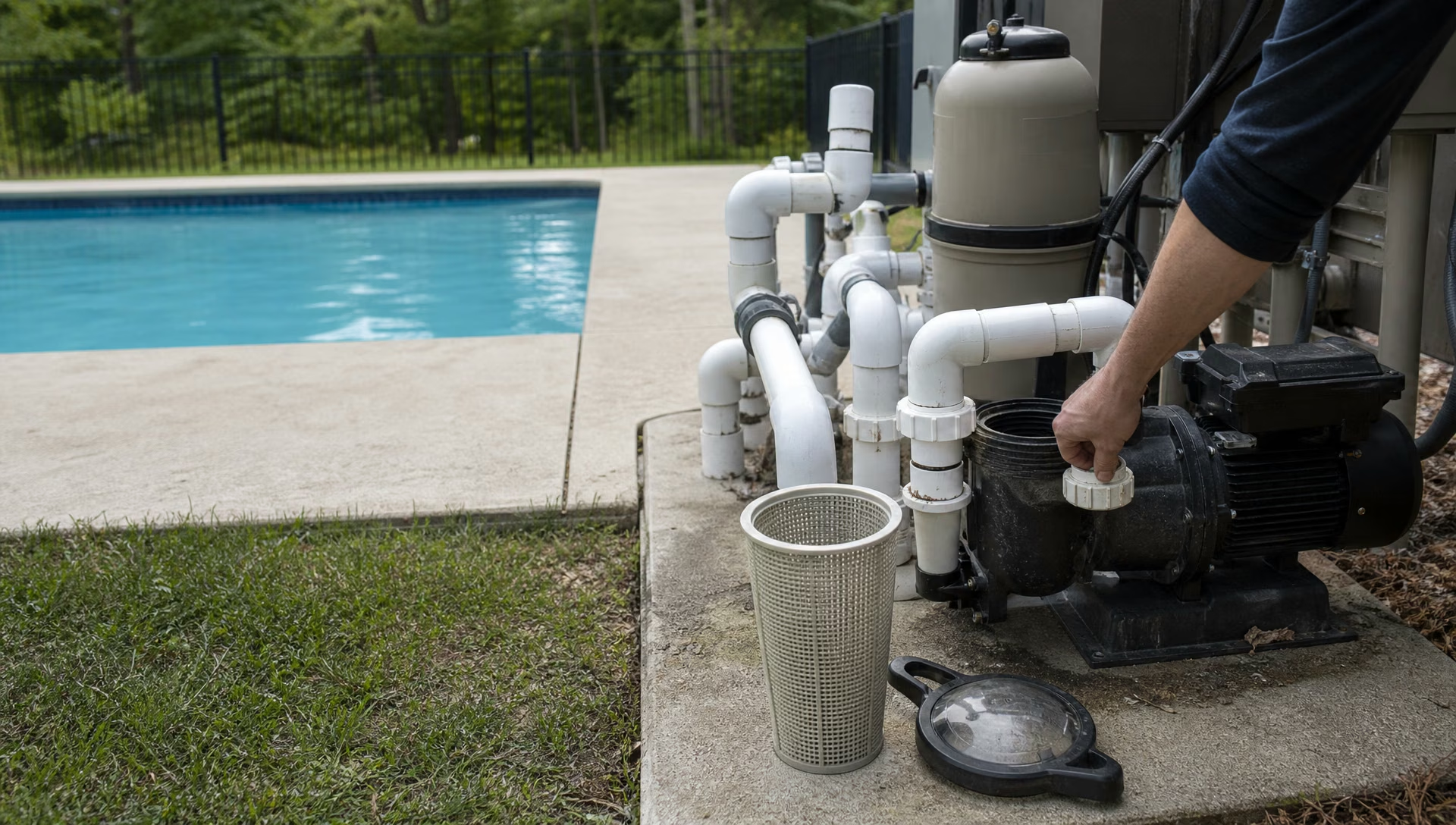
Remove the winterizing plugs and reinstall all skimmer baskets and return eyeballs.
Reassemble all pool equipment — everything pulled or drained at closing goes back.
Initial vacuum to waste (pulling debris straight out of the system rather than through the filter) or net the pool, depending on what the winter has left in it.
Prime the pump so it draws water rather than air, start every system and check each component for proper operation.
Add the initial dose of chemicals — shock the water to break down the winter's organic load, then chlorinate and balance to spec.
Early to mid April — earlier than most people expect, and the reasoning is not about comfort.
Reason one: algae. Water warming under a cover with no circulation and no sanitiser is water that will grow algae. Open before that starts and you are balancing a pool. Open after and you are recovering one, which costs more in chemicals and time than the early visit saved.
Reason two, and it is the better one: diagnosis. An opening is when every piece of equipment gets started and watched. Anything the winter broke shows up now. A heater that will not fire in April is an inconvenience with two months to fix it. The same heater in the first week of July is a ruined holiday weekend — and a parts wait in peak season is a different proposition from a parts wait in spring.
On the water temperature: the same 65°F threshold that makes autumn closing safe works in reverse. Once water is heading past it, biological activity picks up. Opening before that is opening on your terms.
Book early. Spring is one of the two heavy stretches of our year and the schedule fills in order.

An opening is where the previous close gets marked, and it is worth knowing what we are looking for.
Its seal dried out over five idle months, or water was left in the volute and it freeze-cracked.
A valve body left full and frozen cracks internally where nothing is visible from outside.
Could be the winter, could be flow — but it needs establishing before the season, not during it.
Freeze-thaw cycling works at every joint through a Northeast Ohio winter, which crosses freezing repeatedly rather than freezing once.
Clamp bands and lid o-rings take a set over the idle months.
Freeze damage does not announce itself in December — it appears in the thaw, when the system is repressurised and asked to work. So the opening visit is also an inspection:
None of this means the close was done badly — some of it is simply five months of standing still. But if a line was left with water in it, the opening is when you find out, and it is why we would rather do both visits for a pool. See pool closing service for how the winterizing is actually done.
Where we find something, a $150 service call covers up to the first hour of diagnosis or repair — see pool equipment repair and pool pump repair.
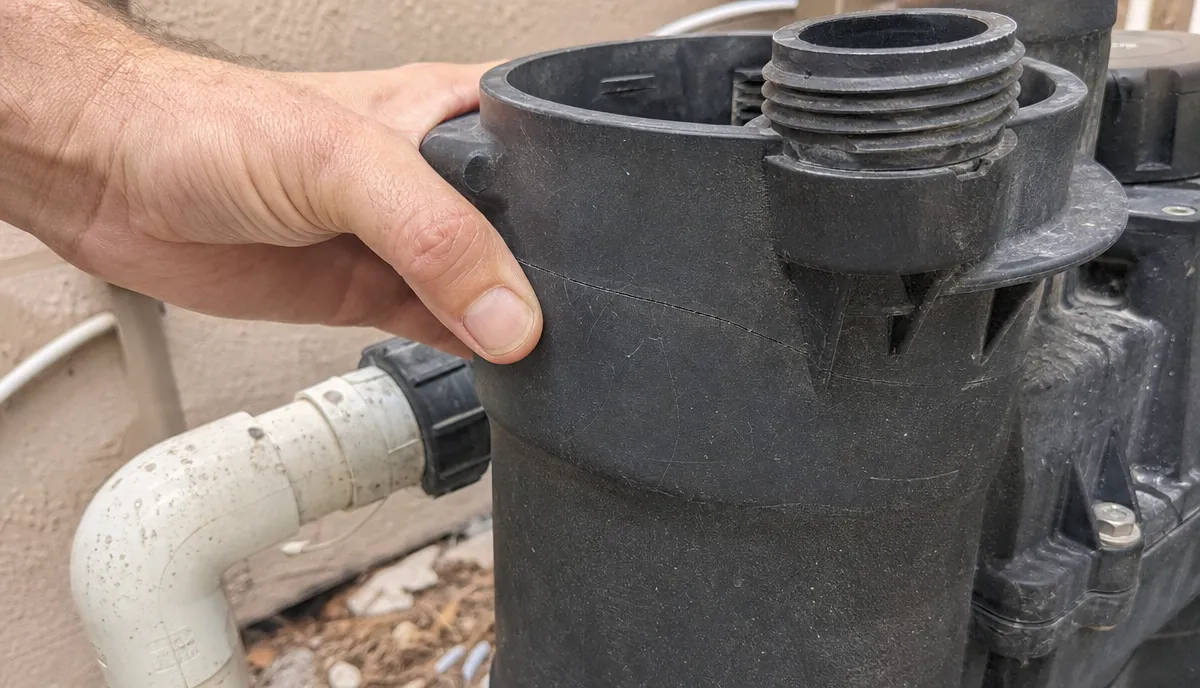
A hairline crack in a pool pump volute
The water at the appropriate level before we arrive. This is the single most common reason an opening has to be rescheduled.
Over winter the level is deliberately down, and it needs bringing back up before we can start the system. A pump cannot prime with nothing to draw, and a pump run dry is a pump destroyed — so if the level is short when we arrive, we cannot start the pool and the visit has to be rebooked.
Beyond that: clear access to the equipment pad and the pool surround, and pets indoors while we work.
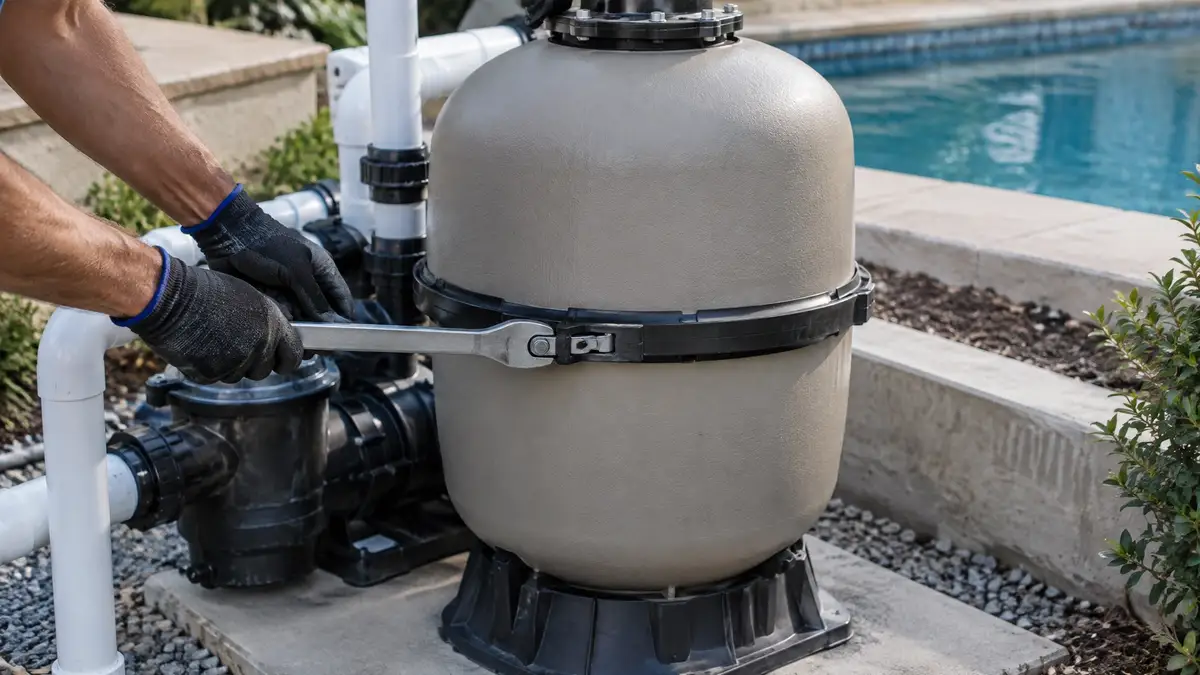
A pool filter being bolted back together
Chemical demand is least predictable at an opening, which is exactly why it is not built into the price.
What the pool needs depends entirely on what the winter did to it: how it was closed, what the cover let through, how warm the spring was, and how much organic load is sitting in the water. A mesh cover passes meltwater and fine debris, so those pools generally start dirtier than one that wintered under a solid cover — see safety covers. Two identical pools on the same street can need materially different amounts.
So we price the service and bill the chemicals for what actually goes in.
“Matt and his team are fantastic to work with. Easy to schedule, quality work is done right the first time. Highly recommend.”
Spring fills in order, so earlier booking means an earlier slot.
Two things make the difference between a pool that is swimmable in April and one that is not ready until June.
A heater, correctly chosen. In this climate that means gas rather than a heat pump if the aim is genuinely to use April, because a heat pump's output falls with the air temperature and effectively floors out in the shoulder months. See pool heaters.
Chemistry that never got away from you. A pool that starts the season balanced and stays balanced is much cheaper to run than one that is chased all summer. Customers on a regular chemical and equipment check get that by default, from $72 per visit plus chemicals, and every visit is documented.
Most of our customers have us do both, and there is a practical reason beyond convenience: the company that closed the pool knows what was done to it.
We know which lines needed antifreeze, what condition the equipment was in, and where the chemistry finished the season. That makes the opening faster and the diagnosis better. See pool openings and closings for both services together.
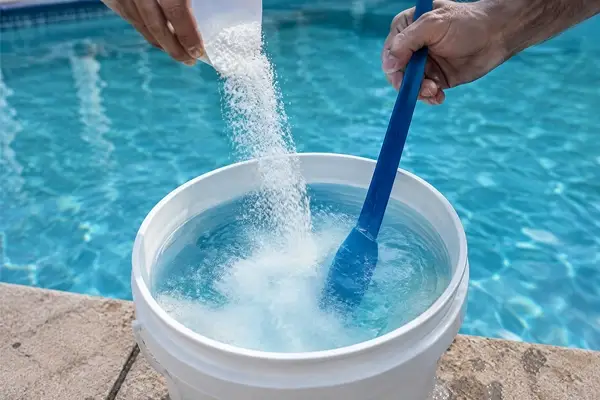
Granular pool sanitiser being pre-dissolved in a bucket
M & G Pools services in-ground pools exclusively. We do not service, repair or supply equipment for above-ground pools, and we do not service hot tubs or spas.
From $495 plus chemicals. The full step list is itemised above. What moves the figure is pool size, what is on the equipment pad, how much debris the winter left in the water, and access.
Early to mid April. That prevents algae taking hold in water warming under a cover with no circulation, and — more valuably — it surfaces any equipment problem while there is still time to fix it. A heater that will not fire in April is an inconvenience; the same fault in July is a ruined weekend and a peak-season parts wait.
Bring the water back up to the appropriate level. It is deliberately low over winter, and we cannot start the system without it — a pump cannot prime with nothing to draw, and a pump run dry is destroyed. If the level is short when we arrive the visit has to be rescheduled. Also clear access to the pad and pool surround, and pets indoors.
Because demand is least predictable at an opening. What the pool needs depends on how it was closed, what the cover let through, how warm the spring was and how much organic load is in the water — a pool that wintered under mesh usually starts dirtier than one under a solid cover. Two identical pools on the same street can need very different amounts.
Often, and that is part of the value. Freeze damage and five months of standing still both show up when the system is repressurised — a pump that will not prime, a valve leaking between positions, weeping unions, a heater that will not light. A $150 service call covers up to the first hour where something needs diagnosing.