
Two comparisons people mix up — a safety cover against a winter cover, and mesh against solid. Here is what each one actually costs you over an Ohio winter.
These are not two grades of the same thing. They are different products with different jobs, and this is the comparison worth getting right first, because the material question only exists inside one of them.
| Winter cover | Safety cover | |
|---|---|---|
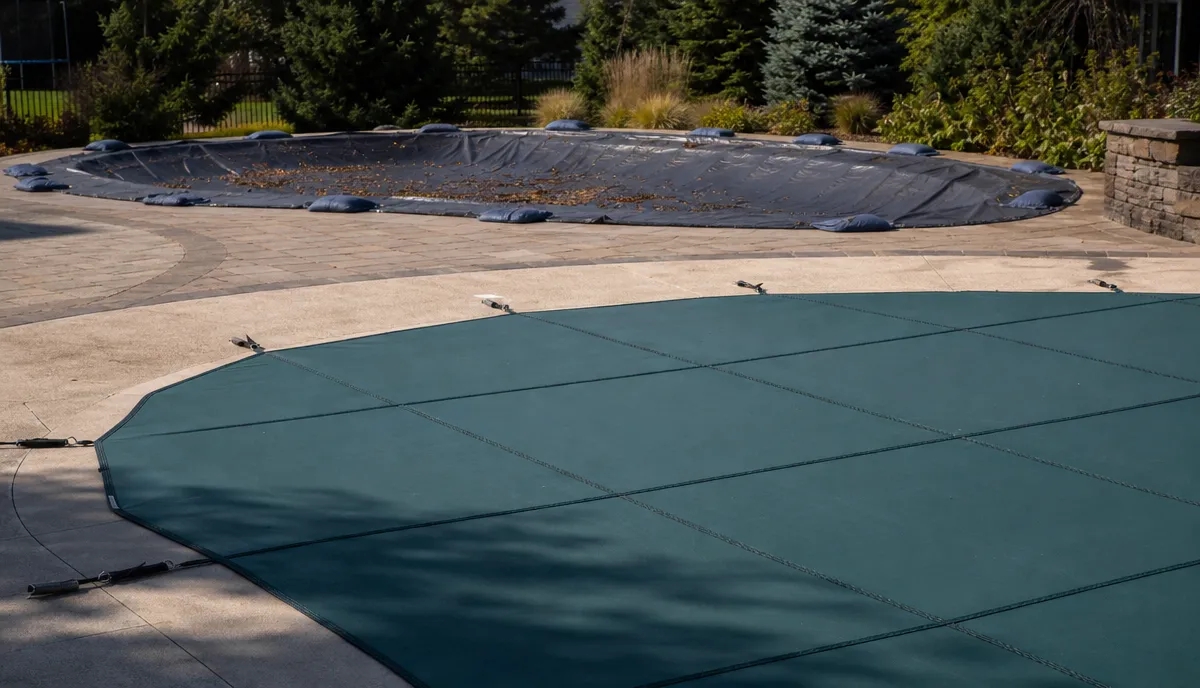
| How it is held | Laid on, weighted at the edges with water bags or blocks | Anchored into the deck, straps under spring tension |
| Designed to hold weight | No | Yes — load transfers out through the straps into the deck |
| What happens if something goes on it | It goes into the water with the cover, which closes over the top | The surface acts as a barrier |
| Edges | Held by weight, so wind can get under | Fastened at intervals all the way round |
| Can it be pushed aside | Yes — slid, blown, or walked off its own edge | No, when fully fastened |
| Mesh or solid choice | Solid sheeting | Both available — see Part 2 |
| What we install | No | Yes, custom only |
If the reason you are buying is children, pets or peace of mind, only the right-hand column is the product. The fundamentals — what "anchored and tensioned" actually buys, and the several things it still is not — are on what makes it a safety cover.
Now the genuine trade-off. Both are real safety covers; both are anchored and tensioned. The difference is whether water passes through, and everything else follows from that one property.
| Mesh | Solid | |
|---|---|---|
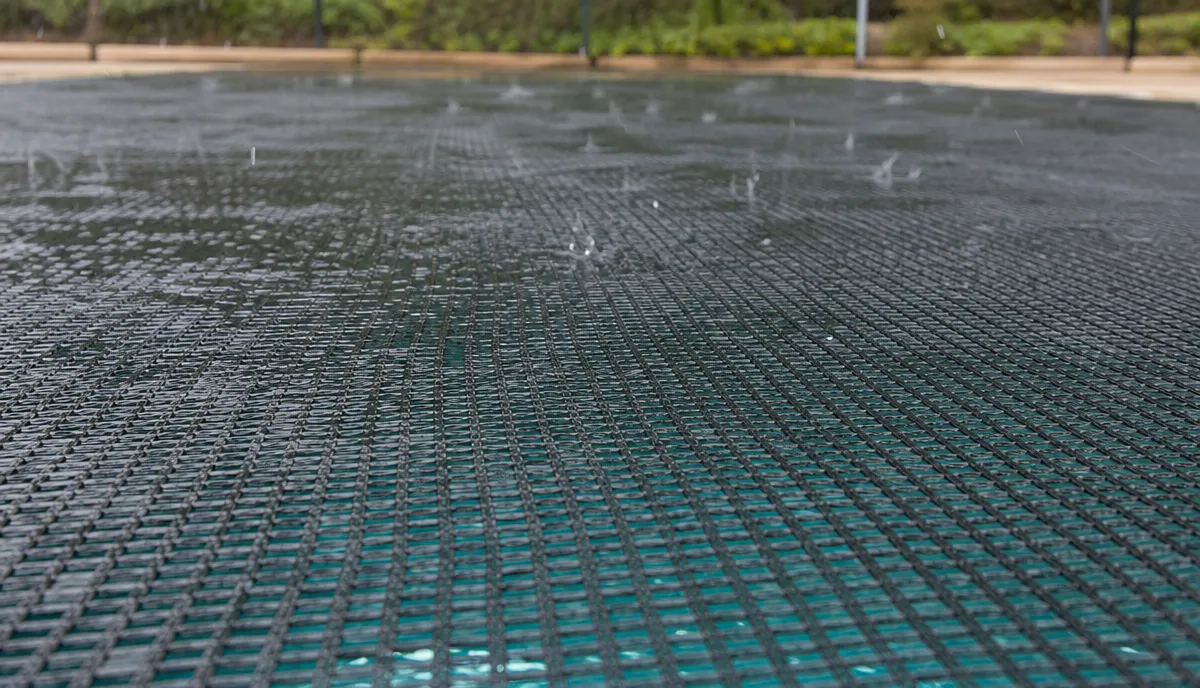
| Water | Drains through into the pool | Sits on top |
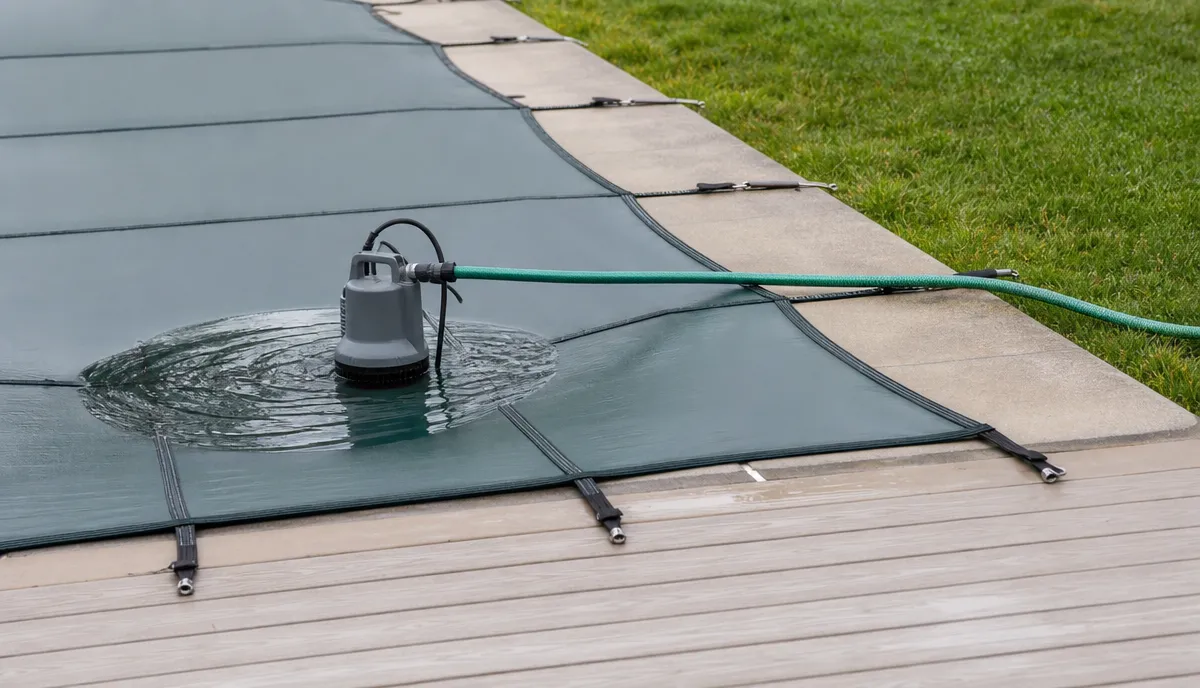
| Cover pump needed | No | Yes, and it has to keep working |
| Debris | Fine debris and leaf tannins pass through with the water | Blocked |
| Light | Passes some | Blocked, which suppresses algae over winter |
| Spring water condition | Dirtier and often tinted; opening takes more filtration and chemistry | Cleaner; opening is quicker |
| Winter attention | Largely looks after itself | Wants checking after storms and snow |
| Under heavy trees | Leaves dry on top and much blows off; tannins wash through | Wet leaves in standing water make a heavy sludge on the fabric |
| Wind | Air passes through, so less lifting force | Sealed surface for wind to press on and lift |
| Weight of water on the fabric | None standing | Standing water is a serious load, added to any snow |
Read the table as a single question: would you rather do the work in March, or in January?
Mesh trades a dirtier spring for a winter that mostly looks after itself. Nothing stands on the cover, no pump to think about, and what lands on top largely blows off. You pay for it at the opening — more filtration, more chemical work, and water that has been quietly taking on fine debris and tannins for five months.
Solid trades a cleaner spring for a cover you have to attend to. The water underneath is genuinely protected and the opening is faster. But a cover pump is not a fit-and-forget device: its intake blocks with leaf debris, it needs to sit where the water actually collects, and it can freeze into standing water. The routine is set out on the cover-pump routine.
Neither is a default, and the property decides more than the preference does. Under a mature canopy with nobody watching a pump in January, that is a real argument for mesh. On an exposed near-lake site, mesh's airflow is an argument in the same direction. On a sheltered plot with few trees where a clean spring opening matters, solid earns its keep.
Three loads, and they behave differently — which is why "stronger cover" is usually the wrong instinct:
And the water underneath the cover carries most of it. That is why the water level set at closing matters, and it applies to both materials. See snow and ice load.
And nothing pushes back — all of it goes into the straps and anchors. Correct tension does far more here than fabric weight, and mesh has a genuine edge because air passes through it. See wind loading.
Working at grommets, straps and springs. Milder winters near the lake cycle more, not less. See cover life.
“The crew is super knowledgeable and courteous.”
Tell us about the property — the trees, the exposure and who will be around in January.
This is where most of the confusion actually comes from — there are four products, not two.
A leaf net is a lightweight debris sheet that goes over a fitted safety cover for the few weeks the trees are dropping, then comes off with the bulk of the leaves. It is not a safety device, it is not anchored, and it holds nothing up. It works alongside a safety cover, never instead of one.
A solar or thermal blanket is a floating sheet used in season, to slow evaporation while the pool is in use. It goes on and off easily and it is genuinely useful for a heated pool — most of a pool's heat loss is off the surface, and most of that is evaporation. It is also not a safety device and it will not hold weight.
We do not supply solar or thermal blankets. If that is what you need, a pool retailer is the right place. We would rather say so than sell you the product we happen to make.
So there are four products, and exactly one of them is a safety device. A safety cover is the only one of the four designed and built as a barrier — which is worth holding on to, because all four get called "a pool cover".
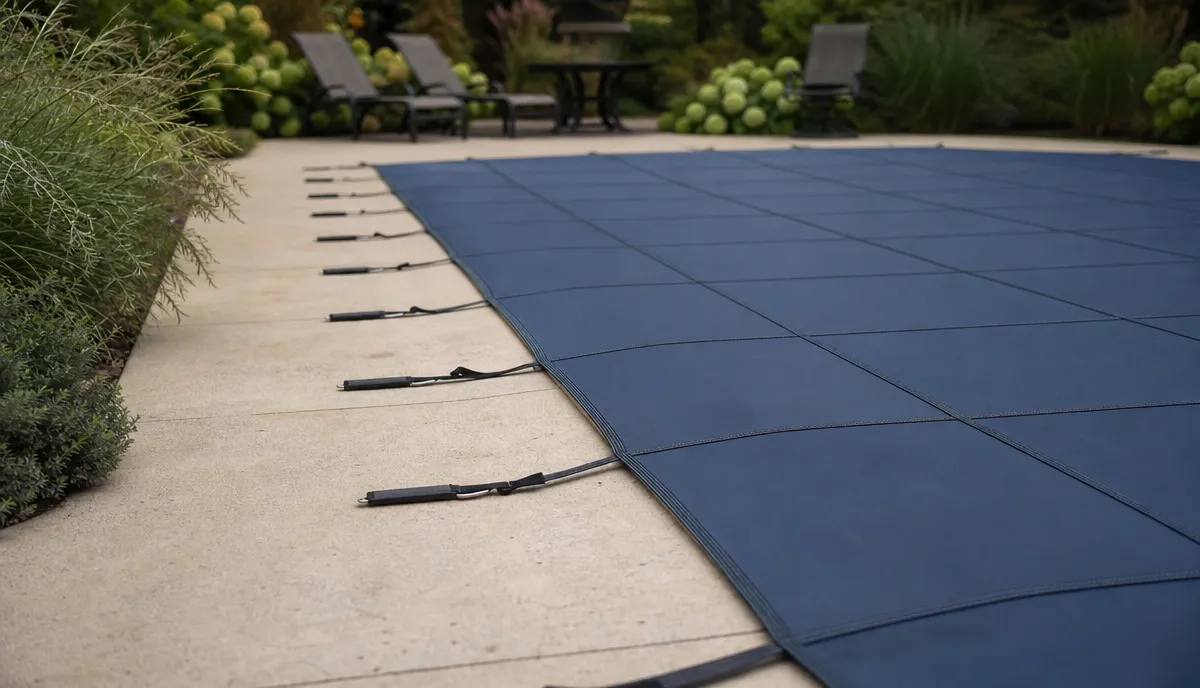
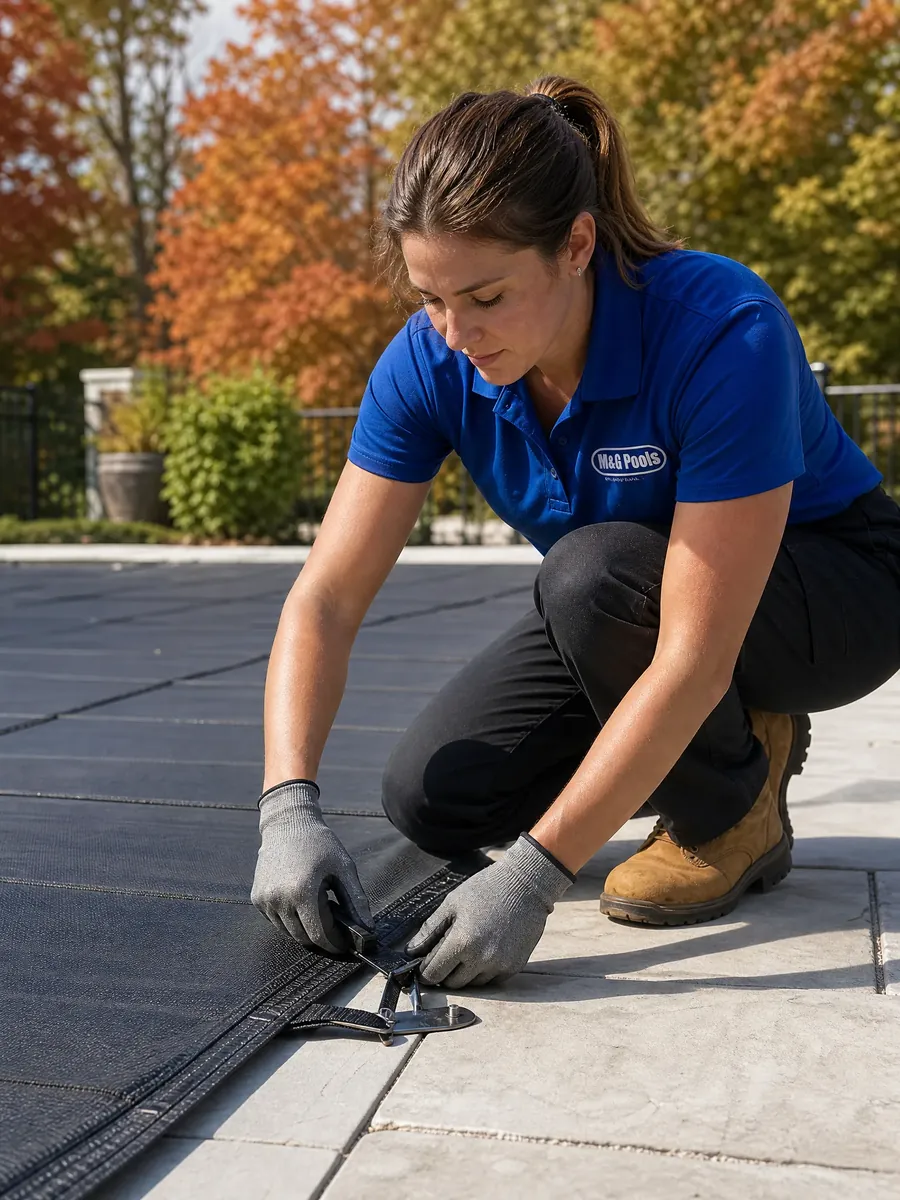
A safety cover anchored and tensioned around a pool perimeter
A safety cover installed to the manufacturer's instructions and fully fastened is a barrier. It is not a reason to stop watching. No cover replaces supervision of children and pets around water, and a cover that is only half on is a hazard rather than a barrier.
Nobody should stand, walk or play on any cover. What a particular cover is rated for is the manufacturer's own statement in their own literature — we install Merlin and GLI and will show you what each says, rather than making a performance claim for them.
Whichever material you choose, it is made to your pool — measured on site, because a cover only works as a barrier if it fits. We do not sell or fit stock or standard sizes.
Fabric is one of six things that move a quote, alongside surface area, shape, anchor count and deck type, obstructions, and whether an existing anchor line can be reused. The buying sequence end to end is on the pool safety cover buying guide, and the fitting detail is on safety cover installation.
One practical note either way: whatever you have comes off in spring, and what happens in the next ten minutes decides how long it lasts. Cleaned, dried, stored loosely and out of the sun. We handle it as part of an opening — from $495 plus chemicals. See pool opening service and the pool safety covers service page, or the rest of the resources.
No — different products with different jobs. A winter cover is laid on and weighted at the edges; it keeps debris and light out, it is not anchored, and it is not built to hold weight, so something that goes onto it goes into the water with it. A safety cover is anchored into the deck and held by spring-tensioned straps, so the surface acts as a barrier.
Neither, universally — it depends on the property and on who will be around in winter. Mesh drains water through, needs no cover pump and largely looks after itself, but fine debris and leaf tannins pass into the pool and the spring opening is more work. Solid protects the water and gives a cleaner opening, but it needs a cover pump kept working and wet leaves in standing water make a heavy sludge.
Yes, and it is not a fit-and-forget device. Solid fabric does not pass water, so rain and snowmelt collect on top — and standing water across a whole pool is a serious load on the cover and its anchors. Under trees the intake blocks with leaf debris, and a pump left in standing water can freeze in.
Not as a safety cover. A leaf net is a lightweight debris sheet that goes over a fitted safety cover for the weeks the trees are dropping, then comes off with the leaves. It is not anchored and it holds nothing up — it works alongside a safety cover rather than instead of one.
No, and they are for opposite jobs. A solar or thermal blanket floats on the water in season to slow evaporation while the pool is in use; it is not anchored, not a safety device and will not hold weight. We do not supply them — a pool retailer is the right place for one.