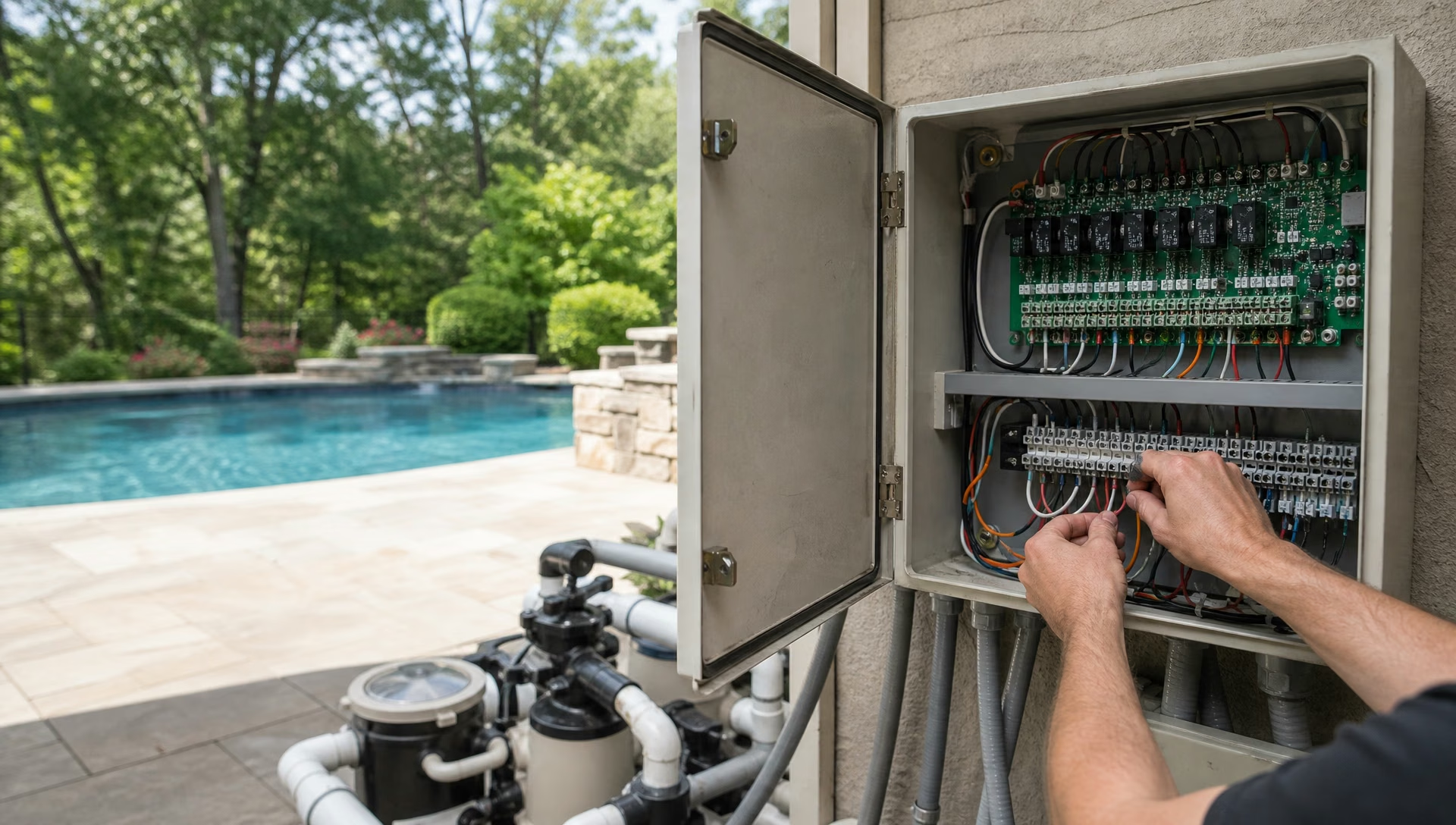
Everything intermittent. Check the bond and the grounds first. A corroded lug produces faults that come and go and look exactly like a failing board.


Controller repair, retrofits onto existing plumbing, and upgrades — with freeze protection set up and actually tested. Serving Twinsburg, Solon, Hudson, Chagrin Falls and the Route 91 corridor.
Most writing about pool automation is about convenience — turning the heater on from your phone, setting a schedule, running lights from a tablet. That is all real, and in Northeast Ohio it is not the important part.
It is frequently switched off — sometimes by an installer, sometimes by an owner who found the pump starting at odd hours and assumed it was a fault. It is not a fault. It is the feature working.
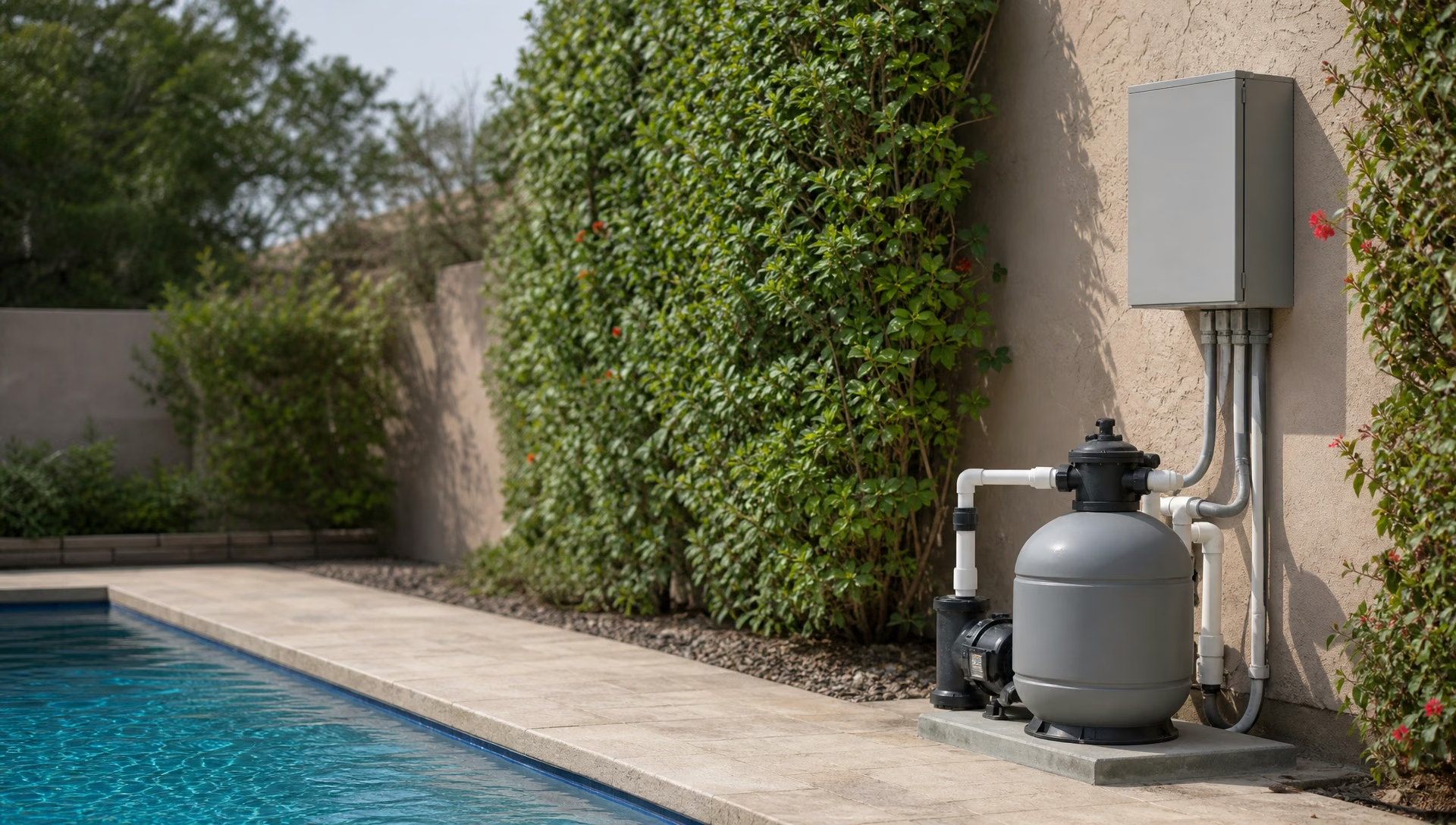
A sensor in direct afternoon sun, or against a warm wall, reads warmer than the air the plumbing is sitting in. It will not trip when it should.
Thresholds are configurable and vary by controller. Set too low and it trips after the risk has begun.
The important part is freeze protection.
An automation controller can watch air temperature and start circulation when it falls below a set threshold. Moving water does not freeze the way standing water does, so that one function protects the plumbing on any night the pool is still open and the temperature drops unexpectedly — a late-October cold snap, an early frost in April, or the week between "we should close it" and actually closing it.
Why this matters more than it sounds: the failure it prevents is the expensive one. A cracked underground return line means lifting a concrete deck to reach the pipe. A split heat exchanger is a heater replacement. Neither is a warranty matter, because both are consequences of water freezing where it should not have been.
Three things we check on every automation visit:
Freeze protection is not a substitute for a proper close — see pool openings and closings, because a pool that is properly winterized has had the lines blow out and the equipment drained and purged, and nothing left in them to freeze. Freeze protection covers the pool while it is still open. Winterizing covers it once it is shut. You want both.
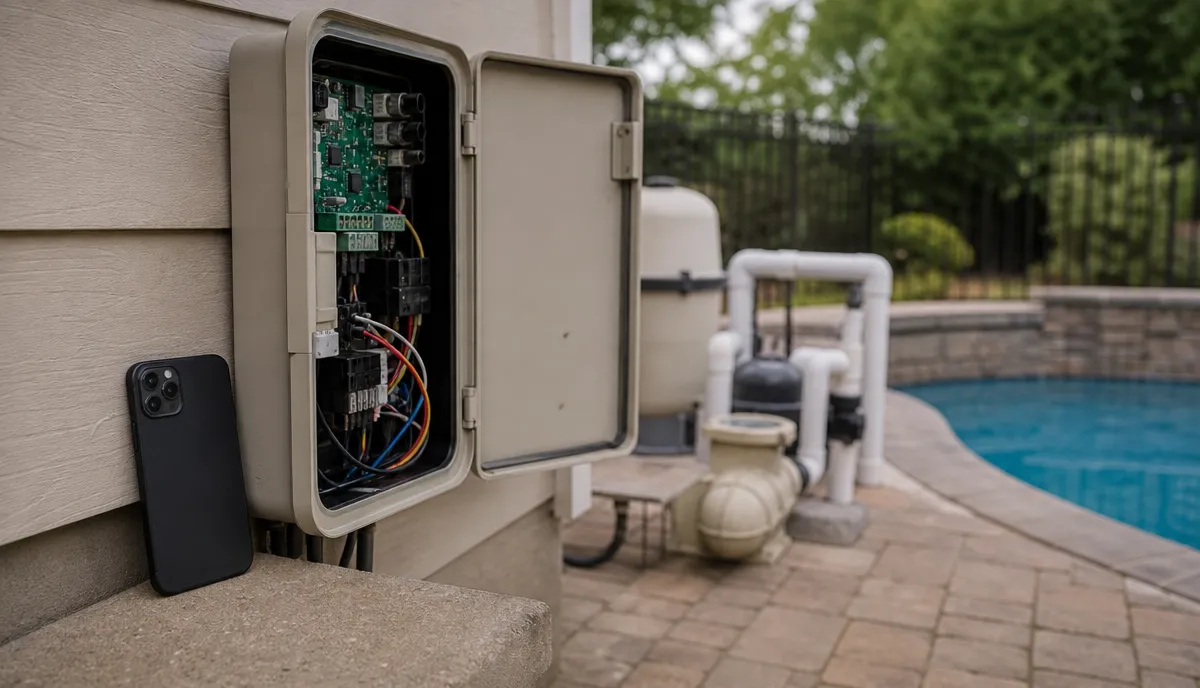
Repair. Controllers, actuators, valve automation, relays, temperature and flow sensors, and the wiring between them.
Retrofit onto an existing pool. This is what most people actually want and it is entirely doable — automation is added to plumbing that was built without it. Valve actuators go onto existing valves, the controller replaces the old timer and relay setup, and the pump, heater and sanitiser are brought under one system.
Upgrade. An older controller that still works but cannot talk to a phone, cannot run a variable speed pump properly, or has no usable freeze logic. Replacing the brain and keeping the plumbing.
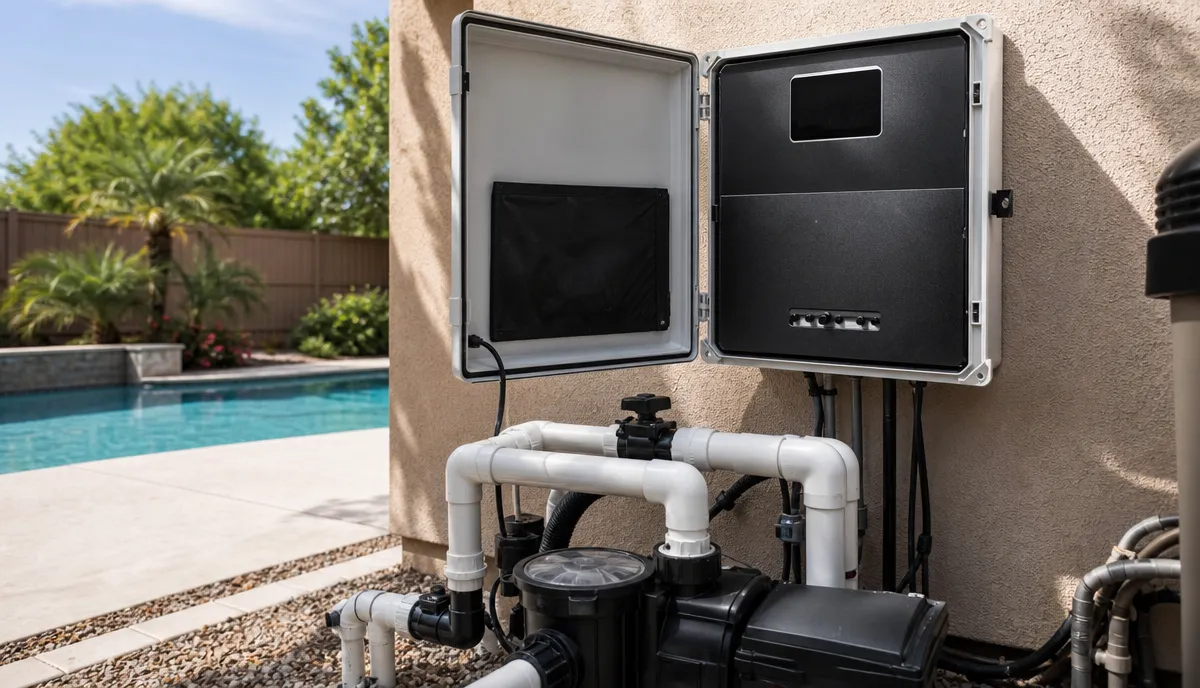
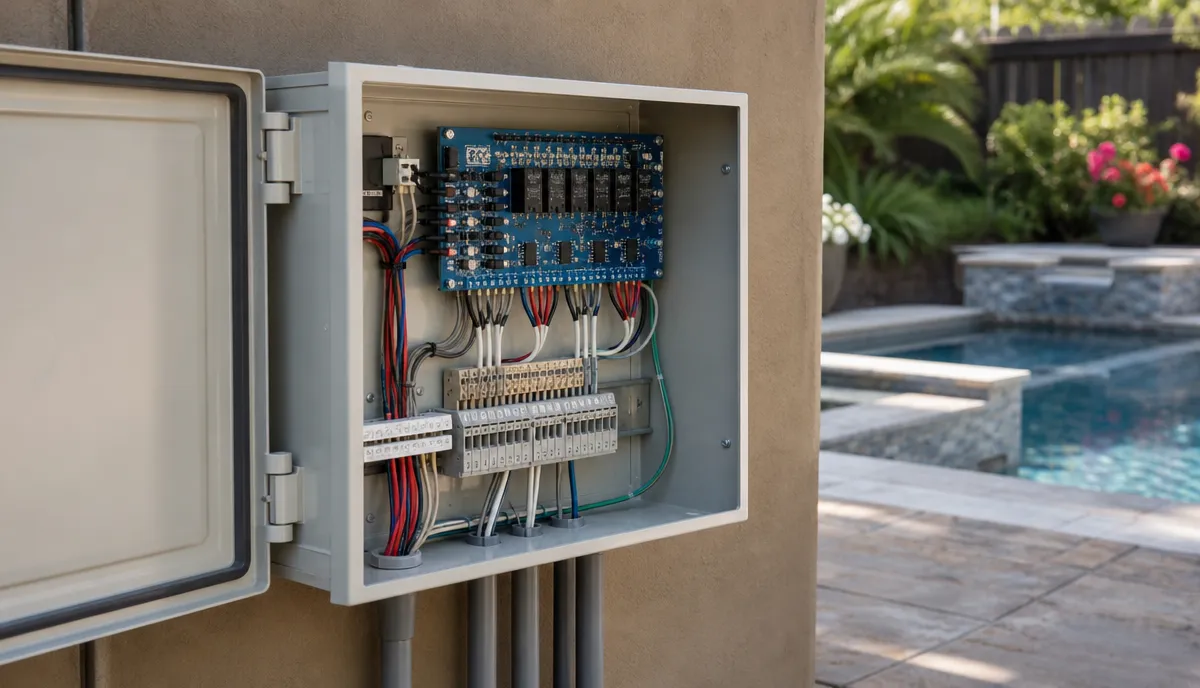
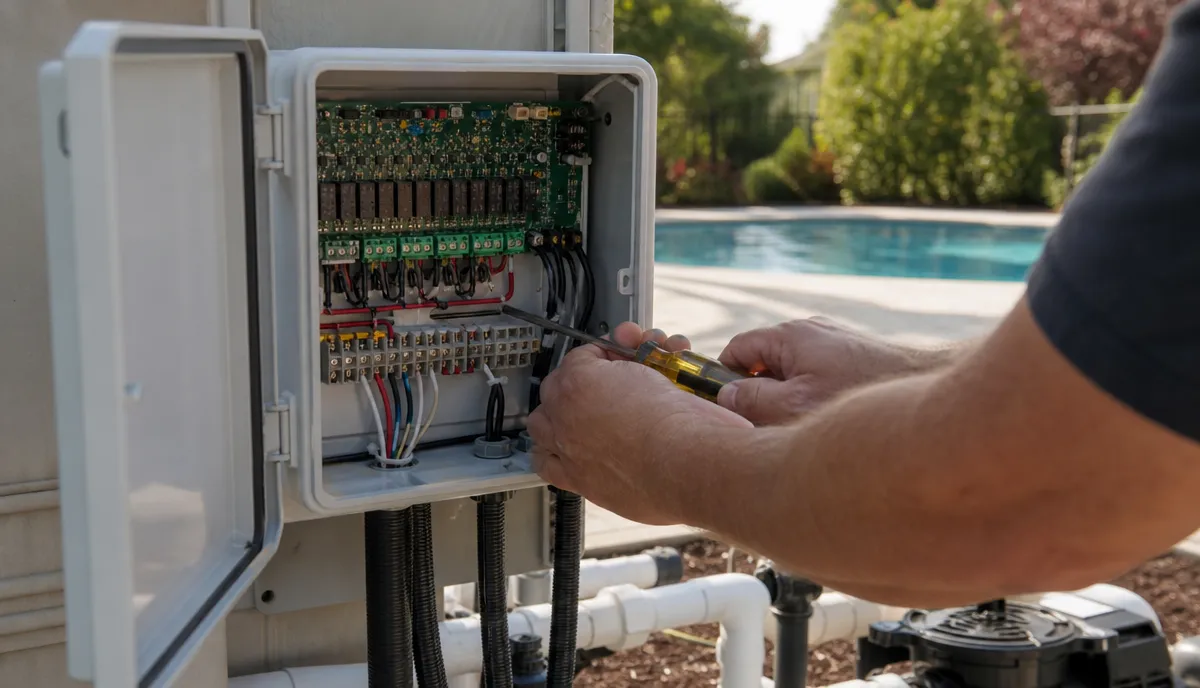
A pool controller enclosure with the door open at the pad
Integration. Bringing a variable speed pump, a heater and a salt chlorine generator under one controller so they cooperate rather than fight — a pump running too slowly for the heater's flow switch is the classic symptom of three devices installed by three people.
Automation faults have a reputation for being mysterious, and mostly they are not. They are usually one of a handful of things, and the controller is the least likely of them.
Everything intermittent. Check the bond and the grounds first. A corroded lug produces faults that come and go and look exactly like a failing board.
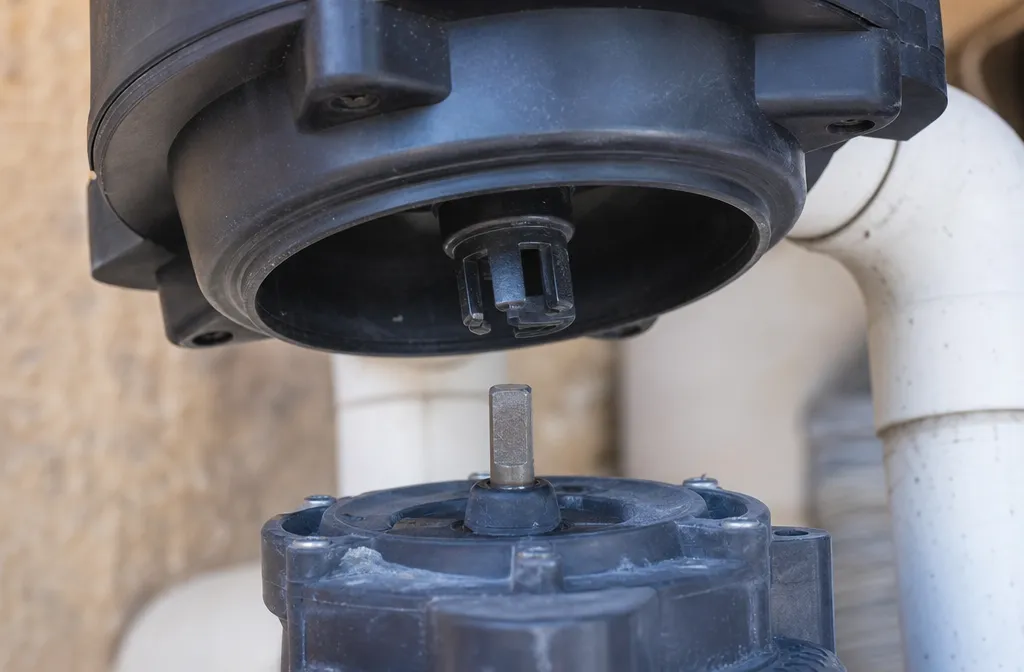
A valve that does not move, or moves to the wrong position. Nearly always the actuator or its cam setting, not the controller. Actuators are a wearing part.
The heater will not fire on a schedule but fires manually. Flow. The pump is running at a speed the heater's flow switch does not accept — a real and common variable-speed integration fault. The fix is a speed setting, not a part. The same setting matters at the other end of the range: a speed too low to prime reliably, or low enough to make the pump cavitate, will produce faults all over the system that look like anything but a pump speed.
A sensor reading that is obviously wrong. Sensor or its placement.
The pump starting at odd hours. Usually freeze protection doing its job. Worth confirming before anyone "fixes" it.
A $150 service call covers up to the first hour of diagnosis or repair.
We do not publish menu paths or model-specific procedures on this page. Controllers differ, and a wrong instruction reaches someone with the panel open and the power on.
We service, repair and replace automation from Pentair, Hayward and Jandy, including IntelliCenter, OmniLogic and iAquaLink systems, plus older controllers from the same manufacturers.
On the commercial side we work on BECS, Stenner, Blue-White and Chemtrol controllers and chemical feeders. These systems balance water continuously and chlorinate to a measured setpoint rather than to a schedule, which is a different discipline from a residential controller and carries different record-keeping expectations. About a quarter of our work is commercial.
The full list is on brands we service.
Products we install carry the full manufacturer's warranty, which varies by manufacturer and generally runs between one and three years. We do not offer a separate workmanship guarantee, and nothing on this page should be read as one.
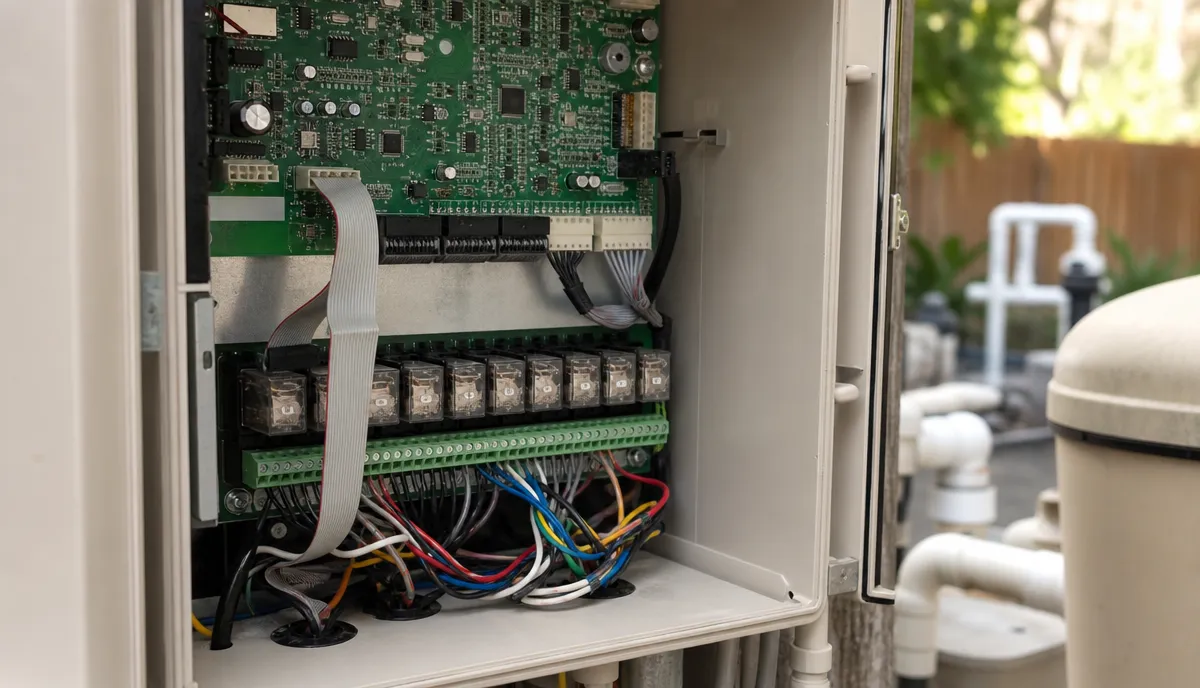
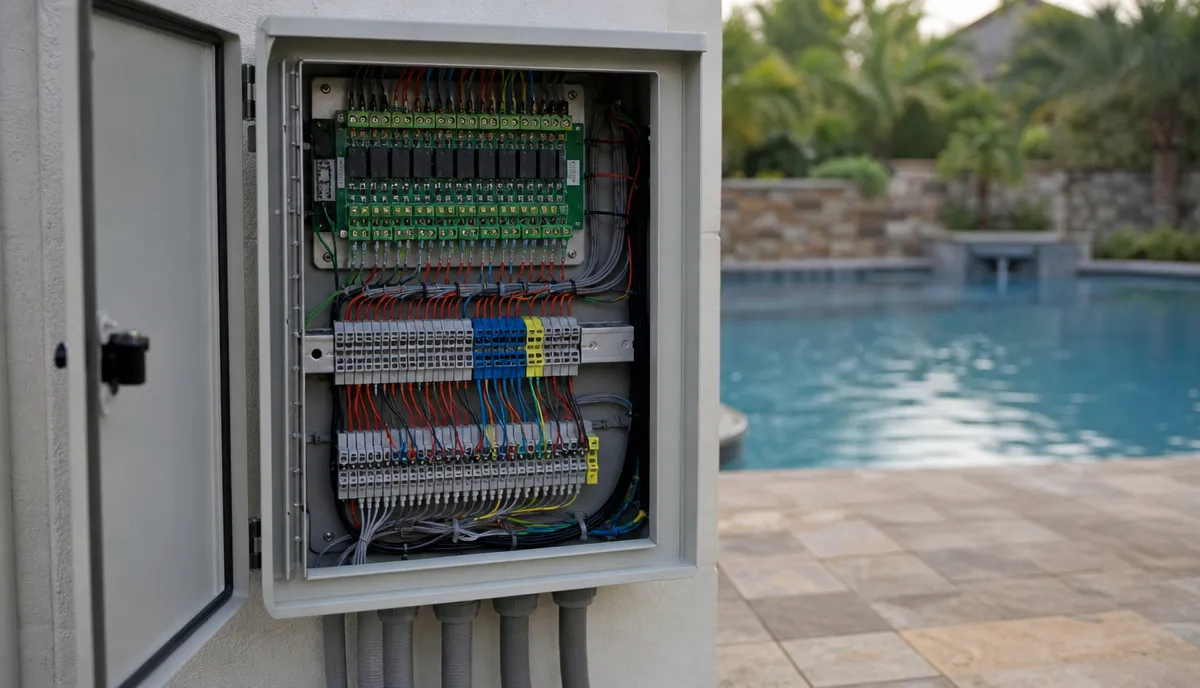
The inside of a pool automation panel
An honest answer, since it is usually a retrofit question.
It is worth it if you have a variable speed pump (automation is how you actually get the savings out of one, by running the right speed for each task), a heater you turn on and off with the weather, a salt system, or water features. The more devices, the more there is to coordinate.
It is worth it for the freeze protection alone if your pool stays open into the shoulder seasons.
It is less compelling if you have a single pump, no heater, and you close early. A good timer does most of that.
We will tell you which of those you are. There is no version of this where selling a controller to a pool that does not need one ends well for either party.
Controllers live outdoors in an enclosure for five months of being closed, and the failure profile reflects it.
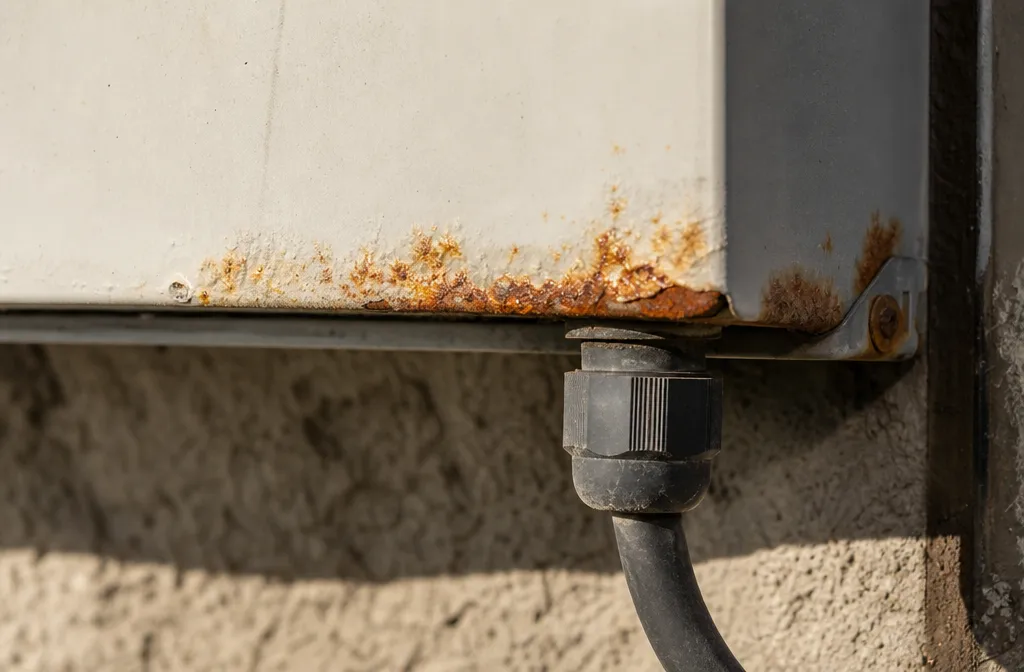
Moisture and freeze-thaw get into enclosures through gaskets that have lost their seal and through unsealed conduit entries, and Northeast Ohio crosses freezing repeatedly rather than freezing once — so condensation forms, freezes, thaws and forms again. Corrosion on terminals and relay contacts is the commonest winter casualty.
Actuators seize when they sit in one position for months, particularly if water has got into the housing.
Sensors drift or fail open, which is worth knowing because a failed temperature sensor can disable the freeze protection you were relying on without any obvious signal that it has.
That last one is the reason we check freeze protection at every opening rather than assuming last year's setup survived.
Service call, up to the first hour of diagnosis or repair
“We have used M&G for many years, they are always knowledgeable and accommodating. The professionalism is not something you find in the pool industry. Highly recommend for any pool needs.”
Putting automation on a pool that has none, or getting the system you already have doing what it should.
Tell us what you have and what you want it to do.
M & G Pools services in-ground pools exclusively. We do not service, repair or supply equipment for above-ground pools, and we do not service hot tubs or spas.
Cover work travels further than routine service, especially off-season. If your town is not on that list, ask — see service areas for the full picture.
It is a function in most automation controllers that starts circulation when air temperature falls below a set threshold — moving water does not freeze the way standing water does. In Northeast Ohio it is the most valuable thing automation does, because it protects the plumbing on any night the pool is still open and the temperature drops unexpectedly. It is not a substitute for properly winterizing a closed pool.
Probably not — that is usually freeze protection working. It is worth confirming before anyone switches it off, because switching it off is how a cold snap turns into a cracked line.
Yes, and that is most of what we do. Valve actuators go onto existing valves, a controller replaces the old timer and relay setup, and the pump, heater and sanitiser come under one system. The plumbing does not need rebuilding.
Usually flow. The automation is running the pump at a speed the heater's flow switch will not accept, so the heater refuses to fire. It is a very common variable-speed integration fault and the fix is normally a speed setting rather than a part.
Pentair, Hayward and Jandy, including IntelliCenter, OmniLogic and iAquaLink systems, plus older controllers from the same manufacturers. On commercial pools we also work on BECS, Stenner, Blue-White and Chemtrol controllers and chemical feeders.
Often not. A single pump, no heater and an early close is a job a good timer does. Automation earns its cost when there are several devices to coordinate — a variable speed pump especially, since automation is how you actually realise the savings — or when the pool stays open into the shoulder seasons and you want the freeze protection.
A service call is $150 and covers up to the first hour of diagnosis or repair. Installation, retrofit and upgrade work is quoted, because it depends entirely on what is already on the pad and what you want it to do.