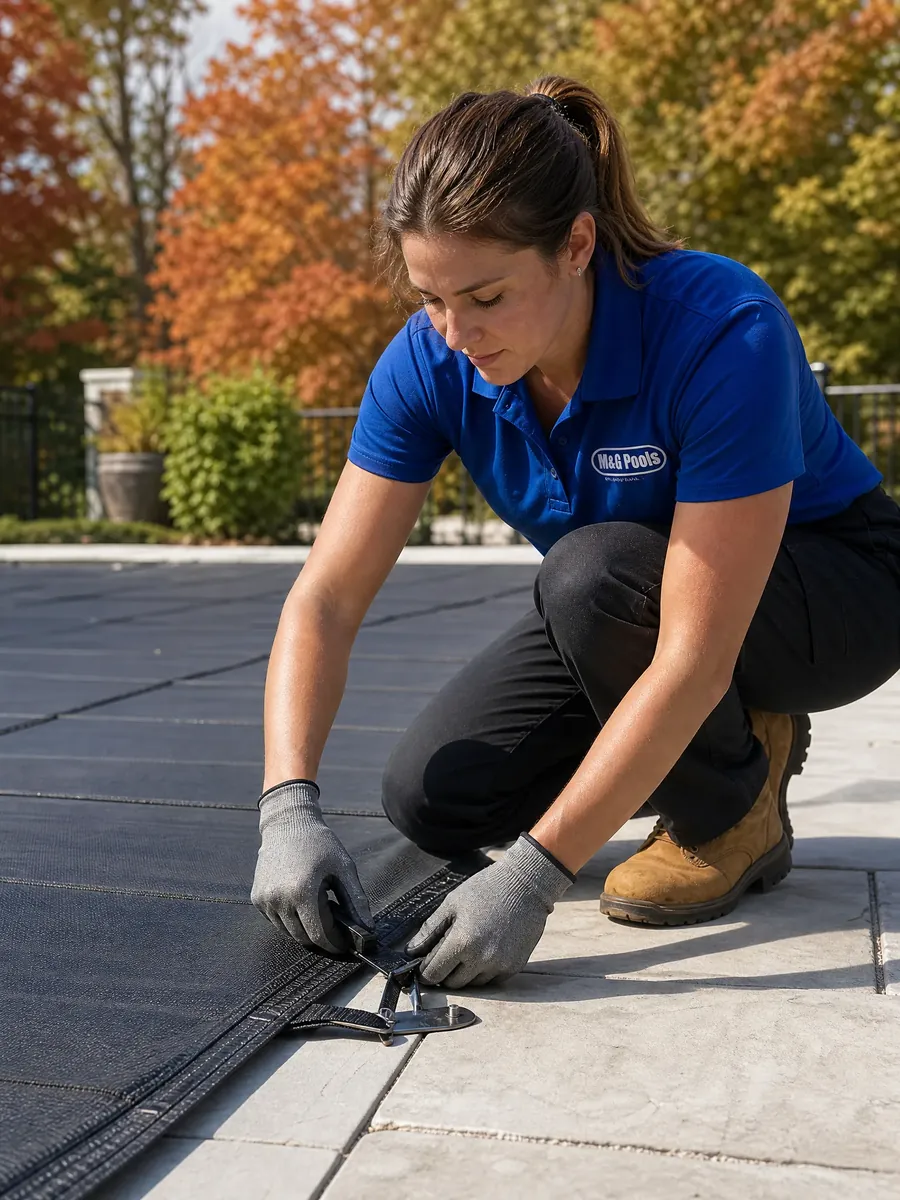

What actually makes a cover a safety cover, how one gets measured and fitted, and the questions worth asking before you buy. For in-ground pools in Northeast Ohio.
A safety cover is anchored into your deck and held by straps under spring tension. It carries load across the surface instead of sinking under one. That is a structural difference from a winter cover, not a fabric upgrade — and it is the whole reason the word “safety” is in the name.
Six decisions, in the order they actually come up:
Different products, different jobs.
The one genuine trade-off, and it goes both ways.
Because a cover that does not fit is not a barrier.
It decides the anchors, and you do not get a say.
Made to order, so the season decides your options.
Six variables, none of them mysterious.
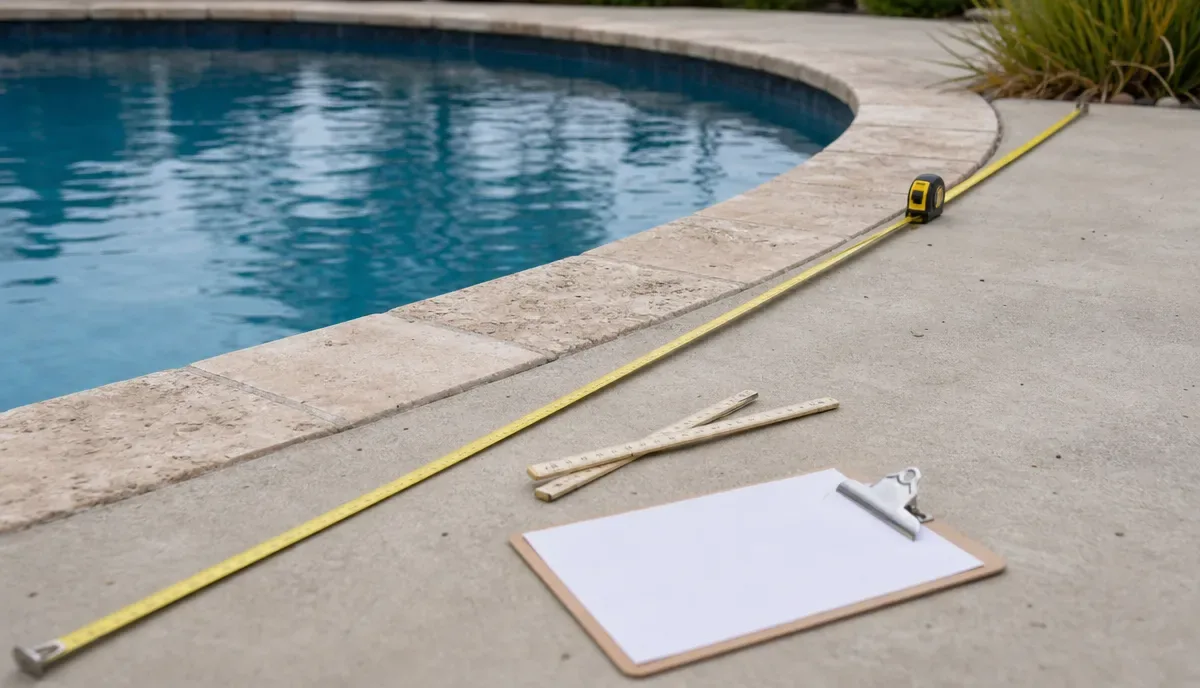
The rest of this page is those six, with the detail on each linked rather than repeated.
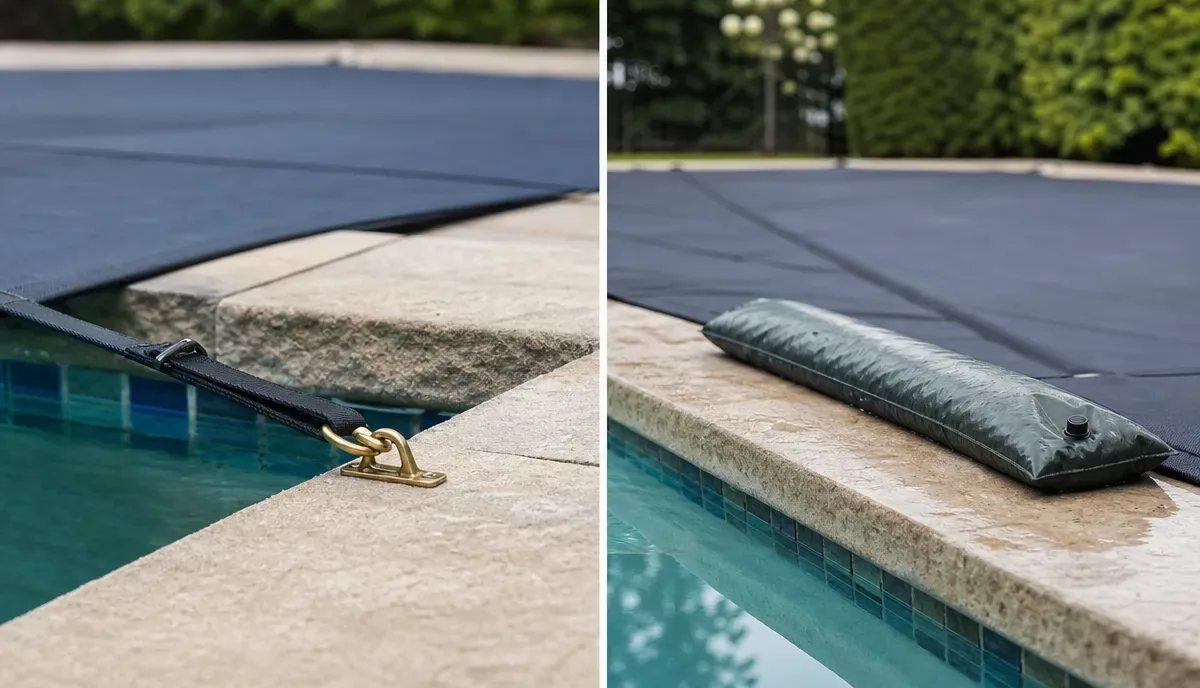
Winter Cover
A winter cover is laid over the pool and held down around the edges with water bags or blocks. It keeps debris and light out. It is not anchored and it is not built to hold weight — something that goes onto it goes into the water with it.
Safety Cover
A safety cover is anchored into the deck, held by spring-tensioned straps, and designed so the surface is a barrier rather than a lid.
If the reason you are buying is children, pets or peace of mind, only one of those two is the product you want. The full comparison is on what makes it a safety cover.
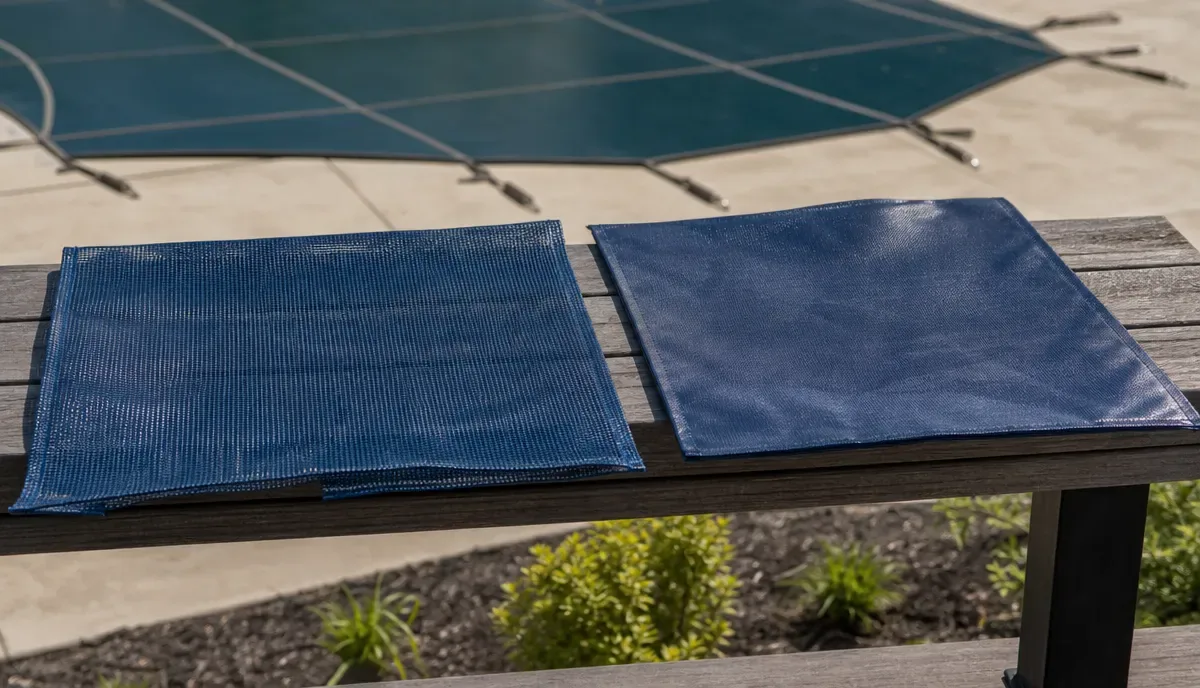
Mesh
Mesh passes water. Rain and snowmelt drain through into the pool, so nothing stands on top and there is no cover pump to look after. The price is that fine debris and the tannins from wet leaves go through with the water, so the pool opens dirtier.
Solid
Solid does not pass water. It blocks debris and light, so the water underneath is genuinely protected and the opening is cleaner and quicker. The price is a cover pump that has to keep working, and wet leaves in standing water make a heavy sludge on the fabric.
Neither is the right answer everywhere, and under a heavy tree canopy the trade sharpens considerably. See mesh vs solid safety covers.
A cover only works as a barrier if it fits.
Gaps are the issue. A cover made to the wrong outline leaves openings at the edge, straps landing where there is nothing to hold them, and uneven tension across the surface. A gap at the edge of a pool is exactly where a gap should not be.
Which is why we install custom covers only — made to your pool by Merlin or GLI, measured on site. We do not sell or fit stock or standard sizes. A shelf rectangle stretched over a pool with steps and a raised wall is not a fit, and no amount of pulling makes it one.
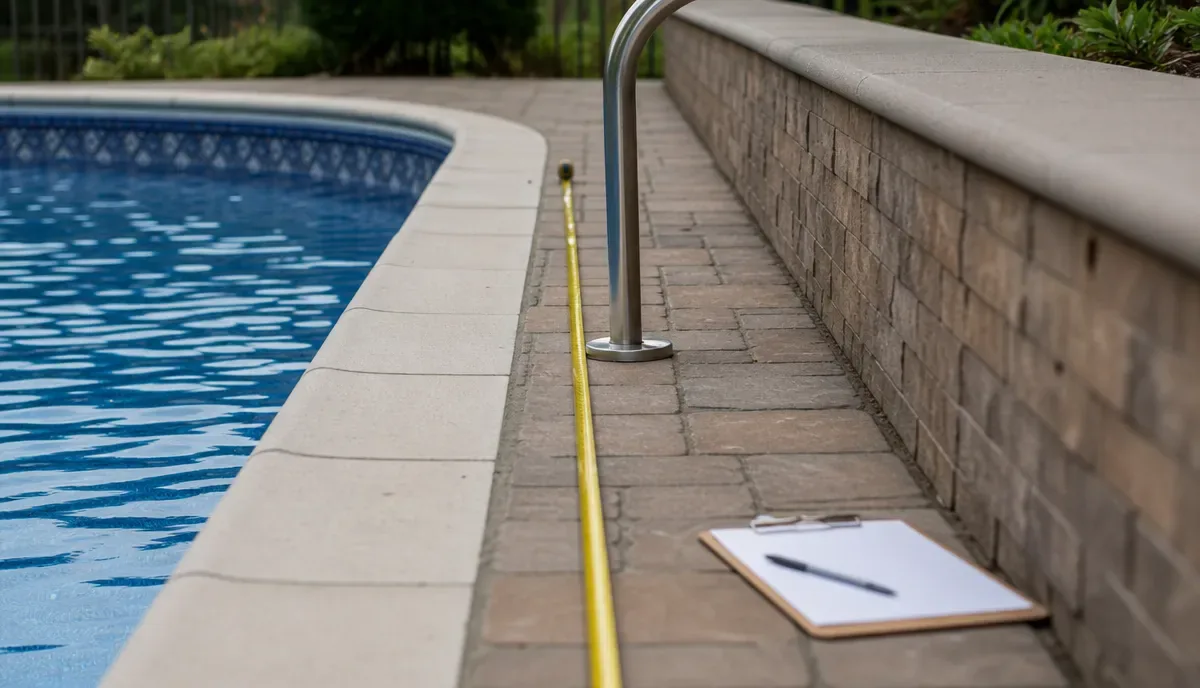
What the measure actually records is more than a length and a width: the shape at multiple points, the deck material, its width and its slope, every obstruction inside the anchor line, where the straps can physically land, and the existing anchor pattern if there is one. The full account is on the measure and the fit.
And we will not measure from your old cover. It has almost certainly shrunk — often that is why it is being replaced — so measuring from it builds the shrinkage into the new one.
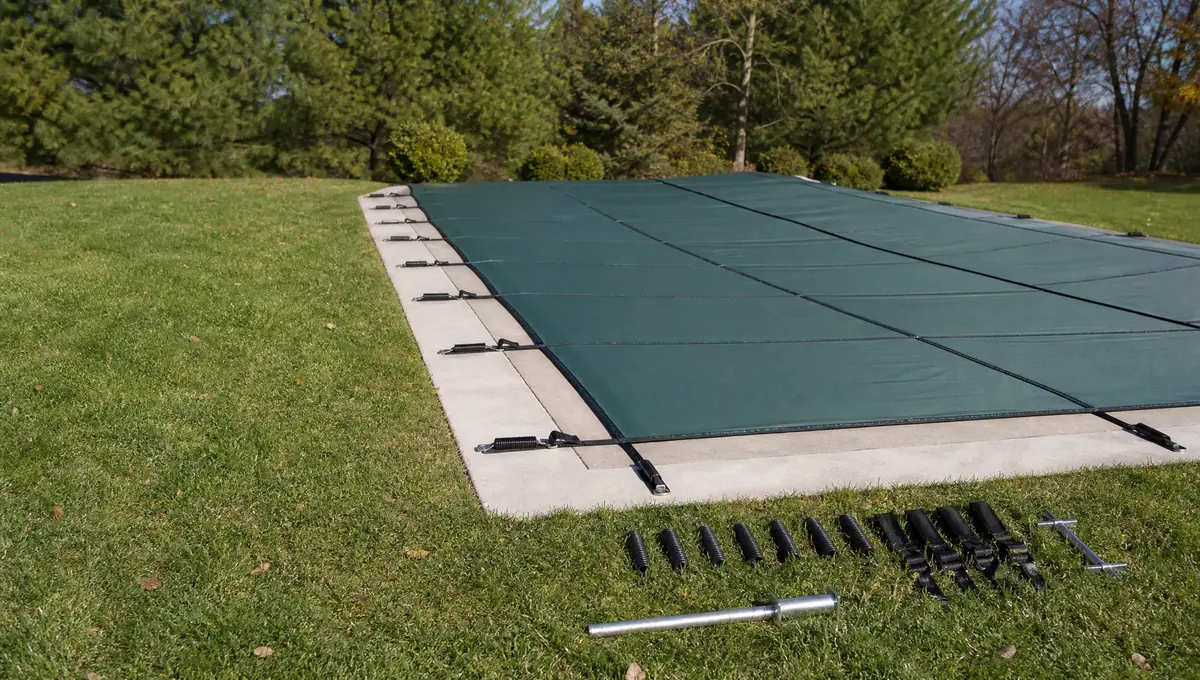
Anchored and load-rated, or weighted and not. That is the whole difference.
You choose the cover. The deck chooses the anchors.
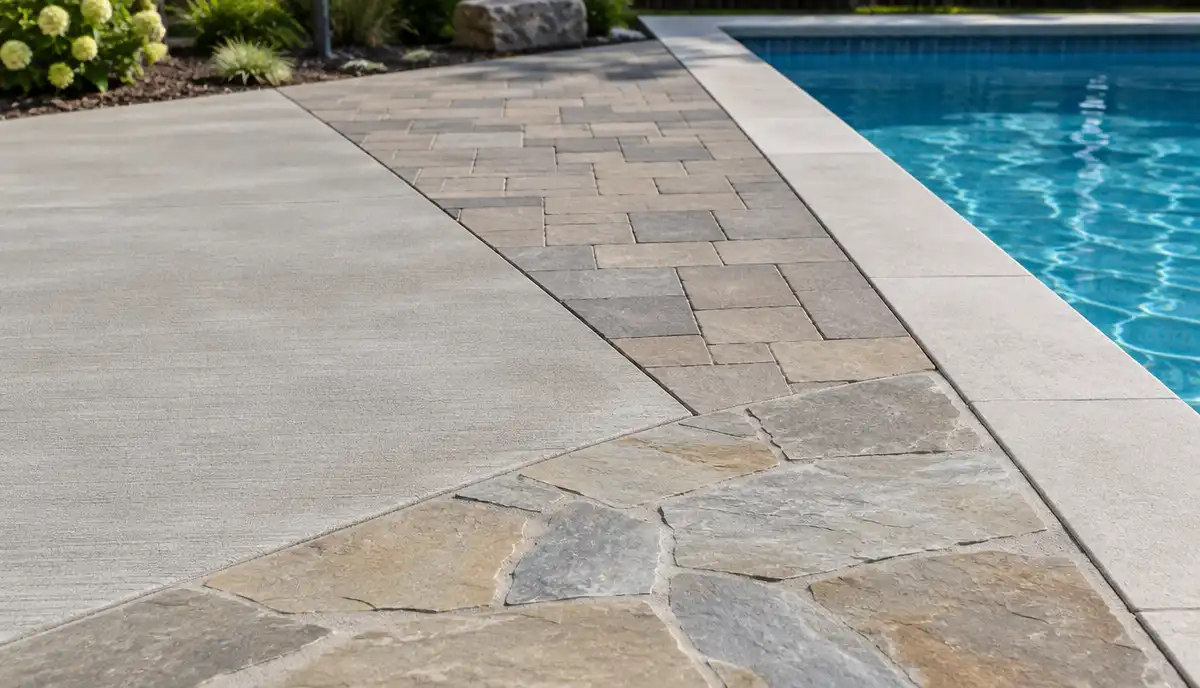
On an older pool the surround is rarely one thing — original concrete, a section re-poured after a repair, coping replaced along one side, a paver terrace added later. Each is a different anchoring condition, and the boundaries between them are where a slab is weakest. See anchors by deck surface and safety cover installation.
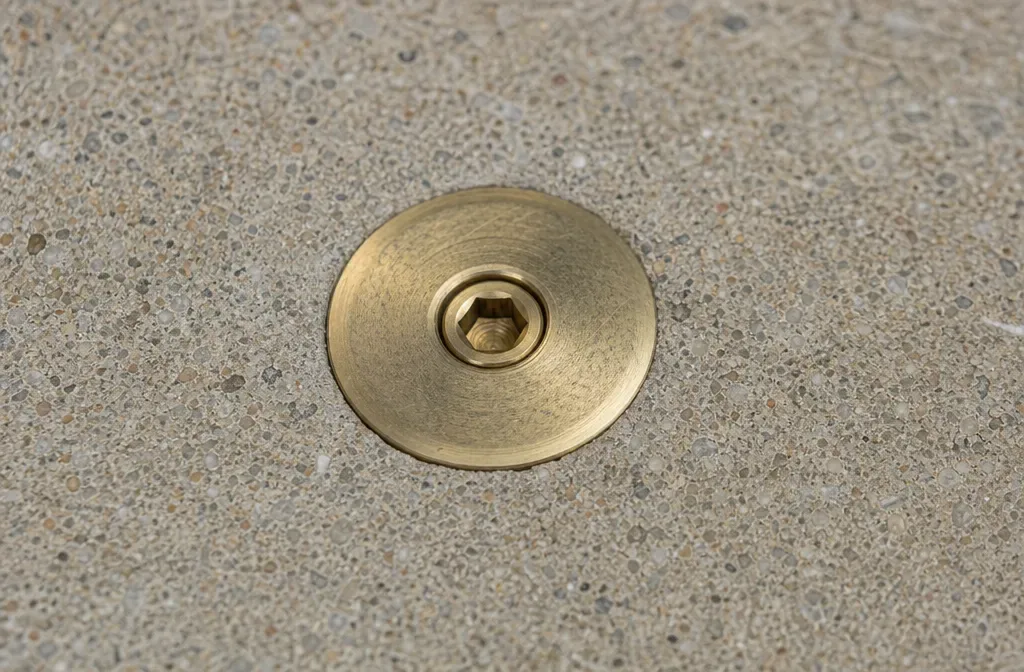
You choose the cover. What the deck is made of chooses the anchor.
A custom cover is made to order. There is a wait, and we will not print a number for it because it moves with the season and we would rather not publish something we cannot stand behind.
What we will say is that autumn is when every pool owner in Northeast Ohio wants one. A measure taken in August sits in a completely different queue from one taken in the second week of October.
Book earlier than feels necessary, particularly if the cover and the close are going to be the same conversation — closings start from $495 plus chemicals. See pool closing service.
Cover work is quote-required, and that is a consequence of the product rather than a reluctance to publish. A custom cover is manufactured to one pool’s outline with the anchor positions one deck allows, so a published figure would be a price for a pool that is not yours.
Six things move it:
That last one can cut either way. The full breakdown is on what drives the quote.
Worth knowing before you choose, because the load is not one thing.
And the water underneath the cover carries most of it — which is why the water level at closing matters and why a cover is a flexible membrane rather than a rigid lid.
And nothing pushes back against a lifting load: all of it goes into the straps and the anchors. That makes correct tension more important than fabric weight on an exposed site.
Which fatigues the fixing points — ice freezing against a strap and releasing has moved it, and dozens of those movements concentrate stress where the strap meets the fabric.
Across our seventeen towns all three happen to different degrees depending on distance from Lake Erie and how exposed the garden is. That is why the honest answer to “which cover” starts with a look at the property rather than a product page.
“After having different companies open and close our pools, and then having M & G Pools, I would never have anyone else! They are extremely professional, kind, efficient, and knowledgeable. They definitely go out of their way to help their customers.”
Tell us about the pool and the deck and we will come and take the measurements.
A safety cover installed to the manufacturer’s instructions and fully fastened is a barrier. It is not a reason to stop watching. No cover replaces supervision of children and pets around water, and a cover that is only half on is a hazard rather than a barrier.
Nobody should stand, walk or play on a cover — not a winter cover and not a safety cover. What any particular cover is rated for is the manufacturer’s statement about their own product, in their own literature, and we will show you what Merlin or GLI says for the cover you are considering rather than making a performance claim on their behalf.
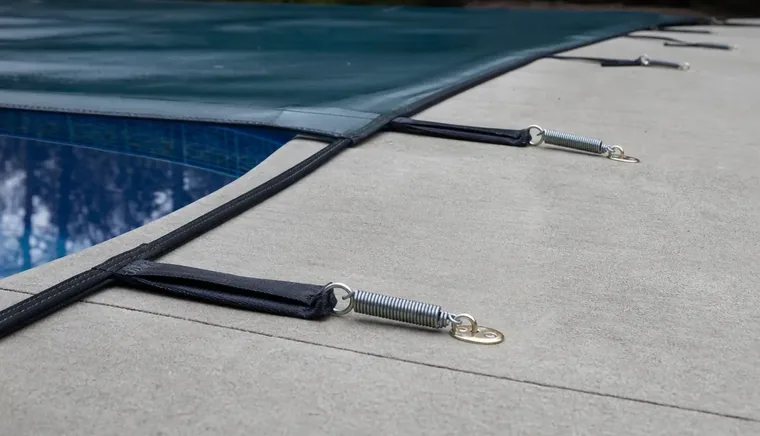
A barrier only when every strap is fastened.
Ask one question early: can the existing anchors stay? It changes the job.
Reuse is likely where the pattern is sound and complete, every anchor still turns freely and sits flush, and neither the pool nor the deck has changed. New anchors are likely where they are seized or corroded through, where they have worked loose, where the deck has been altered, or where the original layout was never right — repeating a bad layout repeats the problem.
Often it is a mixture, and that is a normal outcome rather than a compromise.
And before you replace at all: straps, springs, grommets, D-rings, anchors and a short seam separation are all repairable. Covers get replaced when the fabric or the seams have gone, or when the cover has shrunk beyond adjustment. See safety cover repair and replacement.
Custom safety covers by Merlin and GLI, measured and fitted on site across our service area. Not stock sizes, not laid-on winter covers, and not floating solar or thermal blankets — those are a different product for a different job, sold by pool retailers.
See the pool safety covers service page, or the rest of the resources.
Structure, not fabric. A winter cover is laid over the pool and held down around the edges with water bags or blocks — it is not anchored to anything and it is not built to hold weight. A safety cover is anchored into the deck and held by spring-tensioned straps, so it carries load across the surface instead of sinking under one.
There is no universal answer, which is why it has its own guide. Mesh drains rain and snowmelt into the pool and needs no cover pump, but fine debris and leaf tannins pass through and the pool opens dirtier. Solid blocks everything including light so the opening is cleaner, but it needs a cover pump kept working and wet leaves in standing water make a heavy sludge.
Because a cover only works as a barrier if it fits, and a shelf rectangle over a pool with steps and a raised wall leaves the straps landing wrong, the tension uneven and gaps at the edge. That is a safety argument rather than a sales one, and it is why everything we install is made to the pool.
It is quoted, and we will not publish a figure — a custom cover is made to one pool’s outline with the anchor positions one deck allows, so any number here would be a price for somebody else’s pool. Six things move it: surface area, shape, fabric, anchor count and deck type, obstructions inside the anchor line, and whether an existing anchor line can be reused.
Earlier than feels necessary. A custom cover is made to order, and autumn is when everyone in Northeast Ohio wants one — a measure taken in August sits in a very different queue from one taken in mid-October. We will not print a lead time, because it moves with the season.
Tell us about the pool and the deck and we will come and take the measurements.