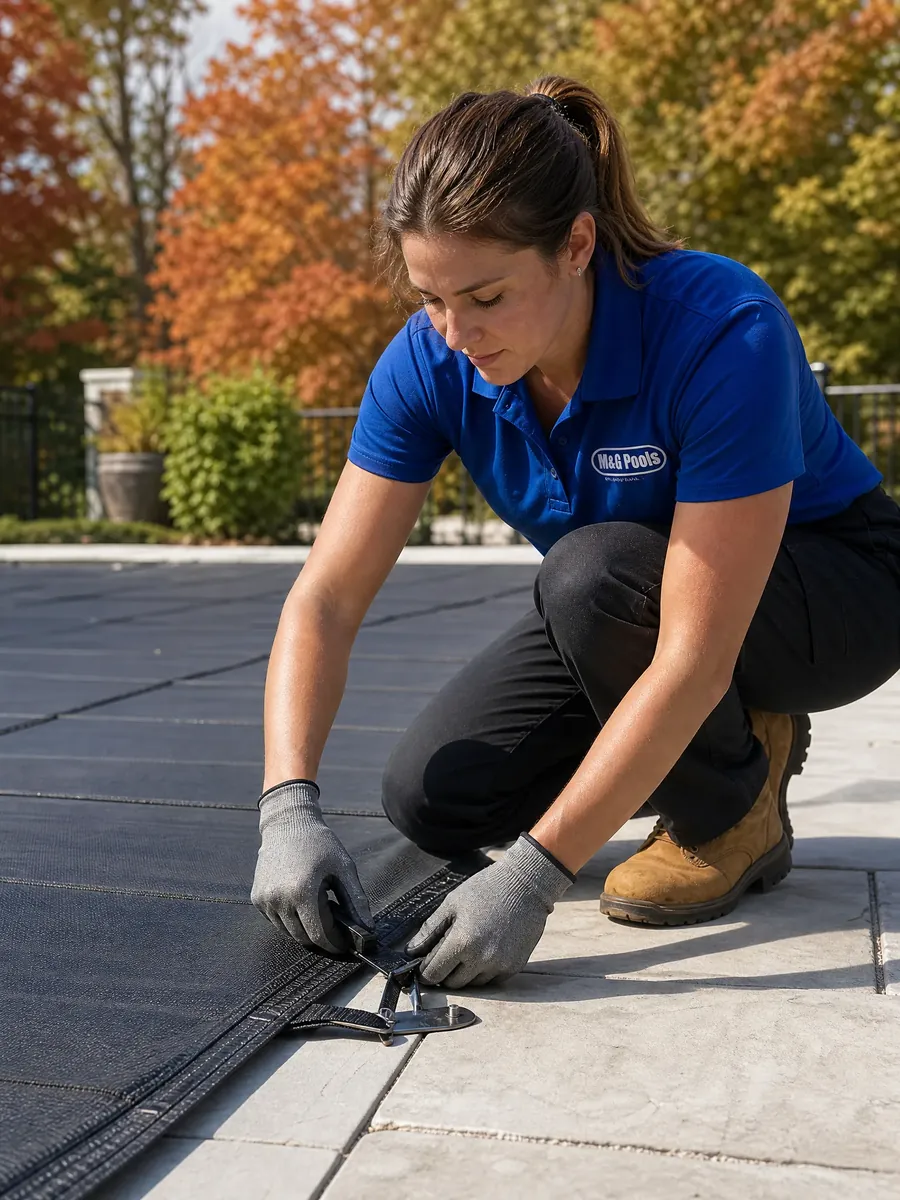

Custom in-ground pool safety covers, measured and fitted on site by the team based here in Twinsburg. Merlin and GLI. Family-owned since 2012.
Twinsburg is where we are based, so this is the page where we can set out how a cover actually happens without any caveats about travel.
It is two visits: a measure, then a fit. People expect the fit to be the significant one. It is not. The measure is the job, and the fit is the consequence of having done it properly.
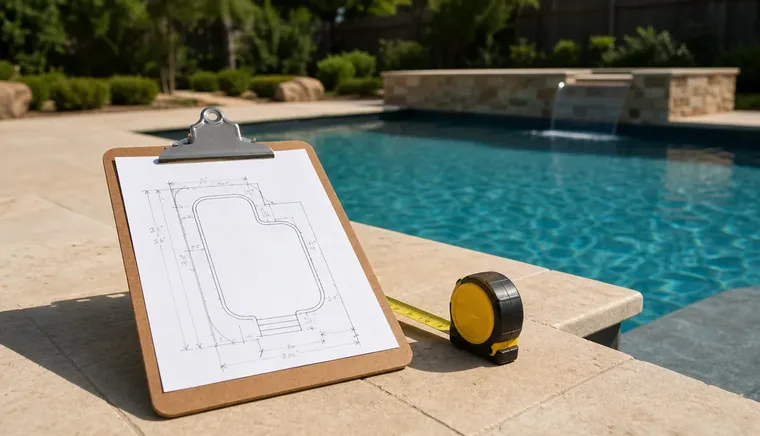
Visit one. The cover is ordered from this, not from a drawing.
A cover is manufactured to your pool, and your pool is not a drawing. Twenty years of ground movement, a deck section re-poured after a repair, coping replaced on one side — all of it means the pool as built and the pool as it is now are different objects. So the measure is taken from the pool, on site, with the water in it.
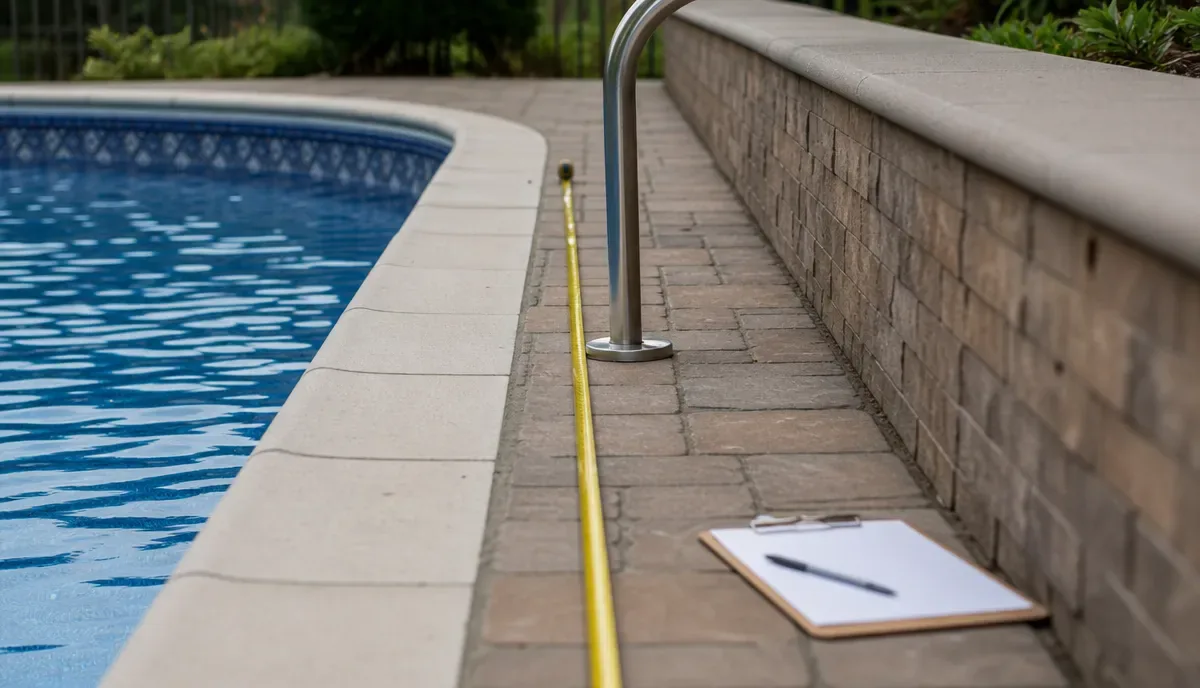
What gets recorded:
Rather than as a length and a width. A freeform pool is a curve, and a curve is captured by a series of measurements from fixed reference points, not by two numbers.
Anchors go into the deck, so what the deck is made of decides which anchor is used and how it is set. A deck that slopes away from the pool changes strap angles.
Steps, a raised wall, handrail sockets, a ladder socket, a light niche in the coping, a planter tight to the edge, a diving board base. Each one either gets designed around or gets in the way later.
This is the part that catches people out on a tight surround — a strap needs somewhere to go, and if the deck runs out at the wrong point the layout changes.
Replacing a cover on a pool that has had one is a different measure from a first fit: the old anchor pattern is either reusable or it is not, and knowing which before ordering saves a lot of drilling.
Why we will not do this from a satellite image or your old cover’s box. An old cover has shrunk — that is usually why it is being replaced. A satellite image has no deck material, no slope and no obstructions in it. Neither produces a cover that fits.
The measure becomes a template, and the template is what gets sent. The manufacturer does not receive “a 20 by 40 pool with steps” — it receives the outline the measure produced, and it will fabricate the cover to that. That is why the panels and the seams fall where they do on a freeform pool, and why the grommet and strap positions match the anchor layout rather than being spaced evenly.
The cover is made to order. It is manufactured to the measurements taken, by Merlin or GLI, in the fabric and colour chosen.
Book Early Rather Than Late
We will not print a lead time, because it moves with the season and we would rather not publish a number we cannot stand behind — but autumn is when everyone in Northeast Ohio wants a cover, and a measure taken in August is in a different queue from one taken in the second week of October. See pool closing service if the cover and the close are going to be the same conversation.
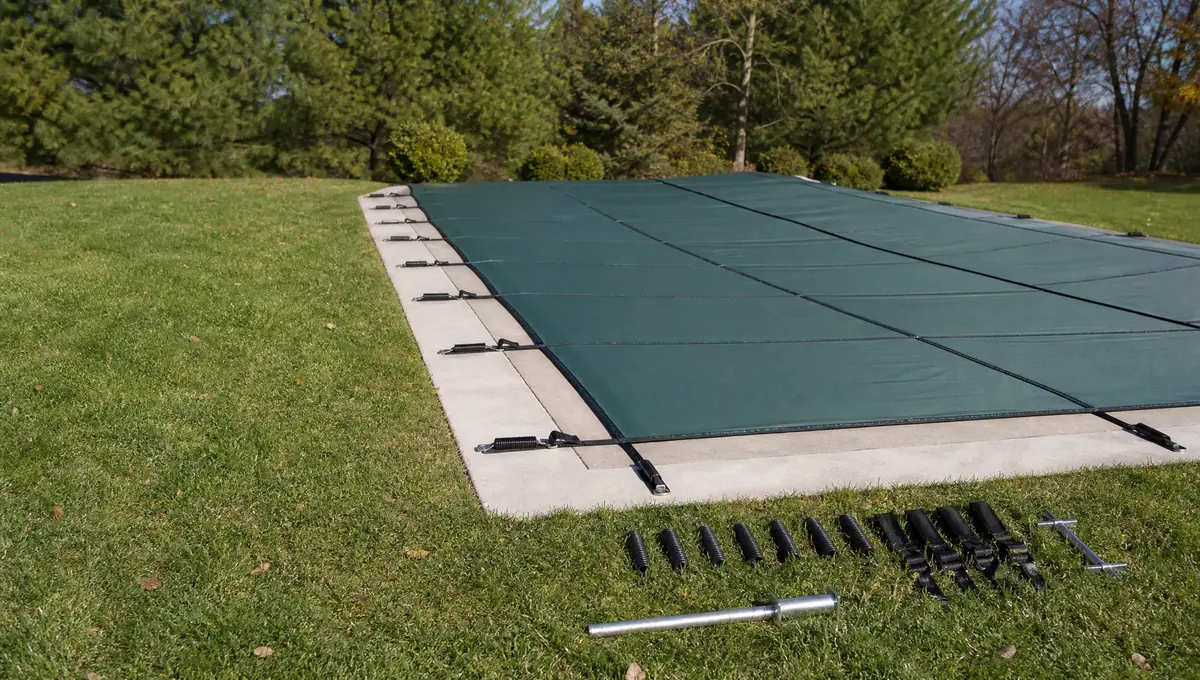
They are drilled into the deck at the layout the measure established, and set flush so the deck stays walkable in summer with the cover off — a brass anchor sitting proud of a deck is a stubbed toe waiting to happen and it is not how the job should look.
Each strap is spring-loaded so the springs take up the load, and the tension is adjusted so the cover is taut without being over-strained. Too slack and it sits on the water and pools debris; too tight and the load goes into the anchors and the fabric rather than being shared.
Which strap comes off first, how the installation rod is used, where the tools live, and how to put it back on in the autumn without fighting it. A cover you cannot get on and off easily is a cover that ends up staying on when it should not, or off when it should not.
See safety cover installation for the full detail on anchors and deck types, and safety cover repair and replacement if what you have now is worn rather than absent.
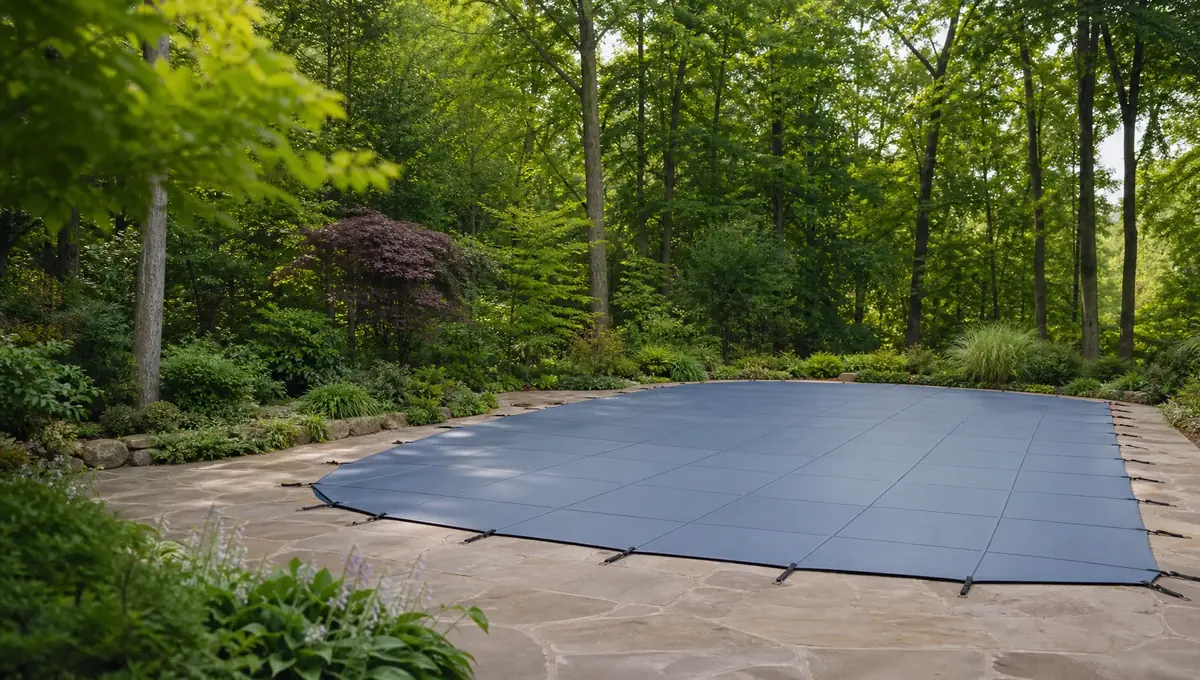
Said plainly, because it matters more than anything else on this page. A safety cover installed to the manufacturer’s instructions and used as intended is a barrier. It is not a reason to stop watching. No cover replaces supervision of children and pets around water, and it has to be fully fastened to do its job at all — a cover half on is a hazard rather than a barrier.
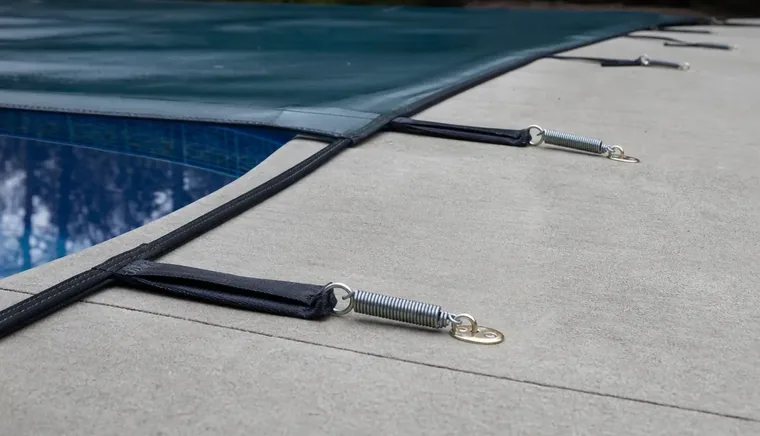
A barrier only when every strap is fastened. Half on is a hazard.
“After having different companies open and close our pools, and then having M & G Pools, I would never have anyone else! They are extremely professional, kind, efficient, and knowledgeable. They definitely go out of their way to help their customers.”
We are in the same town — tell us about your pool and we will come and take the measurements.
Twinsburg is in Summit County, about 18 miles from Lake Erie — inland, with no lake-effect moderation to stretch the autumn. The practical consequence for a cover is timing: the pool wants closing in the middle of October rather than the end of it, so the cover is on for a long winter here.
And it is the town we work out of, which is worth exactly one thing on a page like this: the measure and the fit are easy to schedule, and a return visit to adjust tension after the first hard freeze is not a trip.
For everything else we do here, see Twinsburg pool service. Cover work travels across our whole area — the full list of towns is on service areas.
We do not sell stock covers. Not as a positioning choice — because a rectangle pulled off a shelf and stretched over a pool with steps and a raised wall does not fit, and a cover that does not fit is not a safety cover. The straps land wrong, the tension is uneven, and the gaps are exactly where a gap should not be.
We install Merlin and GLI, and we will talk you through the fabric choice against your property rather than defaulting to one.
Cover work is quote-required. Size, shape, the deck, the obstructions and whether there are existing anchors move the number too much for a starting price to be meaningful.
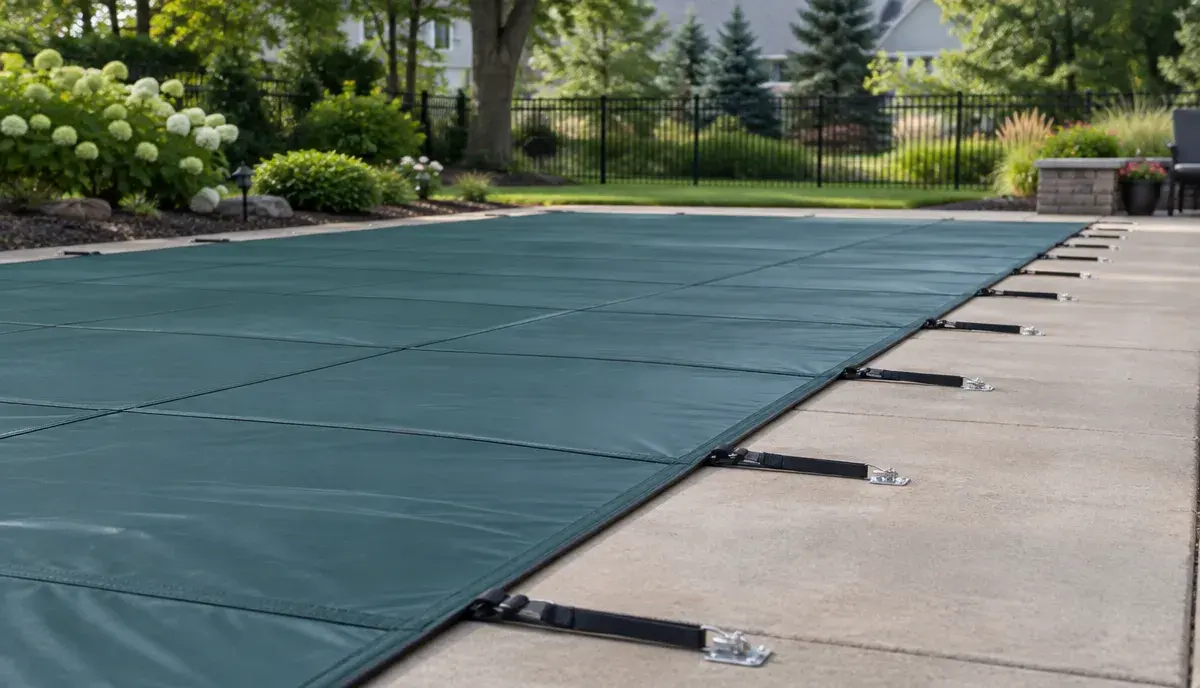
Cut to this pool’s actual shape — which is the whole reason a stock rectangle does not work.
Because the pool as built and the pool as it is now are rarely the same shape — ground moves, deck sections get re-poured, coping gets replaced. The cover is manufactured to your pool as it is today, and the measure also records the deck material, the slope, every obstruction inside the anchor line and where the straps can physically land. None of that is in a set of dimensions.
No, and it is the most common thing people offer. An old cover has usually shrunk — which is often why it is being replaced — so measuring from it builds the shrinkage into the new one. We do take note of the existing anchor pattern, though, because reusing it where we can saves drilling.
It is made to order, so there is a wait, and we will not print a number because it moves with the season. What we will say is that autumn is when every pool owner in Northeast Ohio wants one — a measure taken in August sits in a different queue from one taken in October. Book earlier than feels necessary.
They are drilled into it, and they are set flush so the deck stays walkable with the cover off in summer. Anchor type depends on what the deck is made of, which is one of the things the measure records. An anchor left standing proud of the surface is a job done badly, not a normal outcome.
No. A safety cover fitted to the manufacturer’s instructions and fully fastened is a barrier, and it is not a substitute for supervising children and pets around water. A cover that is only half on is a hazard rather than a barrier — which is part of why we spend time at handover showing you how to fasten it properly.
We do not fit stock or standard sizes at all. A shelf rectangle over a pool with steps and a raised wall leaves the straps landing wrong and the tension uneven, and the gaps end up where a gap should not be. Everything we install is custom, made by Merlin or GLI to the measurements taken at your pool.
Tell us about your pool and we will come and take the measurements.