

Custom in-ground pool safety covers for Pepper Pike — measured on site, with the anchors chosen for the deck you actually have rather than the one the catalogue assumes. Family-owned since 2012.
Two separate questions, and only one of them is a choice.
You choose the cover — the fabric, the colour, mesh or solid. You do not choose the anchors. What is already around your pool decides those, and if the answer is awkward, no amount of preference changes it.
Which is why the measure visit looks at the deck as carefully as the water. An anchor is a load-bearing safety fixing. It has to hold a strap that is holding a cover that may be carrying snow, and it has to keep doing that for years in Northeast Ohio weather.
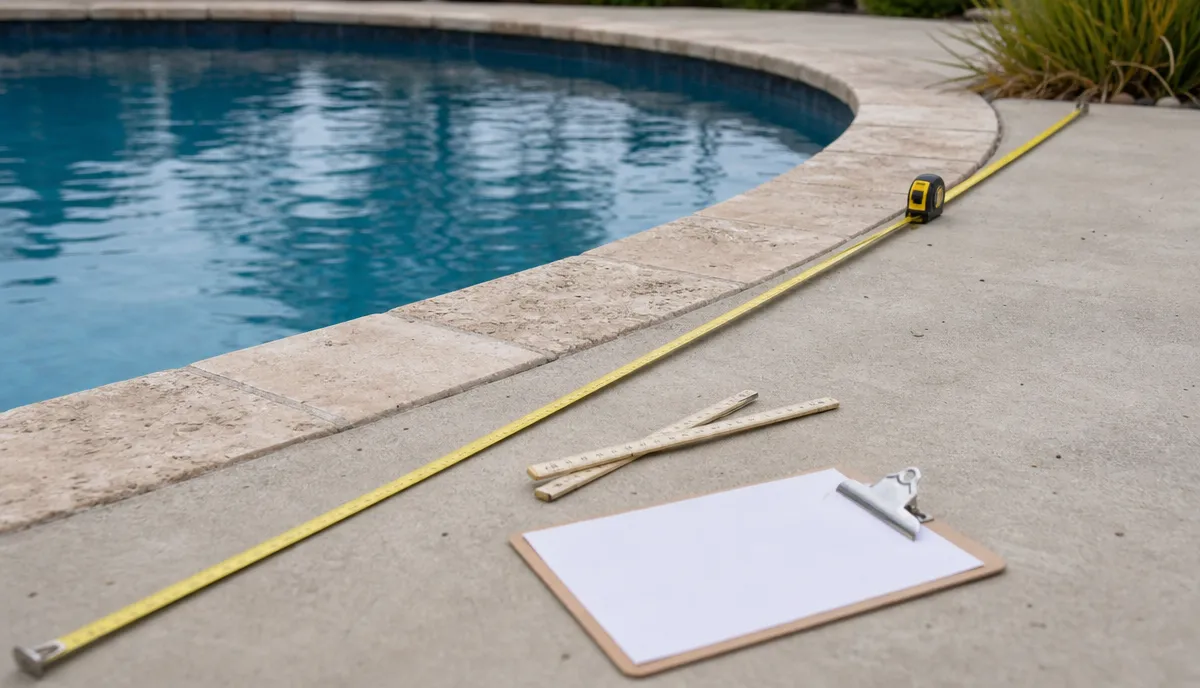
A site measure for a made-to-order pool cover
The straightforward case. Sound concrete of reasonable thickness takes a standard brass anchor set flush into the surface, and that is the arrangement everything else is compared against.
What still needs looking at: thickness, cracking, and whether the slab is spalling. A deck that is breaking up at the surface is not a good host for a fixing that has to stay put.
The complication is that pavers move. They are laid on a bed rather than poured as one piece, and an anchor set into a single paver is anchored to something that is itself only held in place by its neighbours and the friction underneath.
So this is a design question, not a drilling question. It affects where the anchor line can run, and it is one of the more common reasons a cover layout is not simply "the perimeter".
Beautiful, and not uniform. Stone varies in hardness and in how it fractures, and some of it is bedded thin over a base. That combination means the approach has to suit the specific stone rather than stone in general.
And on a salted pool there is a second consideration — chloride and stone do not get on. That belongs to the water rather than the anchor, and it is covered on our Gates Mills cover page.
A different problem entirely: it moves and it is not a slab. Timber decking flexes, expands and contracts, and the fixing has to account for that. It is workable and it is not the same job.
A pool with a grass or planted surround. Is the case people are surprised by. Anchors need something to be set into. Where there is nothing, the answer involves creating a suitable fixing point, and that is a conversation to have at the measure rather than on the day of the fit.
This is the Pepper Pike case, and it is worth its own heading.
On a pool that has been in the ground for decades, the surround is rarely one thing. There is the original concrete, a section re-poured after a repair, coping replaced along one side, maybe a paver terrace added later where a lawn used to be.
Each of those is a different anchoring condition, so the anchor line around one pool can involve more than one approach — and the boundaries between them are exactly where a slab is weakest.
A re-poured section is the one to flag. It may be thinner than the original, it may be a different mix, and it is usually the newest and least settled part of the deck. It is not a reason not to anchor there; it is a reason to have looked first.
This is also why we will not quote a cover from photographs. The deck history is not visible in a picture and it is not in the drawings — it is a thing you find by walking round the pool. The same is true of the pool itself, which is set out on Pepper Pike pool service and, for the shell, pool liners.
They are set flush so the deck stays walkable with the cover off in summer — an anchor standing proud is a job done badly, not a normal outcome.
And they need to keep turning. A brass anchor has a screw that raises and lowers it, and one that has seized with corrosion or filled with grit is a cover you cannot fit properly in October. It is easier to free one in warm weather than on a cold morning with a cover waiting.
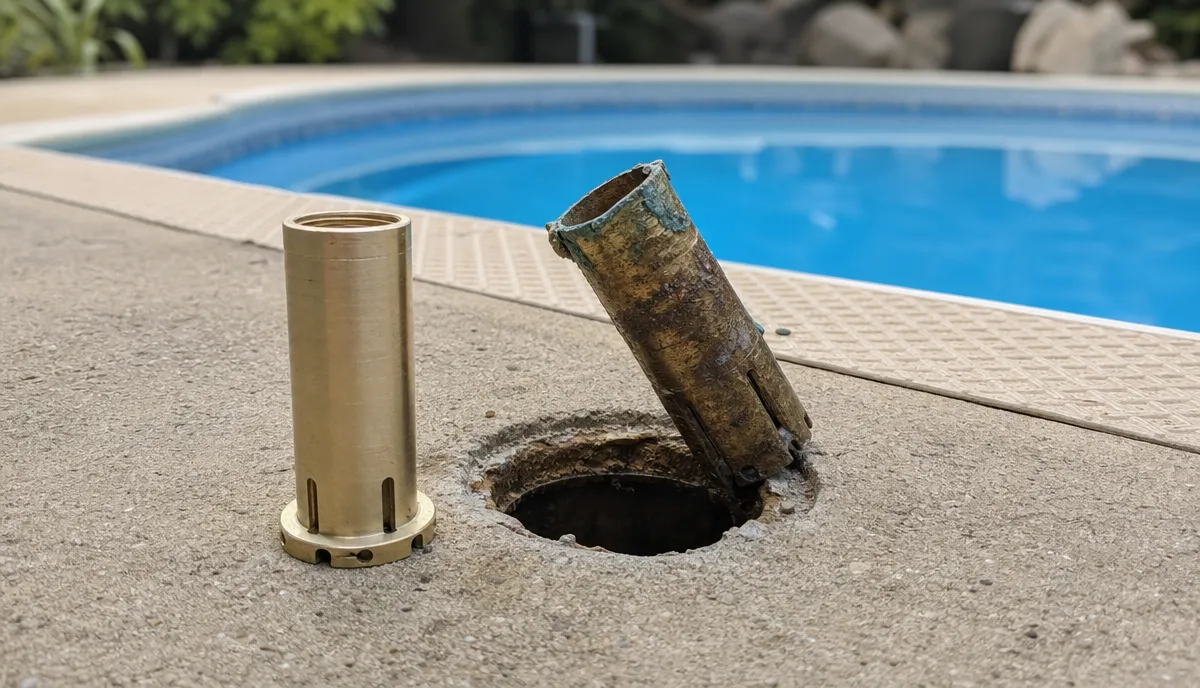
Worth checking each spring while the cover is off
Along with the straps, springs, grommets and seams. See safety cover repair and replacement.
A safety cover installed to the manufacturer's instructions and fully fastened is a barrier. It is not a reason to stop watching. No cover replaces supervision of children and pets around water, and a cover that is only half on is a hazard rather than a barrier.
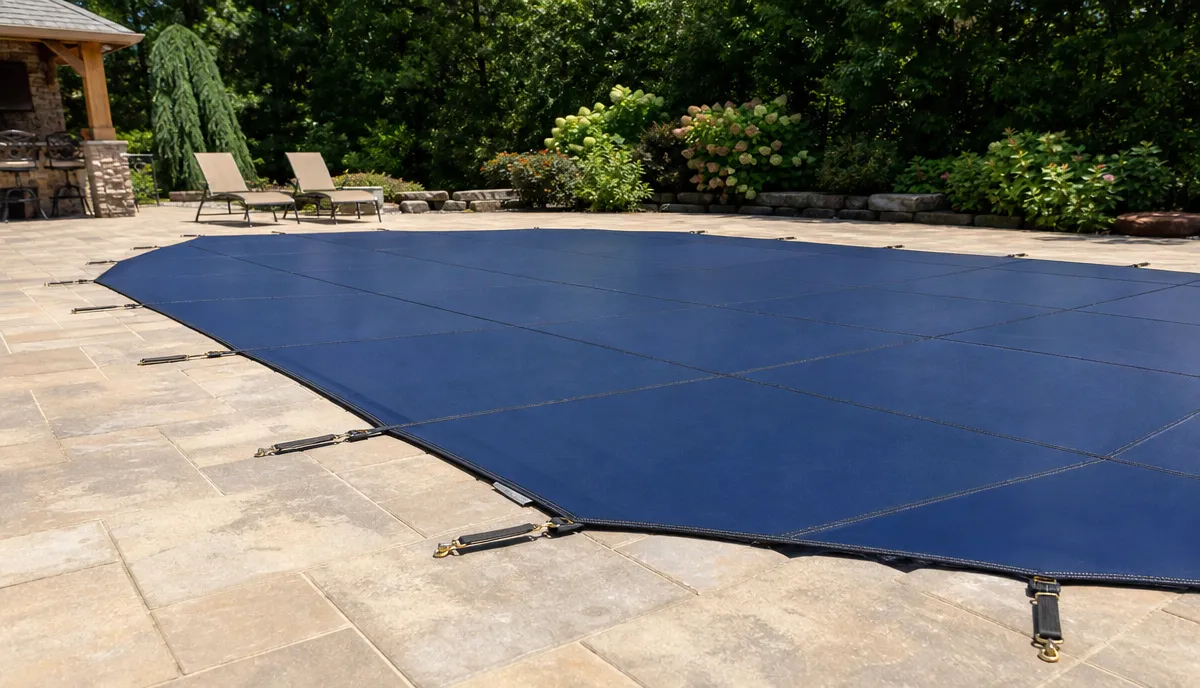
A safety cover anchored and tensioned around a pool perimeter
“The crew is super knowledgeable and courteous.”
That is normal — tell us about it and we will come and look.
Pepper Pike is in Cuyahoga County, about 11 miles from our base.
Everything we install is made to your pool by Merlin or GLI. We do not sell or fit stock or standard sizes. What the measure records and how a fit runs is on our covers in Twinsburg page; the install detail is on safety cover installation; the fabric choice is on the pool safety covers hub.
Cover work is quote-required — and on a mixed deck that is not a hedge, it is the only honest answer. The list of towns is on service areas.
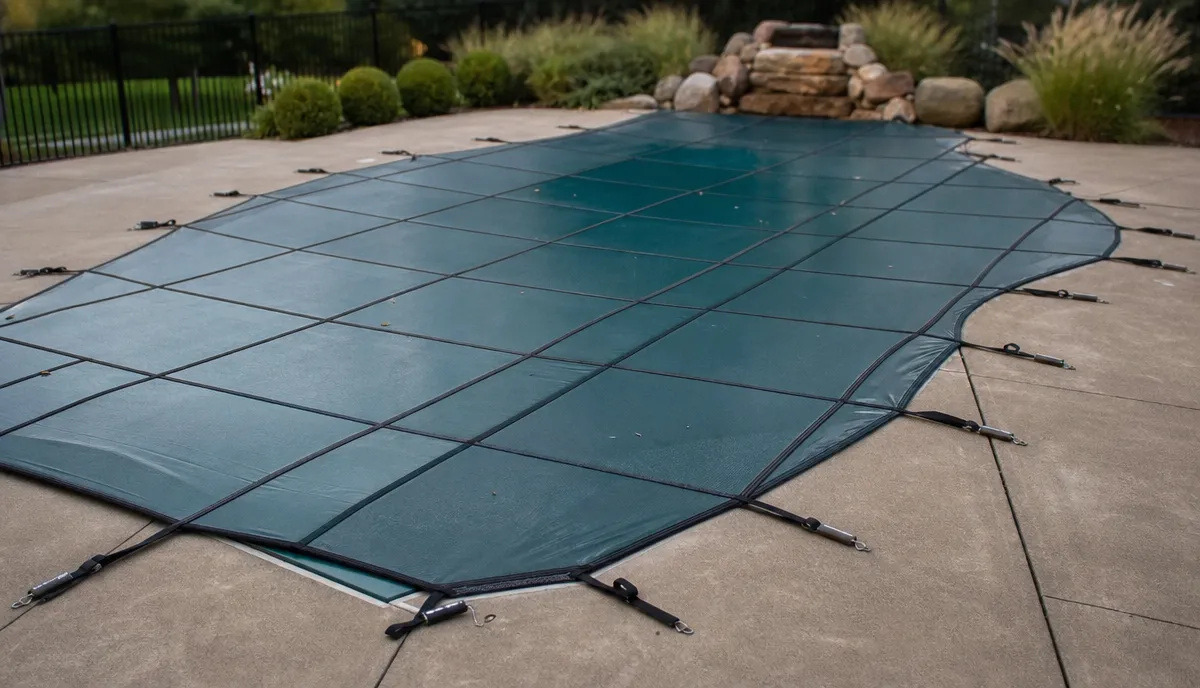
A mesh safety cover on an in-ground pool
It decides the anchors, which is the part of a cover install you do not get to choose. Sound poured concrete is the straightforward case. Pavers move independently, so anchoring into one is a design question rather than a drilling question. Natural stone varies in hardness and in how it fractures. Timber flexes. And a planted surround has nothing to anchor into at all.
Not usually, but it is a thing to have looked at rather than discovered. A re-poured section can be thinner than the original, a different mix, and the least settled part of the deck — and the joins between old and new are where a slab is weakest. It affects where the anchor line runs.
No, and the deck is the reason. Its history is not visible in a picture and it is not in the original drawings — a repaired section, replaced coping, a paver terrace added later. You find that by walking around the pool, which is what the measure visit is for.
Often yes, and it needs designing rather than assuming. The issue is that pavers are laid on a bed and held by their neighbours, so a single paver is not the same host as a poured slab. It usually affects where the anchor line can run, which is why paver decks are a common reason a layout is not simply the perimeter.
It is a maintenance job rather than a failure, and it is much easier to deal with in warm weather than on a cold October morning with a cover waiting to go on. A brass anchor has a screw that raises and lowers it, and one seized with corrosion or packed with grit will not let the cover fit properly. Worth checking every spring while the cover is off.
No — custom only, made by Merlin or GLI to measurements taken at your pool. On a pool with a deck that has been altered over the years, a shelf cover is being made without knowing any of the things that actually decide the fit.