
Custom in-ground pool safety covers for Stow — and an honest answer about how long one lasts, which is mostly a question about how it is treated. Family-owned since 2012.
Somebody will, and the number will be invented.
Cover life depends on the fabric, the exposure and — more than anything — the handling, and the manufacturer is the only party who can state what their product is expected to do. We install Merlin and GLI, and their literature says it for the cover you are considering. We will show you.
What we can do is more useful than a number: tell you what actually consumes a cover's life. Most of it is avoidable, which is the part worth knowing before you have spent five years shortening one by accident.
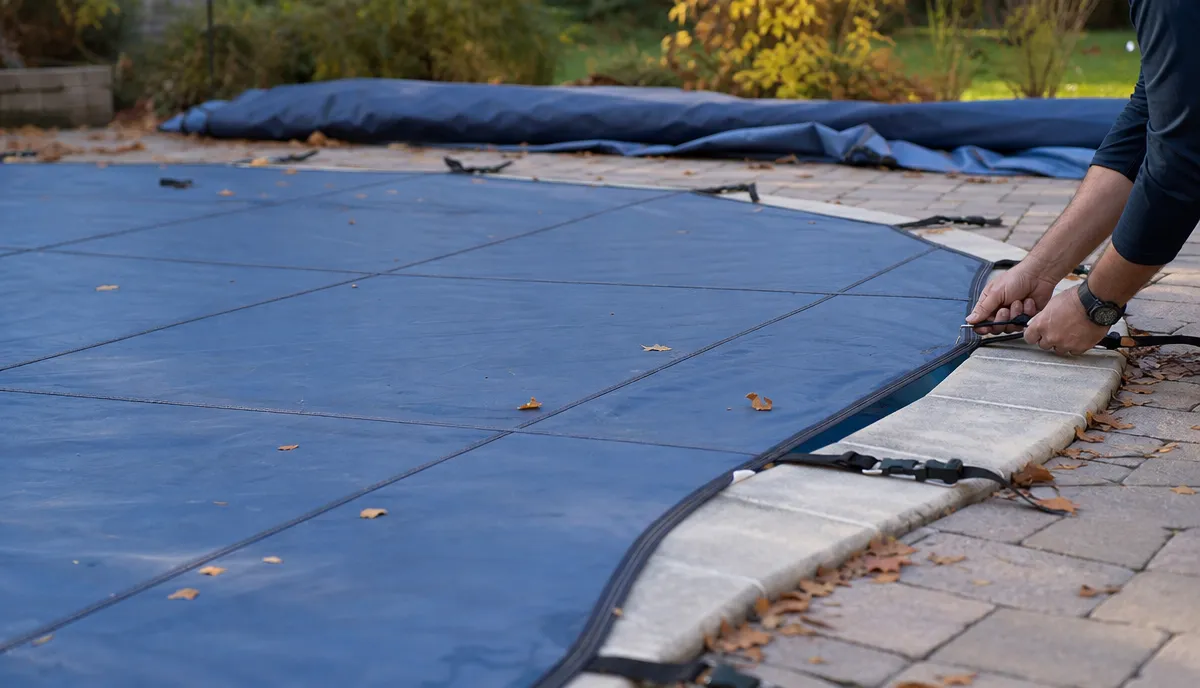
A safety cover part-way through being fitted at a closing
The most avoidable, and the most common. A cover folded up wet spends the whole summer in a warm, dark store growing mildew — and mildew does not merely stain, it works on the fibres and the coating.
Off, cleaned, dried, then stored. That is the entire discipline, and it is worth the extra hour. Where the cover lives once it is dry is a separate question, and it is covered on our Moreland Hills cover page.
Crammed tight into a bin creases a cover along the same lines every year, and repeated hard creasing is where fabric eventually fails — often in a straight line that looks inexplicable.
Loose beats neat. And out of the sun: fabric stored outdoors under UV is being aged while it is not even working.
A cover left loose does not simply sag — it moves. It flaps, it rubs, and it snatches at every strap and grommet each time the wind gets under it. A season of that ages a cover more than a season of sitting taut under snow.
Which is why a fitted cover is worth re-checking after the first hard weather rather than assumed to be fine until spring.
Almost every worn-out cover has a worst spot, and it is where the fabric has been rubbing on coping, a step, a raised edge or a rough patch of deck.
Abrasion is a location problem rather than a fabric problem. Left alone, it does the same thing next winter. Found in spring, it can often be addressed — by a repair, or by changing what the cover is catching on.
Sunlight ages cover fabric, and a cover gets it at both ends of the season and again if it is stored outdoors. Nothing stops it. What helps is not adding avoidable exposure — which is mostly the storage point again.
And this is where Stow comes in. Stow is about 27.5 miles from Lake Erie — the most inland of the seventeen towns we serve, further from the water than Bath Township or Hudson.
No lake-effect moderation at all. Which means the earliest close and the latest opening in our area: your cover is on the pool for longer, under more sustained cold, than anyone else's. It is not a reason to buy differently. It is a reason the avoidable items above matter more here than they do near the shore.
Most cover faults are worth repairing, and the components are all serviceable — straps, springs, grommets, D-rings, anchors, and a seam separation while it is short. See safety cover repair and replacement.
The point at which repair stops making sense is about the fabric, not the hardware:
The useful distinction: hardware failures are events, and fabric failures are a condition. Replacing a strap on sound fabric is money well spent. Replacing a strap on a cover whose fabric is generally tired is money spent twice.
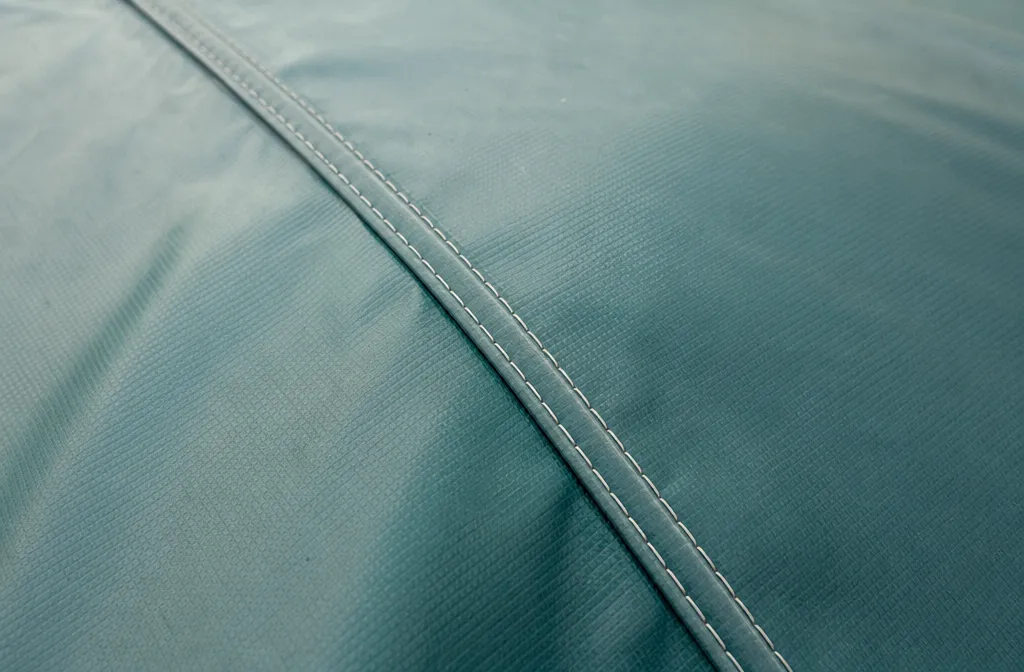
And a cover kept past that point stops being a safety cover in practice
Which is the real argument rather than the cosmetic one.
A safety cover installed to the manufacturer's instructions and fully fastened is a barrier. It is not a reason to stop watching. No cover replaces supervision of children and pets around water, and a cover that is only half on is a hazard rather than a barrier.
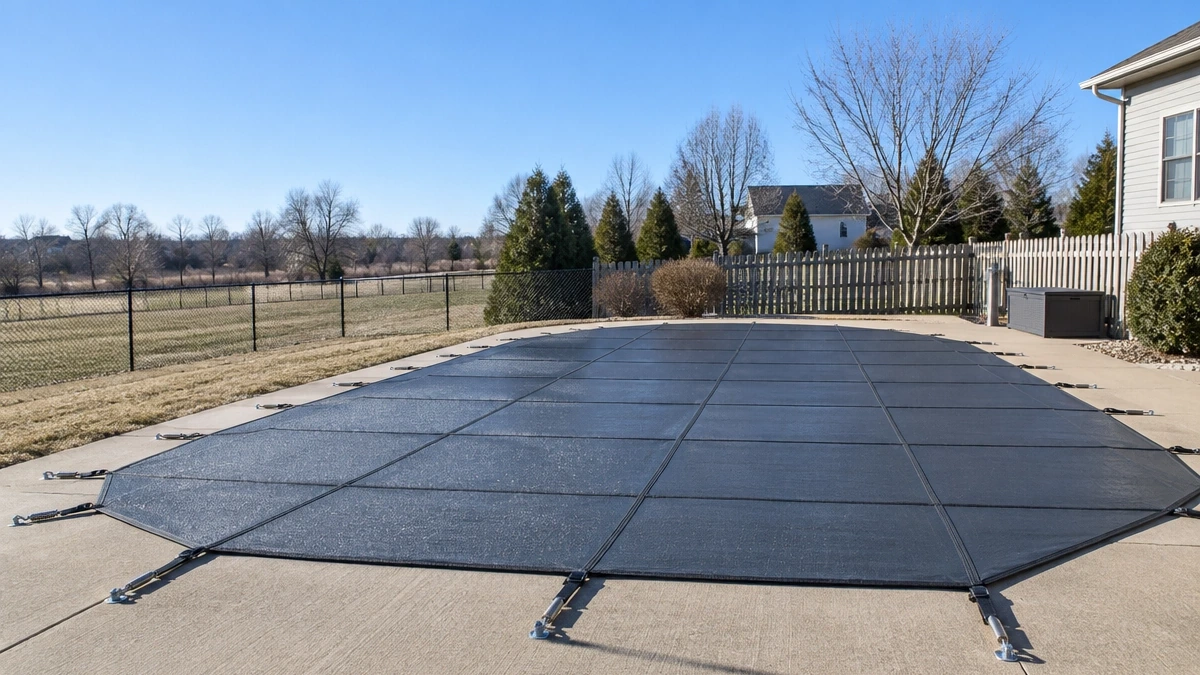
A safety cover anchored and tensioned around a pool perimeter
Stow is in Summit County, about 11 miles from our base.
Everything we install is made to your pool by Merlin or GLI, measured on site. We do not sell or fit stock or standard sizes — and a cover that never fitted properly is one that has been fighting its anchors from the first winter, which is its own kind of shortened life.
What the measure records and how a fit runs is on our covers in Twinsburg page; anchors and deck types are on safety cover installation; the fabric decision is on the pool safety covers hub.
Cover work is quote-required. Closings start from $495 plus chemicals — see pool closing service. For the rest of what we do here see Stow pool service; the list of towns is on service areas.
“The crew is super knowledgeable and courteous.”
Let us look at it while it is off and tell you honestly what it has left.
We will not give you a number, because any figure we invented would be worth nothing — it depends on the fabric, the exposure and above all the handling. The manufacturer states what their product is expected to do, and we will show you what Merlin or GLI says for the cover you are considering.
Putting it away damp. A cover folded up wet spends the summer in a warm dark store growing mildew, and mildew does not just stain — it works on the fibres and the coating. Off, cleaned, dried, then stored. That is the whole discipline.
More than people expect. A loose cover does not simply sag, it moves — flapping, rubbing and snatching at every strap and grommet whenever the wind gets under it. A season of that ages a cover more than a season sitting taut under snow, which is why a fitted cover is worth re-checking after the first hard weather.
Because it is rubbing on something — coping, a step, a raised edge, a rough patch of deck. Abrasion is a location problem rather than a fabric problem, so left alone it does exactly the same thing next winter. Found in spring, it can often be repaired and the cause addressed.
The line is about fabric rather than hardware. Straps, springs, grommets and anchors are serviceable and worth fixing on sound fabric. Once you have a seam that has run, thin patches across the surface rather than one worn spot, or material that has gone stiff, the next failure will be somewhere else — and a strap fitted to a tired cover is money spent twice.
To how long the cover is working, yes. Stow is about 27.5 miles from Lake Erie — the most inland town we serve — so there is no lake-effect moderation, the close comes earliest and the opening latest. Your cover is on the pool for longer under sustained cold than anyone else's, which makes the avoidable items matter more here than near the shore.