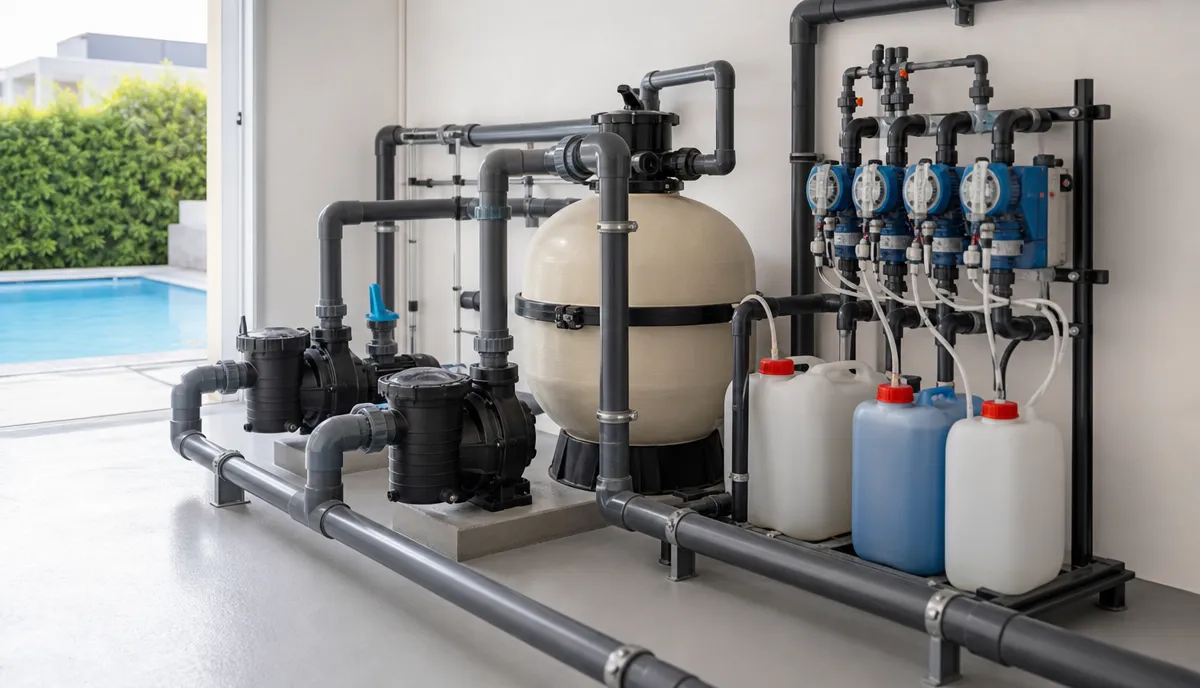

Almost everybody asks the wrong question in October.
They ask "can it wait until spring?" — and in the sense that matters to them, nearly everything can. The pool is closed. Nobody is swimming. A broken thing that nobody needs is not an emergency.
The question that actually decides it is different: does five months sitting idle make this worse?
Which sorts every end-of-season repair into three groups, and the three have genuinely different answers.
Group 1: Gets Worse In Storage
Do these now. Not because they are urgent — because October is when they are cheap.
Anything that can hold water
Water left in a housing expands as it freezes and cracks it. That destroys the component rather than injuring it, and it is not a warranty matter, because it follows from the state the pool was left in.
So anything that stops a part being fully drained is in this group by definition, and it overlaps with Group 3 below. The mechanism and the places it happens are on freeze damage and the close.
A weeping pump seal
This is the clearest case on the list and the one most often deferred.
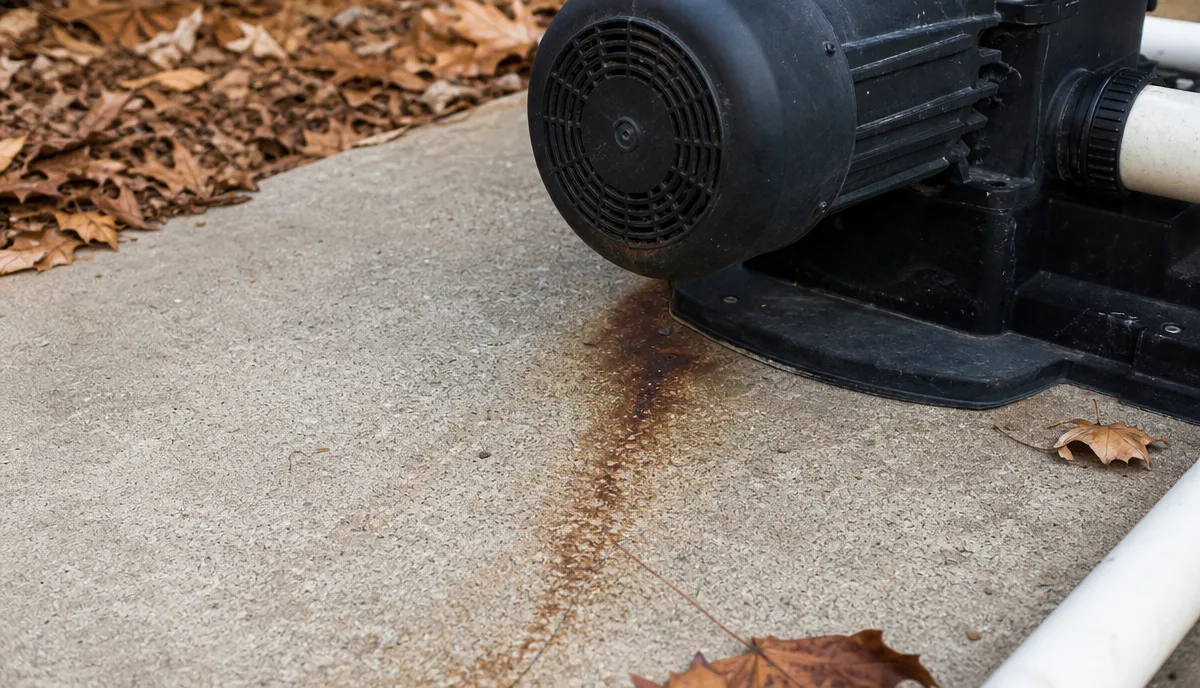
A shaft seal that is letting pool water past is a cheap part in October. Left alone, the motor goes into storage with water already on the wrong side of that seal — and then sits, wet and unrotating, for five months. Grease is displaced, the bearing race corrodes, and the motor that was fine in September is a screech in June and a replacement in July.
Look for the evidence rather than the noise, because a weeping seal is silent: a rust stain or a drip under the motor end, or a chalky deposit on the pad below it. The full chain is on the seal-to-bearing chain.
A seal in autumn is a part. The same seal ignored is a motor. That is the single best-value repair we do at the close.
A cracked or crazed housing
A hairline in a pump volute, a pot lid or a filter body propagates. Thermal cycling over a winter is exactly the condition that grows it, and a crack that was weeping slightly in September can be a genuine failure at the opening — with the pool full and the water going somewhere.
Anything already corroding
Rust on a motor end, a corroded union, a seized valve stem. Five damp months do not improve any of them, and a seized valve in April is often a bigger job than a stiff valve in October.
Group 2: Neutral In Storage
These genuinely can wait, and we would rather say so than sell you a job.
A failed start capacitor. It is a part, it will be a part in April, and nothing about sitting in a shed changes it.
A dead or confused controller board. Same logic. Once the pool is closed there is nothing for it to control.
A scaled heat exchanger. Scale does not get worse without the heater running. The water side can be de-limed when the pool comes back into service, and where the unit is otherwise sound that is the right answer rather than a replacement.
Worn filter media. Sand at the end of its life or cartridges that no longer come back to their clean pressure need replacing before the pool is used again, not before it is stored.
Cosmetic anything. A cracked fan cover, a faded lens, a bent basket lid handle.
One thing worth doing with the filter anyway, since it is coming out of service: offsite filter cleaning is $125 — a proper strip and clean off site rather than a hose in the garden. It is not a repair and it is not urgent; it is simply the moment in the year when the filter is free.
Group 3: The Close Cannot Protect The Pool Without These
The group people do not know exists, and the one that is not optional.
A valve that will not seat or will not hold. If a valve cannot be closed properly, water cannot be kept out of the section behind it, and the whole logic of the close fails at that point.
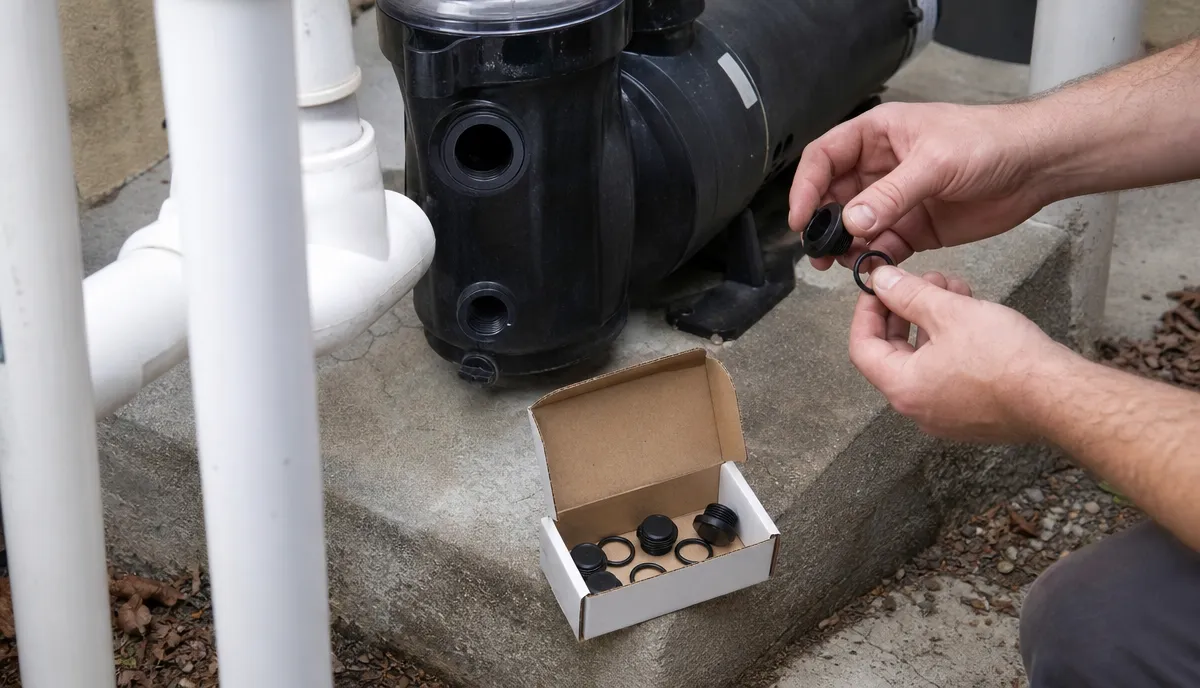
A stripped or damaged drain-plug boss. If a plug cannot be removed, that housing cannot be drained. If it cannot be refitted, it will not hold in spring. Either way it is a freeze risk sitting in the middle of your winterised system.
A heater that cannot be fully drained. A blocked drain point, a seized drain fitting, or a header that will not clear. A heat exchanger with water in it over a Northeast Ohio winter is one of the more expensive outcomes available on a pool.
A pump pot lid that will not seal, or a cracked pot. Both mean the pump cannot be left in a known state.
These are not a value judgement about your budget. If one of them is present, the close is not doing what a close does, and we will tell you that before the visit rather than after it.
Two Things We Do Not Do, Whatever The Season
Stated because they come up at exactly this point in the year.
We do not do electrical supply work. Anything at the breaker panel or on the supply wiring is a licensed electrician's job. We will establish what the equipment needs and say which side of that line a problem sits on.
And we do not run or alter gas lines. That is a licensed gas fitter's work. We will read the supply pressure at the appliance, document what we found, and hand that part over.
Where a heater is at the end of its life rather than faulty, the case for settling it over the winter — and the supply question that makes it a two-trade job — is on heater replacement timing.
How To Decide, In Practice
Three questions, in order.
1. Can it hold water, or is it already letting water somewhere? If yes, it is Group 1 or Group 3 and it wants doing now.
2. Does the close depend on it? Valves, plugs, drain points, the pump pot. If yes, Group 3, and it is not deferrable.
3. Is it simply a part that will still be a part in April? Then it is Group 2, and April is fine.
And if you are not sure which group something is in, that is exactly what a diagnostic is for. A $150 service call covers up to the first hour on site, with parts and any further labour quoted before we do them. See pool equipment repair, pool pump repair and pool filter repair.
The Version That Costs Least Of All
Every Group 1 fault above was smaller in July.
A seal weeps before it screeches. A crack crazes before it opens. A valve stiffens before it seizes. All three are findable by somebody putting a hand on the equipment and writing down what they found — which is what a chemical and equipment check at $72 per visit plus chemicals is doing across a season, as much as the water side.
Tell us in advance what was different this year, before the date rather than on it, and most of Group 1 gets dealt with while the equipment is coming out of service anyway. Your own half of the close — including the anchor check that most often stops a close finishing — is on the closing checklist.
Closings start from $495 plus chemicals, and a close that finds nothing is the one you want.