

Nobody wants to think about a pool heater in November. The pool is closed, the cover is on, and the heater is the least urgent object in the garden.
Which is exactly why it is the right time, and there are three reasons — one of which is the reason people who leave it until May end up losing a month of their season.
Reason 1: The Gas Supply Question Needs a Second Trade
This is the one that catches people, and it is worth understanding before anything else.
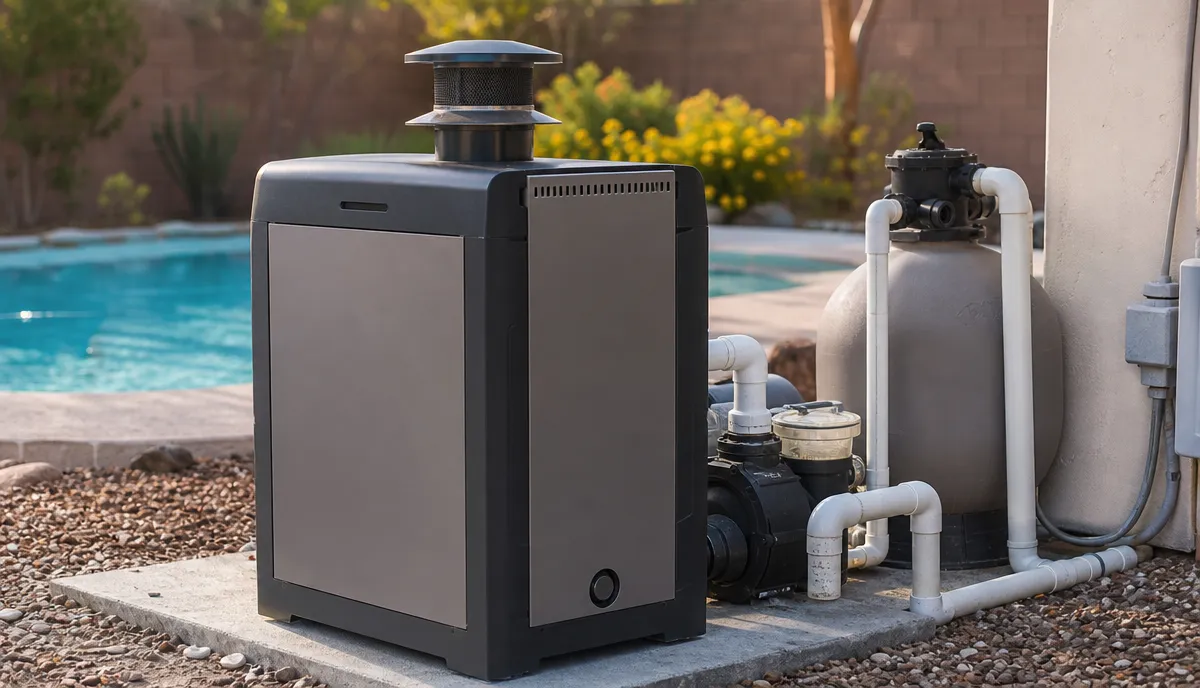
A pool heater is usually the largest gas appliance on a domestic property, and often the last one added. So if you are going up in output — a bigger unit, or a first heater on a pool that never had one — the existing gas line may not carry it. The line was sized for the appliances it was originally fitted for.
The symptom of an inadequate supply is specific: the heater lights, runs, and drops out when it asks for full output. Or it behaves all summer and misbehaves on the first cold morning, when the house furnace is drawing hard at the same time. People spend years mistaking that for a faulty heater.
And here is our boundary, stated plainly: we do not run or alter gas lines. That is a licensed gas fitter's work. We will establish what the unit needs, read the supply pressure at the appliance, document what we found and hand that part over. We do not do the electrical supply work either, which is the equivalent question on a heat pump.
Which means a heater replacement can involve two trades on two schedules. In February that is a sequencing exercise. In the second week of May, with a full pool and a family waiting, it is the difference between swimming in May and swimming in June.
Reason 2: Spring and Autumn Are the Busy Weeks
Seasonal demand is heavily concentrated, and it is not evenly spread across the year — openings cluster into a few weeks and closings into a few more. That is in our terms because it genuinely shapes what can be scheduled.
Winter is the window where a replacement is a planned job rather than something fitted around a queue of openings. That is about demand, not about how quickly anyone arrives — we do not publish response times and are not going to start here.
Reason 3: The Old Unit Is Already Drained
A small practical point that saves a step. At the close, the heater has been drained and winterised — so it is already in the state a removal wants. Taking out a unit that is full and in service is a different morning's work.
The Decision Comes Before the Timing
None of the above is an argument for replacing a heater that does not need replacing, and two of the most common "my heater is dying" calls are not the heater at all.
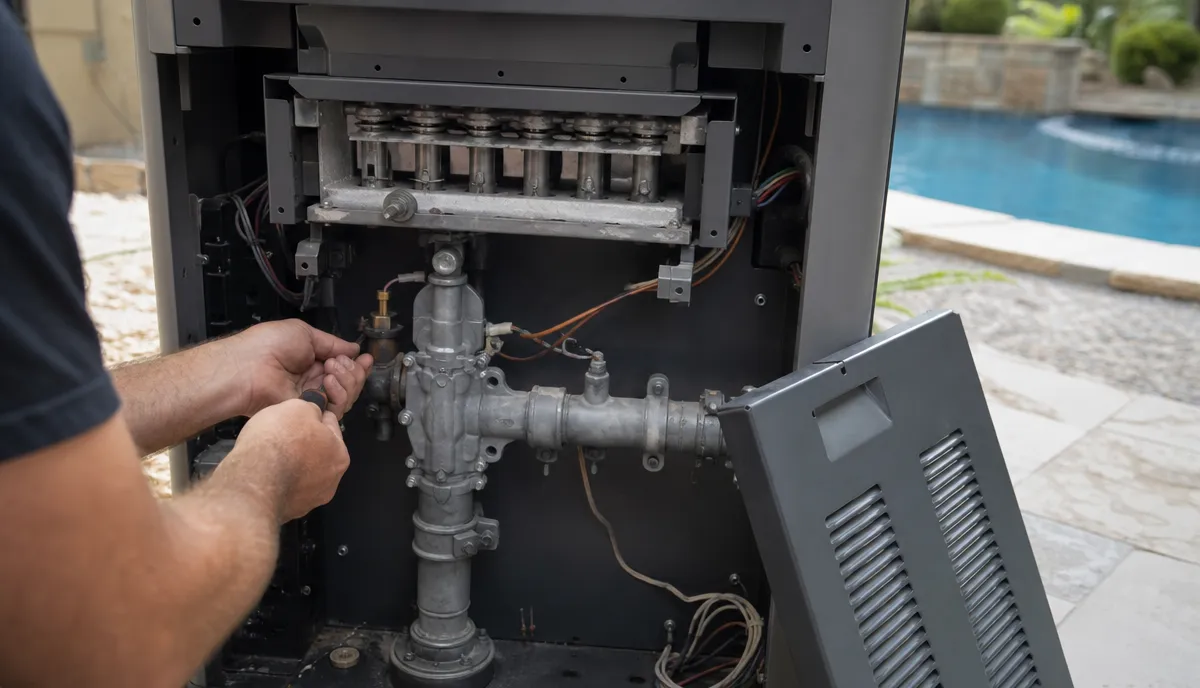
A heater that will not fire is frequently a flow problem — a loaded filter, a part-closed valve, a low water level, or a variable-speed pump running below the minimum flow the heater's switch will accept. That is a cheap outcome and it looks exactly like a broken heater.
A heater that takes longer to reach temperature than it used to is usually scaled, not tired. Calcium comes out of solution on the hottest surface in the system, scale insulates, and the heater burns the same gas to move less heat into the water. Where the unit is sound, the water side can be de-limed rather than replaced. See what kills an exchanger.
When it genuinely is time, the decision turns on three questions: which part failed, whether the cause of the failure is still present, and whether the rest of the unit is sound. A cracked heat exchanger on an older heater is the case where the answer usually tips — see repair or replace.
A $150 service call covers up to the first hour of diagnosis on site, and it is the honest first step rather than a quote for a new unit.
What to Settle Over the Winter
Four things, in order, and none of them needs the pool to be open:
1. Whether the existing heater is finished. A diagnostic, not a guess.
2. What output the pool actually needs. Sizing depends on surface area, the temperature you want to hold, wind exposure and whether the pool is covered when it is not in use — not on volume alone. An undersized heater is the one you buy twice. See pool heaters.
3. Whether the supply is adequate for that output. Read at the appliance rather than assumed — and if it is not, that is the conversation to start in January.
4. What the install involves on your pad. A like-for-like swap on an existing pad is the simplest version; a different footprint means re-plumbing, and access matters because a heater is a bulky item. If your gate is narrower than the unit, that is a conversation before it is a quote. See pool heater installation.
Heater supply and installation are quote-required, because the unit depends on your pool and the installation depends on what is already there. The four separate costs — the unit, the installation, the supply upgrade and the running — are set out on the four costs.
And Then the Opening Is Just an Opening
The version of spring worth aiming at: the heater is already in, the supply question was answered in January, and the pool opening service is a normal seasonal visit rather than the start of a project.
See pool heater replacement for what a swap involves.
