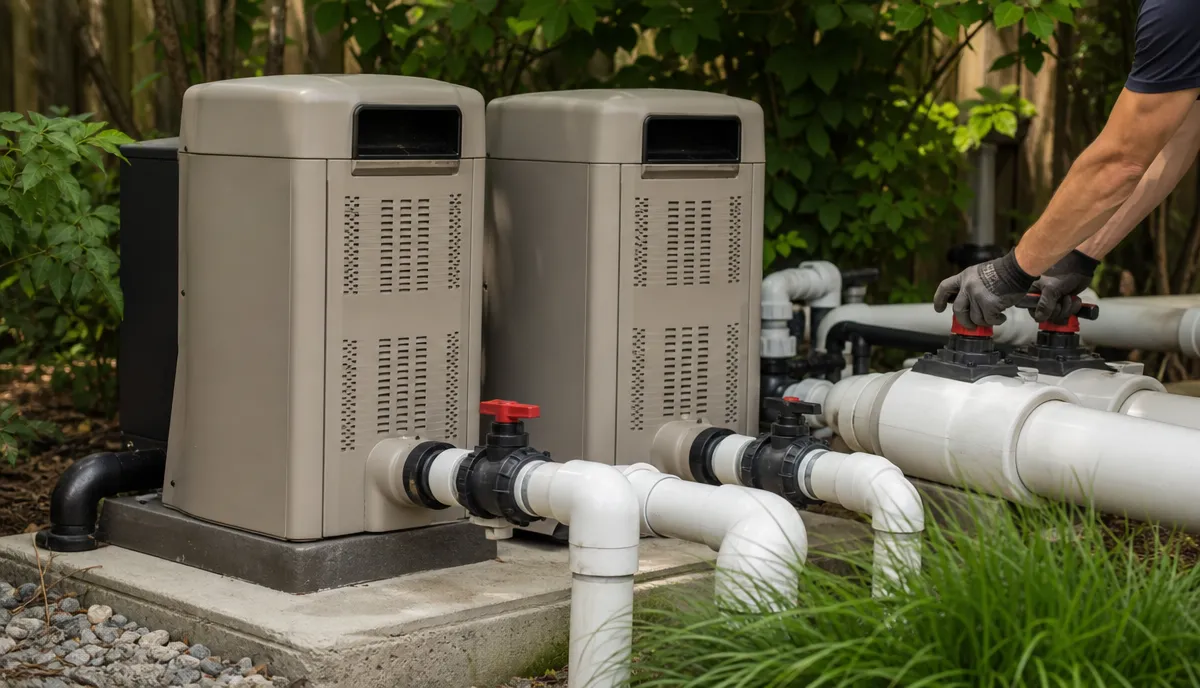

Pool heater repair in Beachwood — including the case the rest of this site does not cover: a heater that never gets an off-season. $150 service call.
Almost everything written about pool heaters assumes a pool that closes in October. That heater's enemies are freezing and idleness — a freeze-cracked exchanger, a seized valve, a season of standing still.
A commercial or indoor heater has neither of those problems and a different set instead. It runs. It runs in February. It runs when the pool is not being used, because the water still has to be at temperature for whoever arrives at six in the morning.
So it fails from use rather than from disuse, and that changes what is worth inspecting and when.
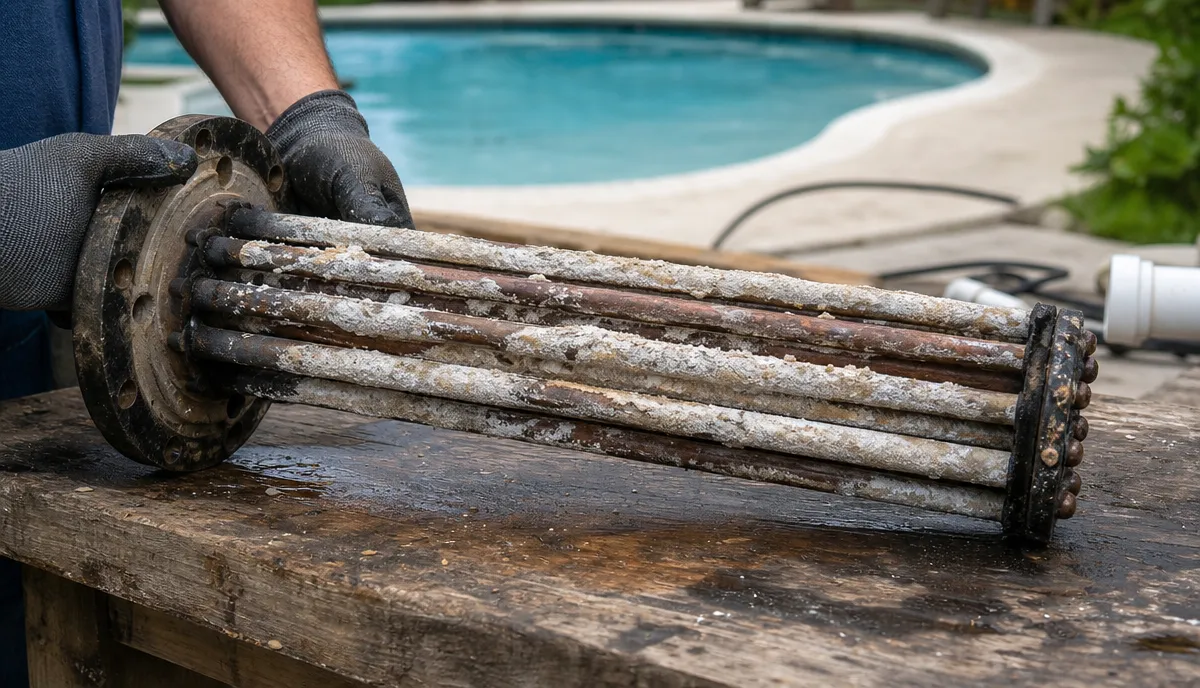
A heat exchanger tube bundle furred with calcium scale
Igniters, gas valves, relays and contactors are all counting operations rather than years. A heater cycling year-round accumulates those far faster than a seasonal one, and the parts that fail are the ones that move or switch.
On a seasonal pool the exchanger gets five months off. On a year-round pool the water is in contact with hot metal continuously, so scale and corrosion progress without interruption. The causes are the same ones set out on our chemistry and exchangers in Pepper Pike page; the difference here is the pace.
A busy facility loses heat to evaporation faster — more surface disturbance, more water carried out on people and towels, more fresh water in. The heater is working against a moving target that a domestic pool never presents.
And nothing is ever off long enough to look at properly. Which is the practical difficulty: a seasonal pool has a natural inspection window every autumn, and a year-round pool has to have one arranged.
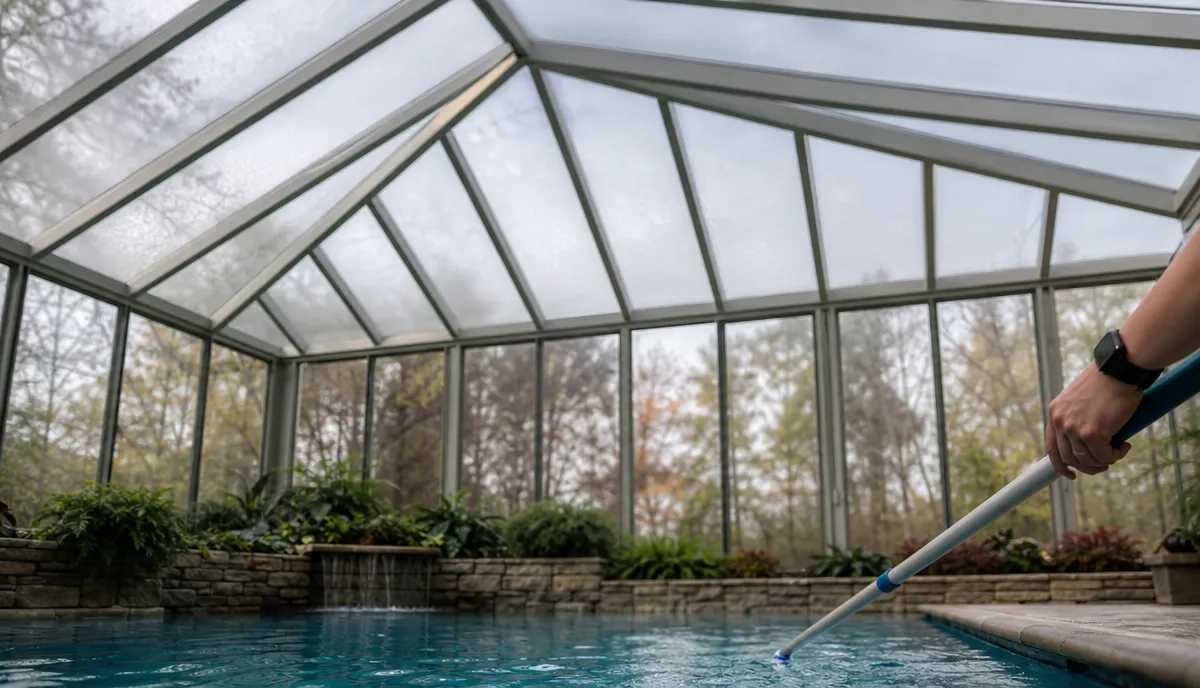
An indoor pool's persistent problem is not frost. It is what the water puts into the air.
Chloramines form when chlorine reacts with what swimmers bring in. They are what produces the sharp smell people wrongly read as "too much chlorine" — usually it is the opposite. And chloramine-laden air is corrosive: it attacks fittings, fixings, ductwork and structure in an enclosed space.
Where that touches the heater: a heater and its flue live in that atmosphere too, and equipment in a pool hall ages differently from equipment on an outdoor pad. Corrosion in places you would not expect on an outdoor unit is normal indoors, and it is worth looking for rather than being surprised by.
And here is our boundary, stated clearly: we do not do ventilation or HVAC work
Air handling in a pool hall is a specialist trade and it is not ours. What we can do is manage the water chemistry that determines how much of the problem exists in the first place — see commercial pool maintenance — and tell you plainly when what you have is an air problem rather than a water one.
And we are not going to pretend that is the same conversation.
Any company can print a number on a website; the useful thing for a facility is different, and it is this:
A heater inspected on a schedule — before the season it is going to be leaned on hardest — is a heater whose tired igniter, drifting flow-switch or scaling exchanger is found while the pool is still working.
Not a promise about speed. Regular attendance means we know your equipment, your water history and your site, which is worth considerably more than an emergency number. See commercial pool maintenance.
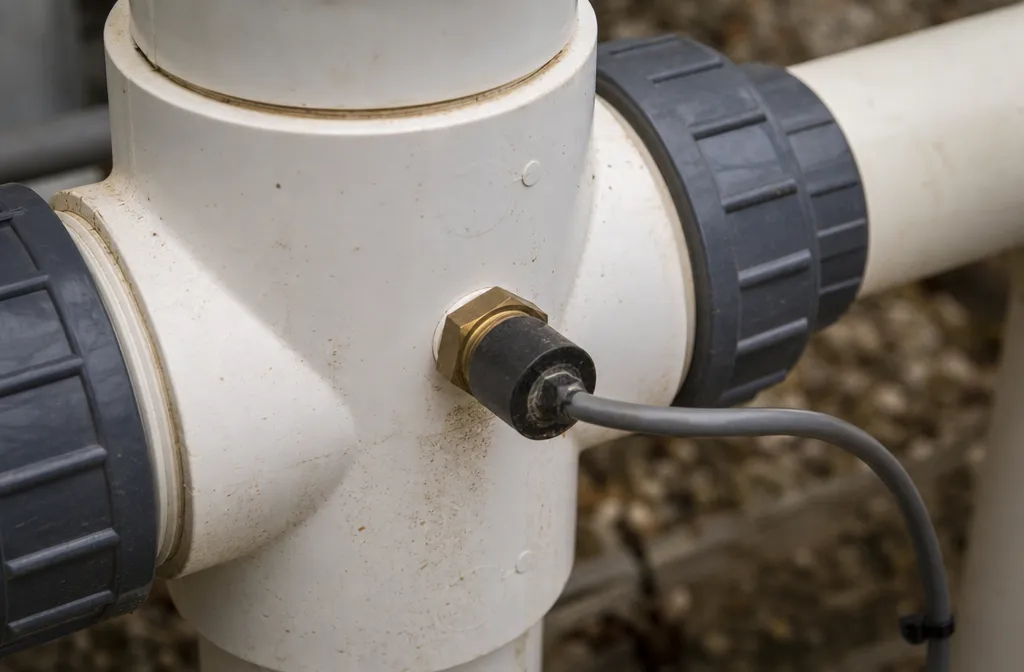
On a commercial pad, a system that records what the heater did and when turns an intermittent fault into a diagnosable one. See pool automation.
We are your service contractor, not your compliance department. We file the paperwork required by the Ohio Department of Health for the work we do; your own regulatory obligations stay yours, including your recordkeeping and any operator certification your facility requires.
We do not run or alter gas lines and we do not do the electrical supply work — both licensed trades, and on a commercial site both are more likely to be involved. We do not do ventilation or HVAC.
And we do not clean pools. On a commercial site that is normally site staff or a separate contract, and we work alongside it.
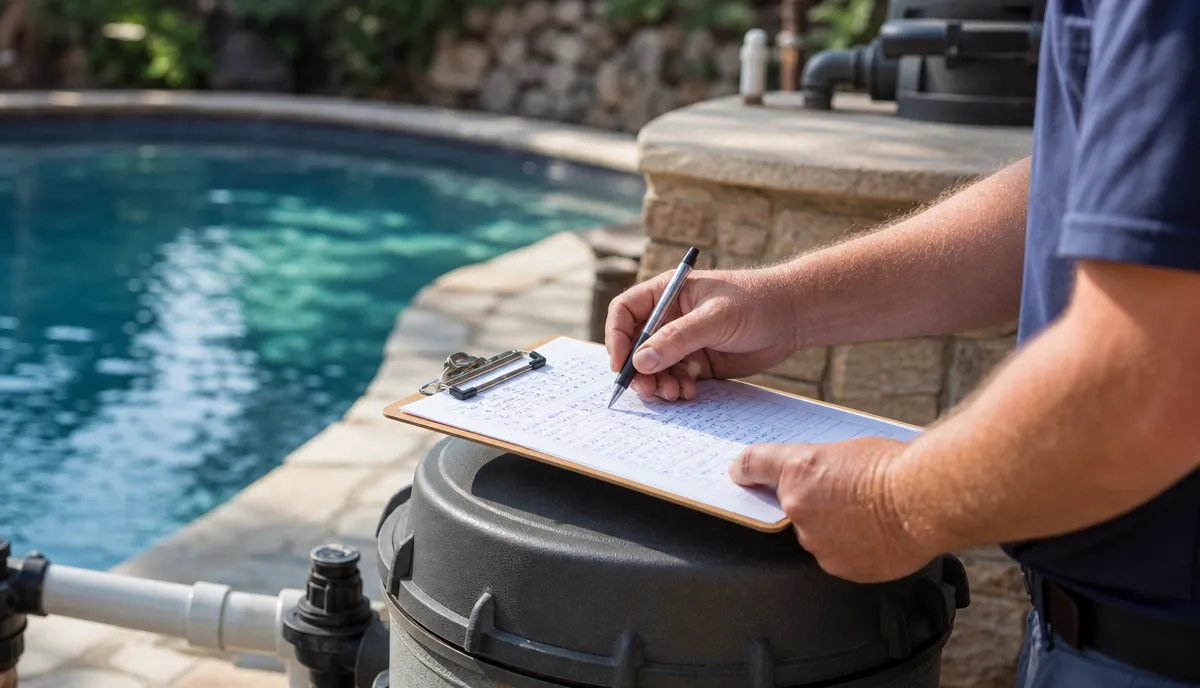
A completed pool service sheet on the equipment pad
“Matt and his team are fantastic to work with. Easy to schedule, quality work is done right the first time. Highly recommend.”
Tell us what kind of facility it is and how it runs.
A $150 service call applies to a diagnostic and repair visit and covers up to the first hour on site. Parts and further labour are quoted before we do them. Commercial contracts and heater supply are quote-required.
Products we install carry the full manufacturer's warranty — generally one to three years, on that manufacturer's terms. We do not offer a separate workmanship guarantee.
The order we diagnose in — flow first, then gas or power, then ignition, then controls, then the exchanger — is on our heater diagnostics in Twinsburg page, and it does not change on a commercial pool. The repair-or-replace decision is on repair or replace in Hudson; on a year-round pool the "is the rest of the unit sound" question carries more weight, because everything else has run the same hours.
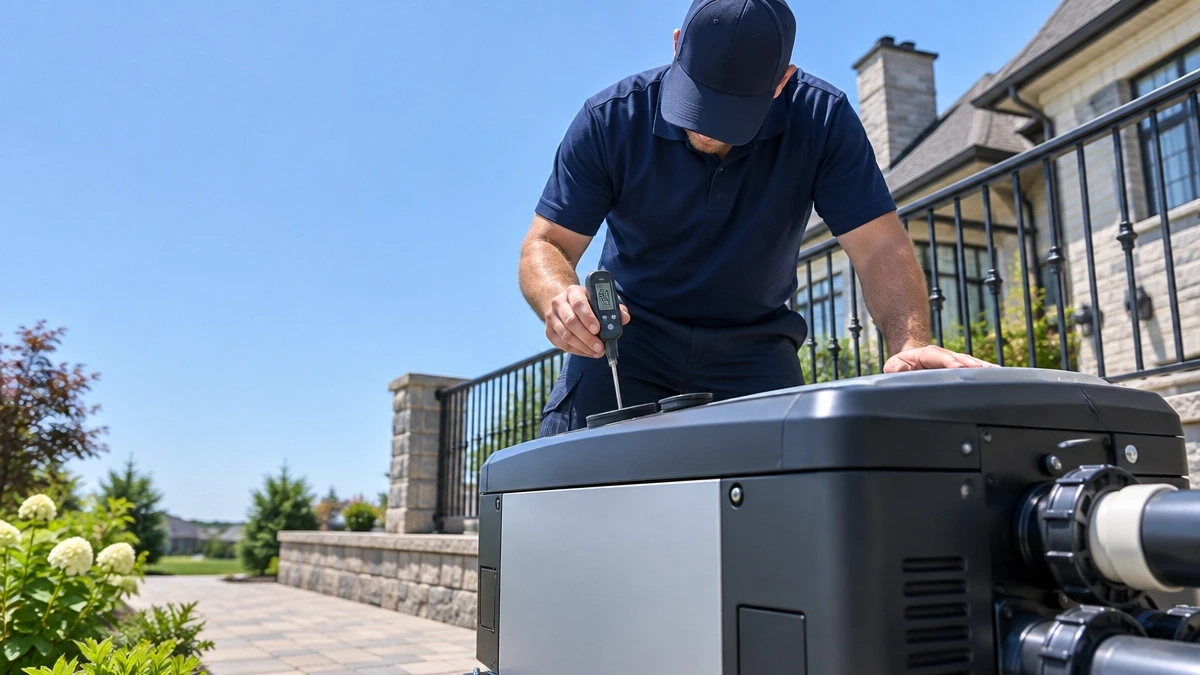
Diagnostic work at a pool heater
Beachwood is in Cuyahoga County, about 11 miles from our base, and it is as much a commercial district as a residential one — which is why the year-round duty case is written here rather than anywhere else on the site.
For the operational side of a public pool — controllers, calibration, the log, what an inspection turns on — see Beachwood pool service. For heater types generally, pool heaters. The list of towns is on service areas.
Yes, and it is close to the opposite. A seasonal heater's enemies are freezing and idleness. A year-round heater fails from use: igniters, gas valves, relays and contactors are counting operations rather than years, and the water chemistry never gets the five-month break a seasonal exchanger gets.
The air as much as the water. Chloramines form when chlorine reacts with what swimmers bring in, and chloramine-laden air is corrosive — it attacks fittings, fixings and structure in an enclosed space, and the heater and its flue live in that atmosphere too. Corrosion in places that would be unusual outdoors is normal indoors.
No. Air handling in a pool hall is a specialist trade and it is not ours. What we can do is manage the water chemistry that determines how much chloramine there is to begin with, and tell you plainly when what you have is an air problem rather than a water one.
We do not publish response times, and we would be wary of anyone who does. What actually helps a facility is planned work: a heater inspected on a schedule before the season it will be leaned on hardest is one whose tired igniter or scaling exchanger gets found while the pool is still working. A service contract is a scheduling relationship rather than a promise about speed.
We file the paperwork required by the Ohio Department of Health for the work we do. Your own regulatory obligations stay yours, including your recordkeeping and any operator certification your facility requires — we are your service contractor rather than your compliance department.
For diagnosis, particularly. A system that records what the heater did and when turns an intermittent fault into something that can actually be traced, rather than a series of reports that it was cold on Tuesday. On a busy site nobody is watching the pad, so the record is the only witness.