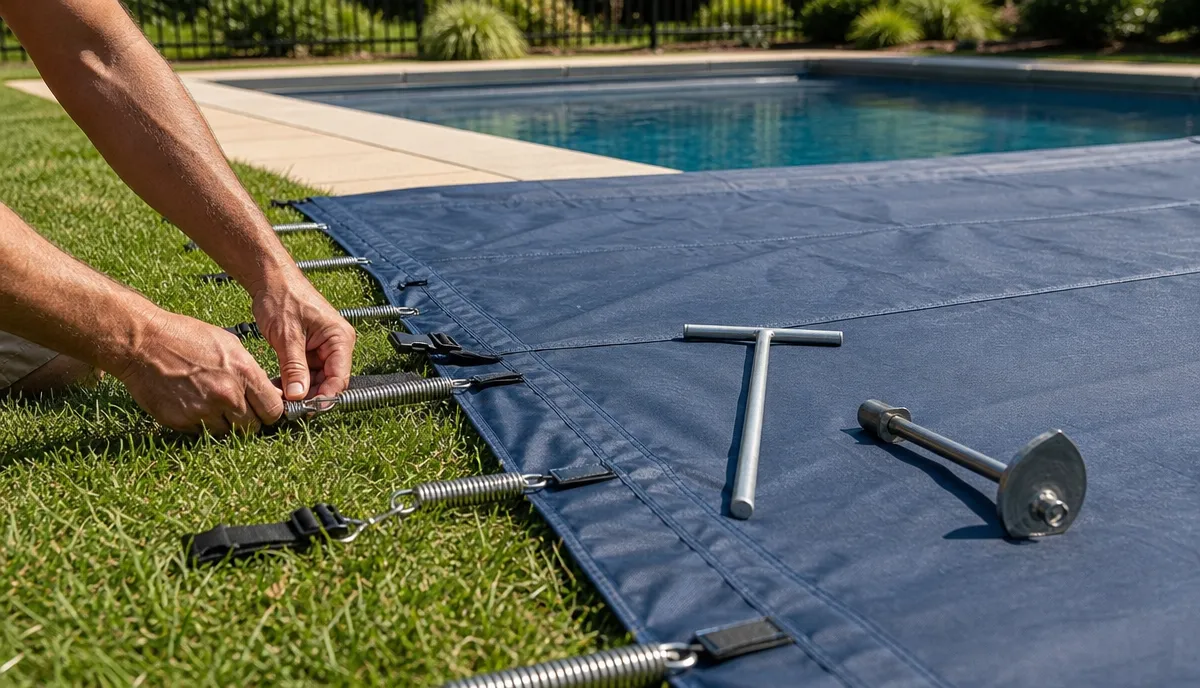

Custom in-ground pool safety covers for Gates Mills — measured on site, and specified with an eye on what salted water does to everything metal around a pool. Family-owned since 2012.
The cell, the pump, the heater — those get discussed. The cover is treated as fabric, and fabric does not corrode.
But a cover is not only fabric. It is anchored into the deck with brass hardware, connected by webbing straps under spring tension, and every one of those metal parts lives in the exact band that salted water splashes onto and evaporates from.
Which makes cover hardware a salt-pool consideration, and it is the part of the conversation nobody has until an anchor will not turn in October.
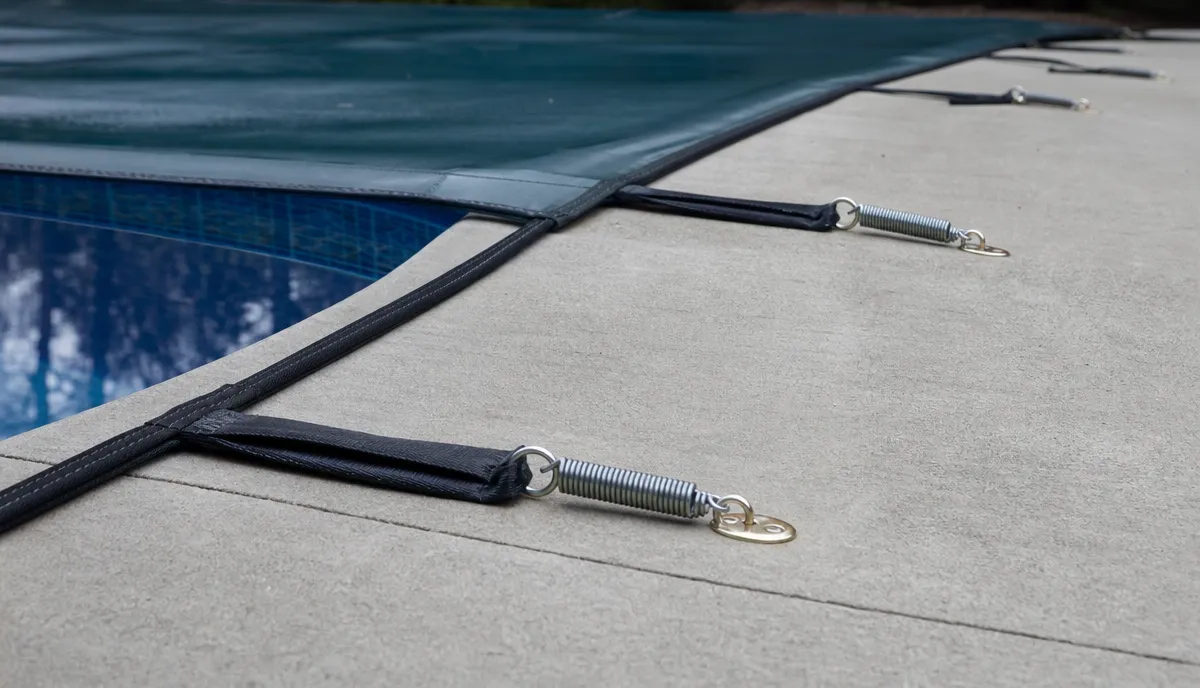
Spring-tensioned straps running from a cover to its anchors
Three consequences worth knowing:
And it does it in a way that is worse than plain water — it breaks down the protective films that metals form on their own surfaces, so corrosion carries on rather than stalling.
Splash-out lands on the deck, the water evaporates, and what stays behind is saltier than the pool was. Do that a few hundred times over a summer around the same anchor and you have a small, repeatedly-concentrated salt deposit sitting on a metal fixing.
An in-ground pool has a bonding grid — a conductor tying together the metal around the water so everything sits at the same electrical potential. It is a safety system, and it is also a corrosion one.
Where bonding is incomplete or has corroded, dissimilar metals in salted water can start behaving like a battery, and one of them corrodes preferentially to protect the other. That is galvanic corrosion, and it is why a set of fixings can degrade far faster than their material should allow.
Cover anchors are metal set into the deck at the water's edge, so they are part of that picture whether or not anyone included them in the thinking.
We look at bonding as a matter of course
On salt pools — and to be clear about scope: bonding and any electrical work is a licensed electrician's job. We will tell you what we find and we will not improvise it. See salt chlorine generators for the system side.
Rather than letting salted splash-out dry on it. Particularly around the anchor line and on stone.
While the cover is off and the weather is kind. An anchor freed in April is a five-minute job; the same one in October, with a cover waiting and cold hands, is not.
At specification. Hardware choice matters more on a salted pool than on a chlorinated one, and it is part of what a measure visit is deciding rather than a detail left to the order form.
At installation. Anchors set properly and flush, so water is not standing in a recess around a fixing all summer. See safety cover installation, and for which anchor suits which deck surface, anchors and decks in Pepper Pike.
And in the routine, which is where you come in. Two habits, both small:
A tired strap, a weak spring or a seized anchor is a repair rather than a new cover — see safety cover repair and replacement.
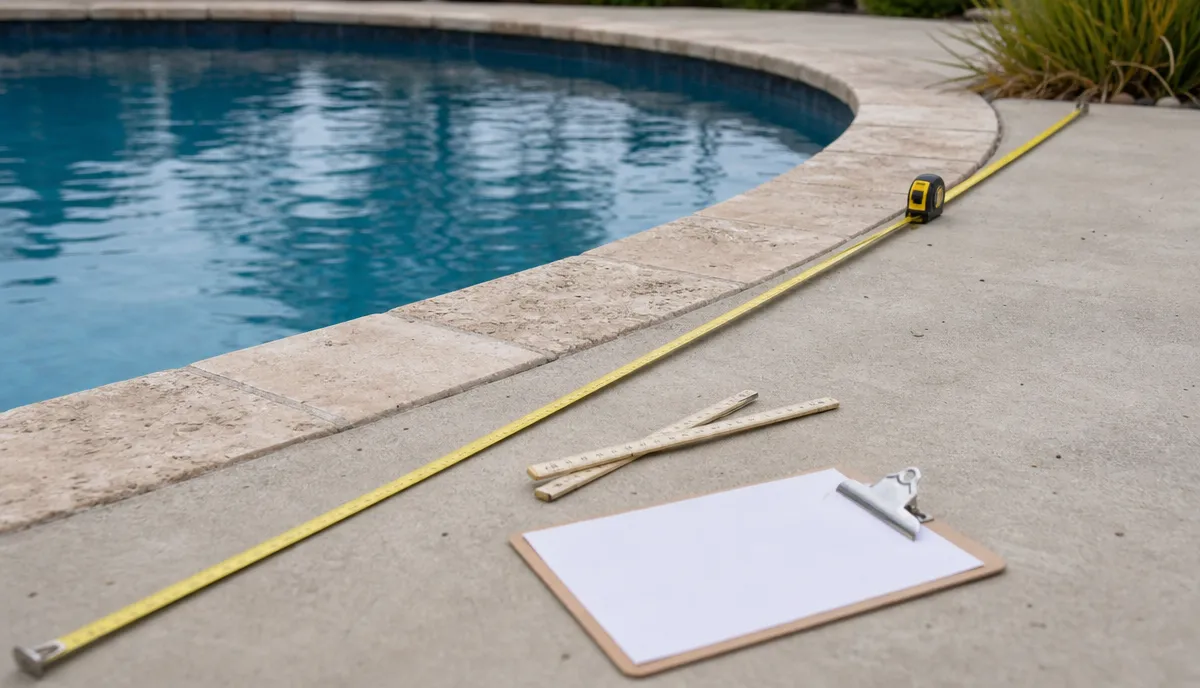
A safety cover installed to the manufacturer's instructions and fully fastened is a barrier. It is not a reason to stop watching. No cover replaces supervision of children and pets around water, and a cover that is only half on is a hazard rather than a barrier — which is one more reason hardware that works smoothly matters.
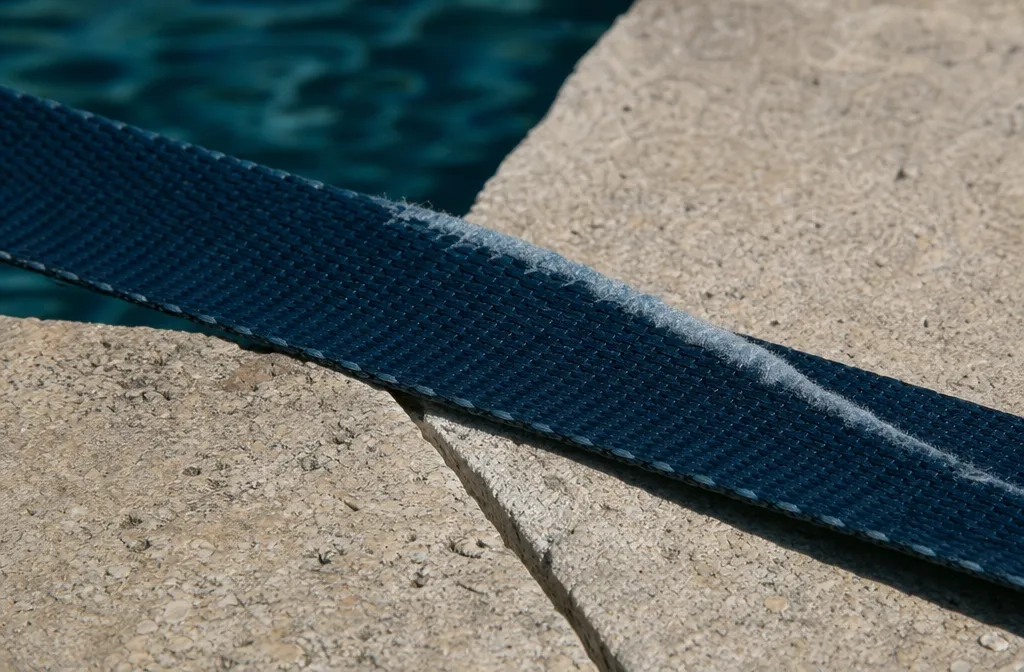
Wear on a pool cover strap where it crosses the coping
“After having different companies open and close our pools, and then having M & G Pools, I would never have anyone else! They are extremely professional, kind, efficient, and knowledgeable. They definitely go out of their way to help their customers.”
Tell us what you have and we will come and look.
Gates Mills is in Cuyahoga County, about 14 miles from our base — the furthest of our tier-1 towns, and cover work is exactly the sort of job that travels comfortably at that distance.
Everything we install is made to your pool by Merlin or GLI, measured on site. We do not sell or fit stock or standard sizes. What the measure records and how a fit runs is on our covers in Twinsburg page; the fabric decision is on the pool safety covers hub.
Cover work is quote-required. For the rest of what we do here see Gates Mills pool service, and the list of towns is on service areas.
Not the fabric, but very much the hardware. A cover is anchored with brass fixings and held by strapping under spring tension, and all of that metal lives in the band that salted water splashes onto and evaporates from. Chloride breaks down the protective films metals form on themselves, so corrosion keeps going rather than stalling.
Because a brass anchor works by a screw raising and lowering it, and corrosion products plus dried salt deposits in that thread are what stop it moving. It is the single most common salt-pool cover complaint, and it is much easier to free an anchor in warm weather than on a cold October morning with the cover waiting.
A pool's bonding grid ties the metal around the water to the same electrical potential. Where it is incomplete or corroded, dissimilar metals in salted water can behave like a battery and one corrodes to protect the other — which makes fixings degrade far faster than their material should allow. Cover anchors are metal at the water's edge, so they are part of that picture.
No — we will tell you what we found and we will not improvise it. Bonding and any electrical work on a pool is a licensed electrician's job. What we do is look at it as a matter of course on a salt pool rather than assume somebody else has.
Two small habits. Rinse the deck instead of letting salted splash-out dry on it, especially around the anchor line and on stone coping. And check each spring that the anchors still turn freely, while the cover is off and the weather is on your side.
Usually not. Straps, springs, grommets and anchors are all serviceable items — a stretched strap or a weak spring is a repair, and catching one in April is a great deal easier than discovering it in October. A cover is normally replaced because the fabric or the seams have gone, not because a piece of hardware has.