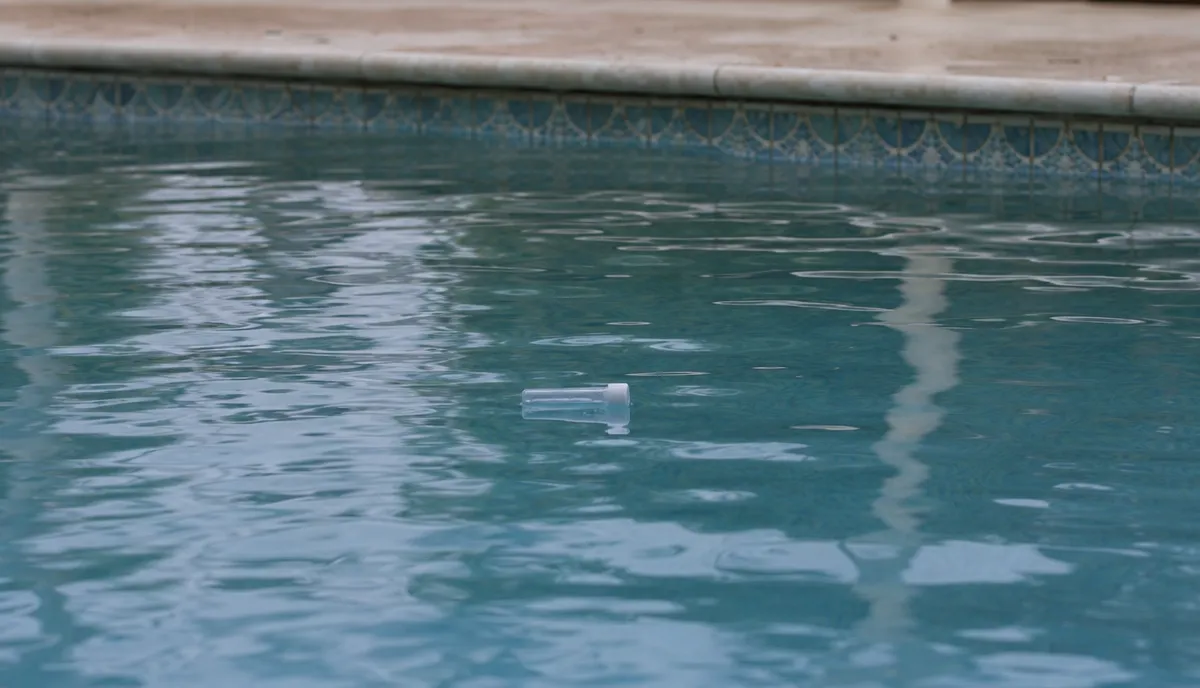

The pool is closed, the cover is on, and the temptation is to forget about it until March. Mostly you can. But a cover spends five months holding weight, shedding water and being pulled at by wind, and four things are worth a look in that time — none of which involve going anywhere near it.
1. The Cover Pump, If You Have a Solid Cover
This is the one that actually fails, and it fails quietly.
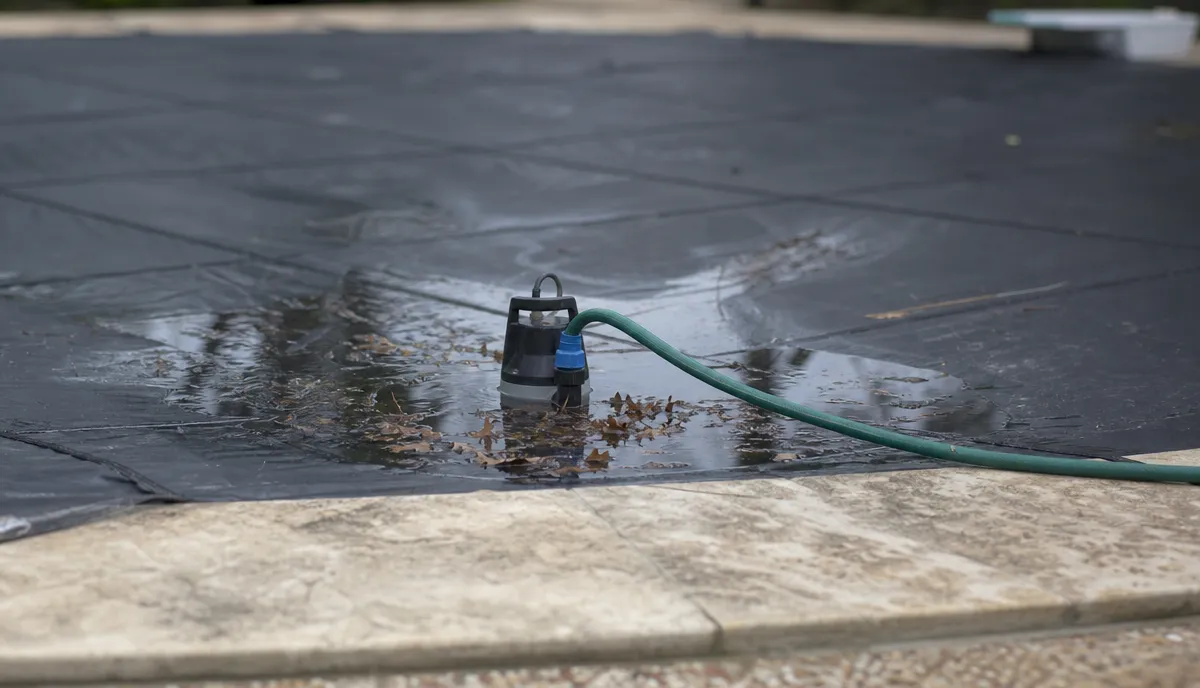
A solid cover does not pass water, so rain and snowmelt collect on top and a small submersible pump removes them. The failure mode is not the pump dying — it is the intake blocking with leaf debris, at which point the pump runs, sounds perfectly busy, and moves nothing at all.
Meanwhile water is a serious load. A layer of it across a whole pool is weight the cover and its anchors are carrying, and if wet leaves settle into it you get a heavy sludge that sits on the fabric all winter.
What to look for from the deck: standing water that is not going down after a thaw or a wet week. If the pump is running and the water level on the cover is not falling, the intake is the first suspect.
A mesh cover has none of this — water drains straight through into the pool, so there is nothing standing and no pump to look after. That trade-off is set out on mesh vs solid safety covers, and the full routine is on the cover-pump routine.
2. Standing Water Under Snow
The heaviest combination available, and it comes from the first problem going unnoticed.
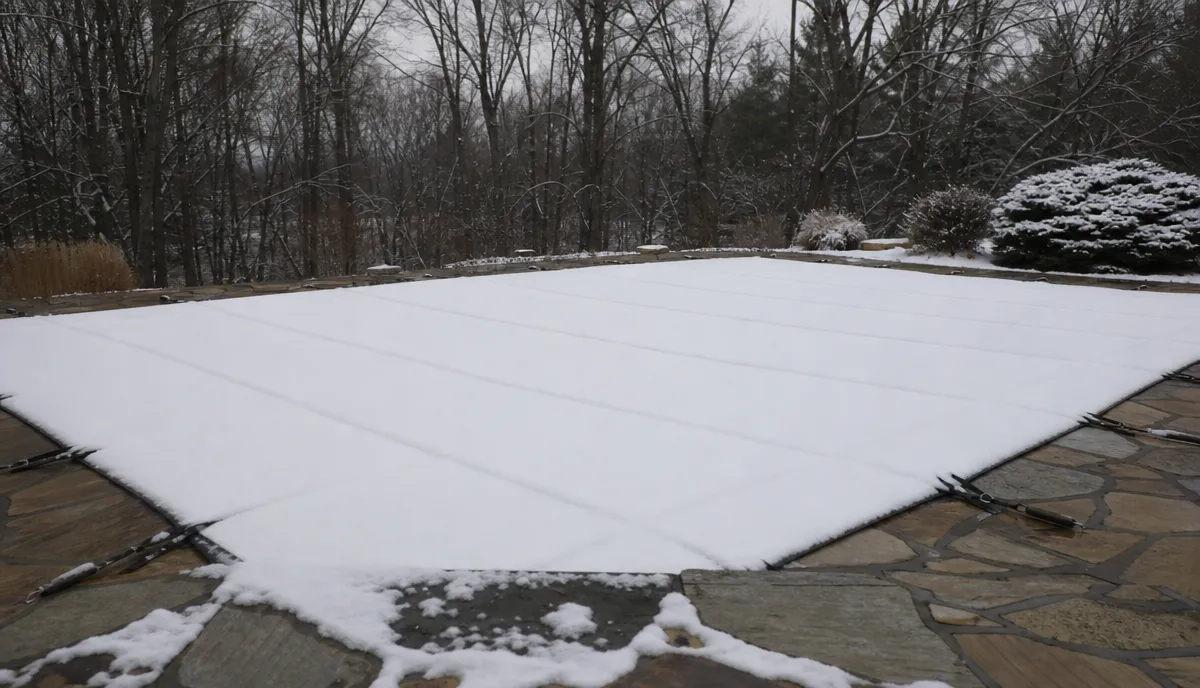
Snow on its own is manageable — it pushes down, and the water underneath the cover carries most of the load while the straps and anchors hold the perimeter. That is why a safety cover is a flexible membrane rather than a rigid lid, and it is set out on snow and ice load.
Snow on top of standing water is a different proposition. If you can see both, that is worth a call rather than a wait.
3. Whether the Cover Has Gone Slack
Look along the edges after the first hard blow of the season.
A taut cover has nothing for the wind to get hold of. A slack one bellies and flaps, and every flap is a small snatch load on every strap and anchor at once — which is fatigue rather than a single failure, and it is why wind damage shows up as several tired components rather than one broken one.
Tension is set at the fit, so a cover that went on properly should not need adjusting. One that has visibly loosened is telling you something.
4. After a Thaw, Not Just After a Freeze
The counter-intuitive one, and it matters more the closer you are to the lake.
A hard continuous freeze is oddly gentle — everything locks up and nothing moves against anything else until spring. A winter that hovers around freezing does the opposite, crossing that line repeatedly, and every crossing moves ice, water and fabric against each other.
Across the towns we serve that gradient is real: Bratenahl sits about 0.6 miles from Lake Erie and Stow about 27.5. The lakefront winter is milder and cycles more, and cycling works at the fixing points — grommets, straps and springs — more than a straightforward deep freeze does. See freeze-thaw cycling.
So the useful habit is to glance at the cover after a thaw rather than only after a snowfall.
The One Thing Not To Do
Do not go out onto the cover. For any reason.
Not to reposition a pump, not to sweep snow, not to break ice, not carefully. A safety cover is a barrier designed to stop a person going into a pool — it is not a floor, and a cover carrying snow, water or ice is the least predictable version of itself, with the edges hidden.
Breaking ice on a cover is also the fastest way to put a tool through the fabric.
If something needs doing out there, that is a job with two people and the right kit. Call us.
And in the Spring
The cover comes off first, and the ten minutes after that decide how long it lasts. Off, cleaned, dried, and stored dry and loosely rather than crammed damp into a bin.
It is also the only time in the year you can actually see the whole thing — spread out, dry, in daylight. Almost every cover fault that causes trouble in October was already visible the previous April: a stretched strap, a spring that has lost its tension, a grommet starting to pull, a seam beginning to separate. All of those are repairable, and all of them are cheaper to find in April than to discover in October. See the spring inspection and safety cover repair and replacement.
One Thing Worth Repeating
A safety cover installed to the manufacturer's instructions and fully fastened is a barrier. It is not a reason to stop watching. No cover replaces supervision of children and pets around water, and a cover that is only half on is a hazard rather than a barrier — which is one more reason a strap that has come off is a call rather than a job for a cold afternoon.
We install custom safety covers only, made to your pool by Merlin and GLI. See pool safety covers.