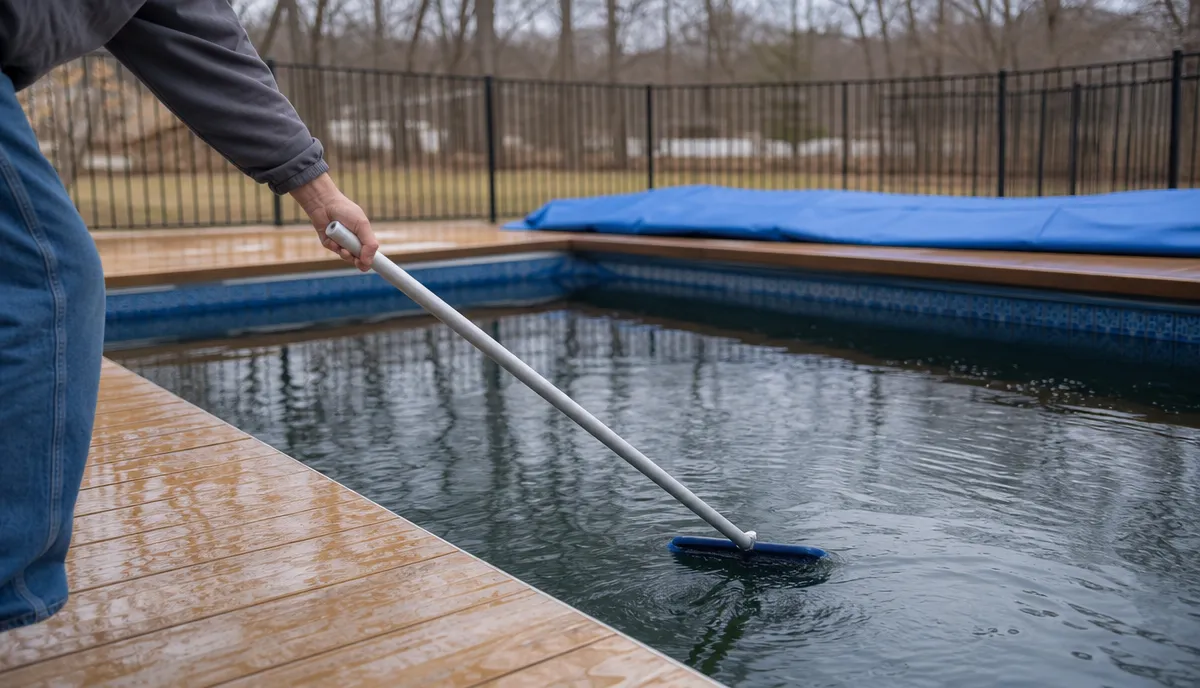

Custom in-ground pool safety covers for Aurora — measured on site, and inspected properly at the one time of year you can actually see the whole thing. Family-owned since 2012.
For five months it is stretched over water under snow. For the other seven it is folded up in a store. There is one moment when it is spread out, dry, in daylight and completely visible — and that is the morning it comes off.
Which makes that morning worth ten minutes. Almost every cover fault we deal with in October was already visible in April, and a fault found in April is a repair with a whole summer to arrange it in. The same fault in October is a problem with a closing date attached.
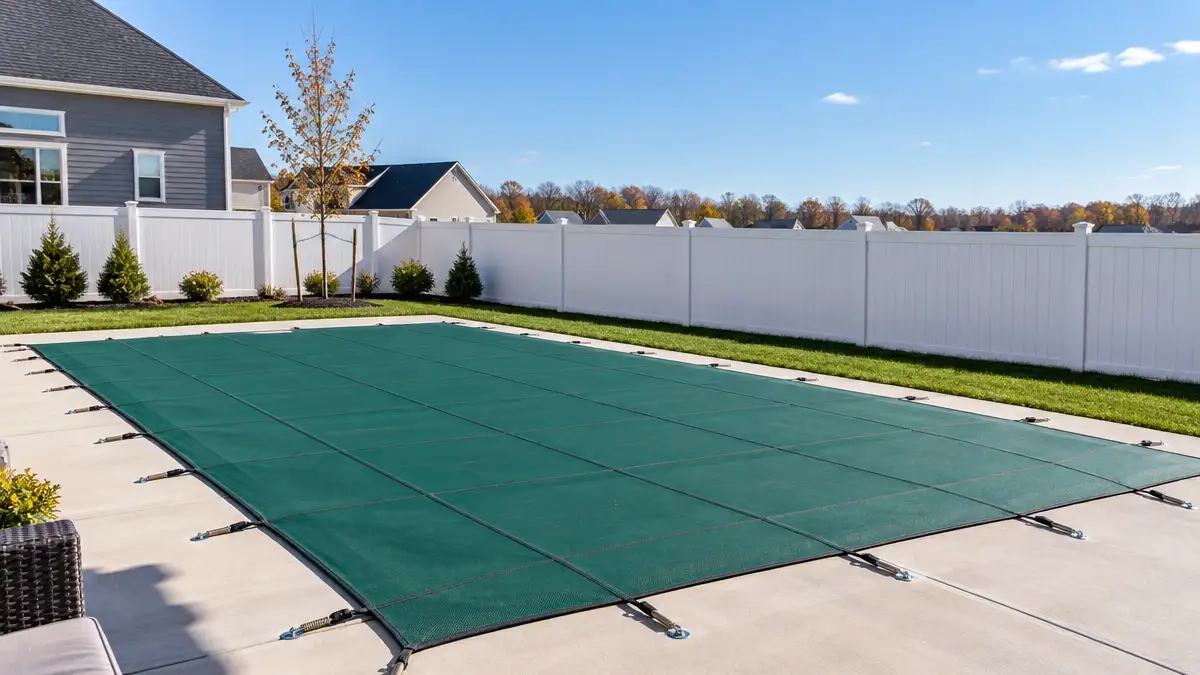
A safety cover anchored and tensioned around a pool perimeter
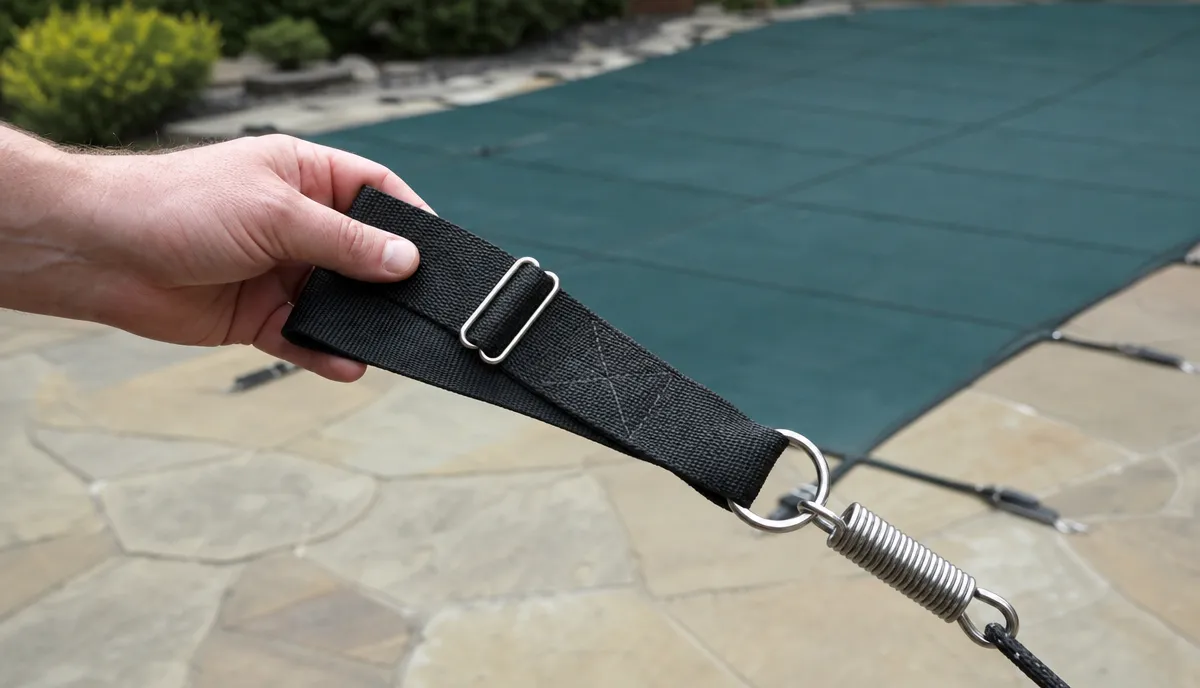
Look for stretch and for fraying at the ends. The webbing carries the whole load, and a strap that has stretched cannot be tensioned properly however far you wind the anchor — so it stops sharing the load and passes it to its neighbours.
Fraying starts where the strap meets its hardware, because that is where it flexes.
Each strap is spring-loaded so the cover can flex under snow and ice without tearing. A spring that has lost its tension, gone rusty or become distorted is no longer doing that — and the load goes straight into the fabric instead.
Compare them to each other. A spring that looks different from the others is telling you something.
Where the strap meets the cover. These are high-stress points, and a grommet that is pulling out leaves a hole in the fabric at precisely the wrong place.
Corners get the worst of it, so start there.
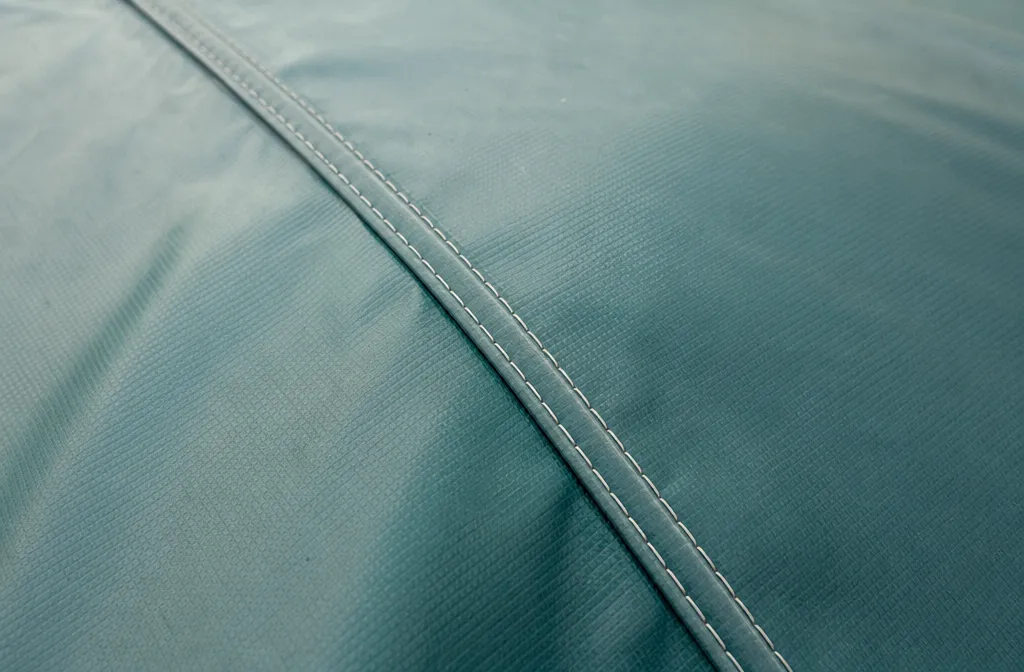
A cover is welded from panels. A seam that has begun to separate is repairable while it is a few inches, and is a replacement once it has run.
Look for thin patches, small tears, and abrasion where the cover has been rubbing on coping or a step. Abrasion is a location problem — it means something is catching, and that will carry on next winter unless it is dealt with.
Each one should turn freely and its cap should seat. A seized anchor is much easier to free in April than on a cold morning in October with a cover waiting.
And they should be flush. One that has worked its way up is both a trip hazard and a sign of movement.
Straps, springs, grommets, D-rings, anchors and short seam separations are all repairable. That is the point of doing this in spring — see safety cover repair and replacement. Repairs are quoted.
A cover is normally replaced because the fabric or the seams have gone, not because a piece of hardware has, and knowing which situation you are in seven months before the cover is needed is worth a great deal.
We do this as part of an opening. The cover comes off, gets cleaned and dried, gets looked over properly, and goes away — and anything we find goes on the sheet rather than into the store with it. Openings start from $495 plus chemicals; see pool opening service.
One thing not to do: go out onto the cover
Not to inspect it, not to sweep it. A safety cover is a barrier designed to stop a person going into the pool; it is not a floor. Inspect it once it is off.
A safety cover installed to the manufacturer's instructions and fully fastened is a barrier. It is not a reason to stop watching. No cover replaces supervision of children and pets around water, and a cover that is only half on is a hazard rather than a barrier — which is one more reason a stretched strap or a weak spring is worth catching.
A strap spring detail
Aurora is in Portage County — the only city in our service area that is — about 5 miles from our base, which makes it one of the closest towns we serve.
Everything we install is made to your pool by Merlin or GLI, measured on site. We do not sell or fit stock or standard sizes. What the measure records and how a fit runs is on our covers in Twinsburg page; anchors and deck types are on safety cover installation; the fabric decision is on the pool safety covers hub.
Cover work is quote-required. For the rest of what we do here see Aurora pool service; the list of towns is on service areas.
“Matt and his team are fantastic to work with. Easy to schedule, quality work is done right the first time. Highly recommend.”
We are about five miles away.
The morning it comes off. It is the only time in the year the cover is spread out, dry and fully visible — for five months it is stretched over water under snow, and for the rest it is folded in a store. Almost every cover fault that causes trouble in October was already visible the previous April.
Six things. Straps, for stretch and fraying where they meet the hardware. Springs, for lost tension or rust — compare them against each other. Grommets and D-rings, starting at the corners, for anything pulling out. Seams, for separation. The fabric, for thin patches and abrasion. And the anchors, for whether they still turn freely and sit flush.
Because a strap that has stretched cannot be properly tensioned however far you wind the anchor down — so it stops carrying its share of the load and passes it to the straps either side. That is how one tired component turns into several.
While it is short, generally yes. Once it has run, it is a replacement. That difference is exactly why a spring look is worth the ten minutes — the same fault caught at two different times of year gives you two completely different answers.
No. A safety cover is a barrier designed to stop a person going into the pool, not a floor to stand on — and with water or snow on it, it behaves less predictably rather than more. Inspect it once it is off the pool.
Straps, springs, grommets, D-rings, anchors and short seam separations are all repairable, and finding them in April means the whole summer to arrange it rather than a scramble in October. Covers are usually replaced because the fabric or the seams have gone, not because hardware has.