

Start with one test, because it sorts the cheap problems from the expensive ones in about a minute.
Does the noise change when the water changes? Top the pool up a few inches, or open a valve that was part-closed, or take the leaves out of the skimmer basket. If the sound alters — quietens, worsens, comes and goes — the problem is on the suction side, and suction-side problems are usually free or nearly free.
If the sound is exactly the same whatever the water is doing, it is on the motor side, and motor-side problems are parts.
That is the whole diagnostic in one sentence, and almost nobody applies it, which is why the cheap faults get ignored for months and the expensive ones get hoped away.
The Suction-Side Noises
Gravel in a tin can
The classic, and the one worth acting on today. A rattling, crackling, gravelly sound from the pump, usually loudest at the pot.
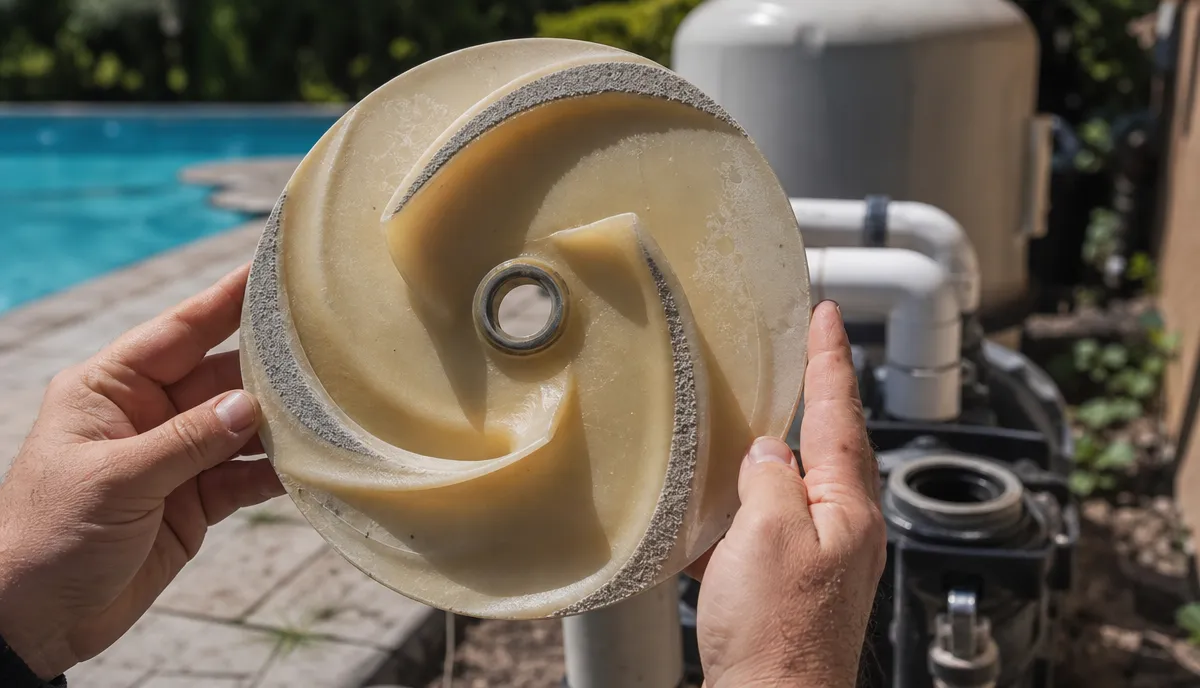
That is cavitation. The pump is trying to move more water than the suction side is delivering, so the pressure at the impeller drops far enough for the water to flash into vapour. Those bubbles then collapse against the impeller face — thousands of times a second.
Which is why cavitation is not really a noise problem. Every collapse takes a little material off the impeller and the volute. A pump that has been "a bit noisy since May" is a pump that has been eroding since May, and the noise is the erosion happening.
What starves a pump, in the order we find it: the water level down below the skimmer mouth so it is pulling air, a full skimmer or pump basket, a part-closed or wrongly set valve, a leaking pot lid o-ring, a blocked skimmer weir, and — the one that catches people with a newer pump — a variable-speed pump set too high for the plumbing it is on. More on that at variable-speed pool pumps.
All of those are yours to check, and most cost nothing.
A sucking or slurping that comes and goes
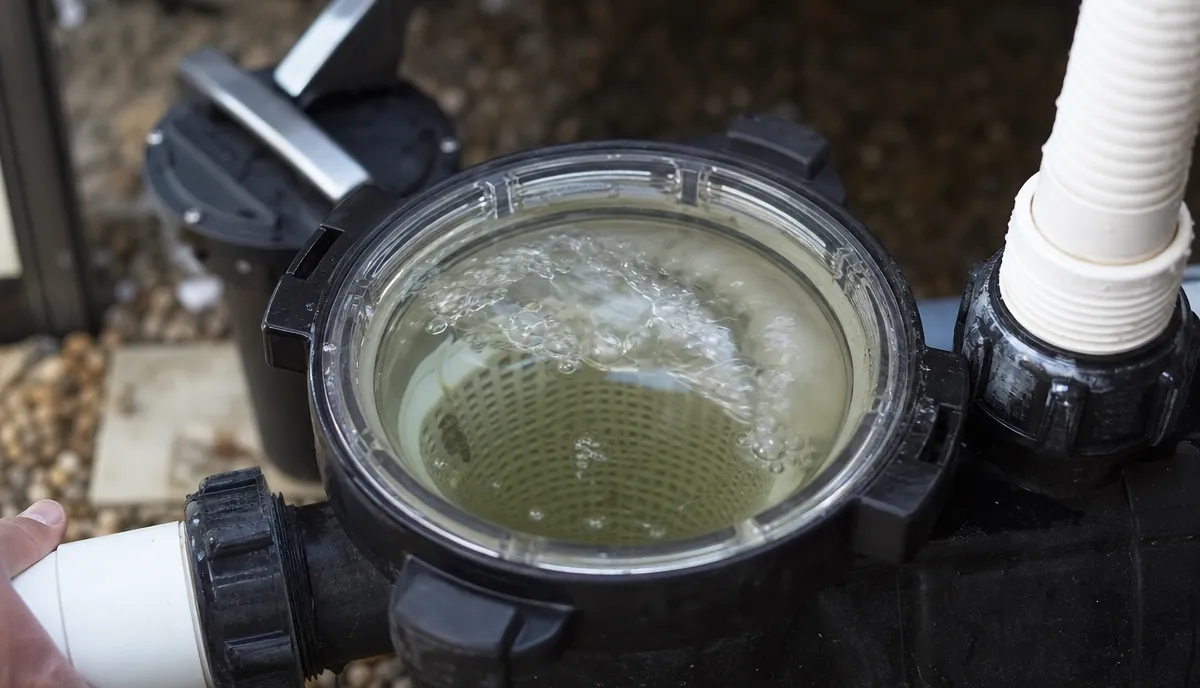
Air, and it is usually the water level. A pool an inch or two low takes air down the skimmer in gulps as the surface moves, and you hear it as a rhythmic slurp with bubbles arriving in the pump pot.
Look at the pot while it runs. Water with a few bubbles is normal. Water with a churning air pocket at the top is a pump about to lose its prime — and a pump that loses prime and keeps running is a pump running dry, which is the start of the expensive chain.
A thin whistle at the pot lid
A lid o-ring that has dried out and gone hard, or a lid not seated squarely. Cheap, quick, and worth fixing because that whistle is air getting in.
The Motor-Side Noises
These do not change when the water changes, and they are not ones to wait out.
A constant high screech or a metallic whine
Bearings. The motor's bearings have lost their grease or their surfaces, and the sound is metal running on metal at speed.
Why it matters more than it sounds: on most pumps, bearings do not fail for their own reasons. They fail because the shaft seal started weeping first and pool water ran down the shaft into the bearing, displaced the grease and corroded the race. So a screeching bearing is usually the second fault, and the first one is still there. That chain is set out on the seal-to-bearing chain.
Which is the reason a screech is worth a look rather than a replacement part. Fitting a motor onto a pump that is still letting water at the seal buys you the same failure again.
A hum that will not start
The motor is getting power and not turning. It hums, it may get hot, and the thermal cut-out will eventually take it offline.
Commonly the start capacitor, which is a part rather than a pump. Sometimes it is the impeller jammed by debris, and occasionally it is the motor.
Two things to do and one not to. Switch it off at the breaker rather than leaving it humming — a stalled motor cooks itself. Then get it looked at. What we will not do is anything at the breaker panel or on the supply wiring: we do not do electrical supply work, and that is a licensed electrician's job.
Grinding, or a regular tick
Something is touching that should not be. Debris that has got past a broken basket and into the impeller, an impeller with a chunk missing so it is out of balance, or a fan cover that has cracked and is catching.
A tick that speeds up and slows down with the motor is mechanical. It is not going to settle down.
A low growl that is just loud
Sometimes this is only the mounting. A pump on a pad that has settled, or with a missing bolt or a perished rubber foot, transmits everything it does into the concrete and gets a great deal louder for no mechanical reason at all.
Worth ruling out before anything else, because it is the one loud pump that is genuinely fine.
What The Noise Cannot Tell You
Being honest about the limits of listening.
A quiet pump is not necessarily a well pump. A weeping shaft seal is silent — you find it by the rust stain and the drip under the motor end, not by ear. That is exactly why it is usually already weeping in September and screeching in July.
And a noisy pump is not always the pump. A loaded filter changes the whole system's flow, so a filter that has not been backwashed or cleaned can present as a pump complaint. See pool filter repair.
What To Do Now
1. Run the water test. Change something about the water and listen. Suction side or motor side.
2. If it is suction side, work through the free list — level, baskets, valves, lid o-ring — in that order.
3. If it is motor side, or the noise did not change, switch it off rather than running it while you decide. Every hour a cavitating or dry-running pump runs is an hour of wear.
4. Get it diagnosed. A $150 service call covers up to the first hour on site, with parts and any further labour quoted before we do them. See pool equipment repair and pool pump repair.
What each fault actually costs, once it has a name, is set out on what each fault costs.
The Version Where You Never Hear Any Of This
Every noise above starts small and silent. A seal weeps before it screeches. A basket fills before it cavitates. An o-ring hardens before it whistles.
A chemical and equipment check is from $72 per visit plus chemicals, and the equipment half of that is somebody putting a hand on the pump and reading the filter pressure every week — which is how a seal gets found in September rather than a motor in July.
