
Nearly every conversation about heater sizing starts with the wrong number.
Somebody asks how many gallons the pool holds. It is the obvious question and it is not the one that decides the answer, because heat does not leave a pool through its volume. It leaves through the surface.
Which means two pools holding exactly the same water can be different heating problems — and the wide shallow one is the harder of the two, every time.
Why Surface Area Is The Starting Point
A pool loses heat in three ways and two of them happen at the top.
Evaporation is the largest single loss, and it is entirely a surface event: water leaving as vapour takes its heat with it. Wind across that surface accelerates it, which is why an exposed pool behaves worse than a sheltered one of the same size.
Radiation and convection to the air are also surface events. A cool, clear night pulls heat off the top of a pool with nothing over it.
Conduction into the surrounding ground is the third, and it is the smallest of the three on most in-ground pools.
So the quantity that actually sets the load is the area of water open to the sky. Volume matters for how long the first heat-up takes; area matters for how much output it takes to hold a temperature once you are there — and holding is what a heater does for most of the season.
The Inputs, In Rough Order Of Weight
We are not going to print a BTU figure on a web page, and here is why: a number that has not seen your pool is worse than no number, because people then use it to compare quotes that were not answering the same question. What is useful is knowing which inputs move the answer, and by roughly how much.
1. Surface area. As above. The first and largest input.
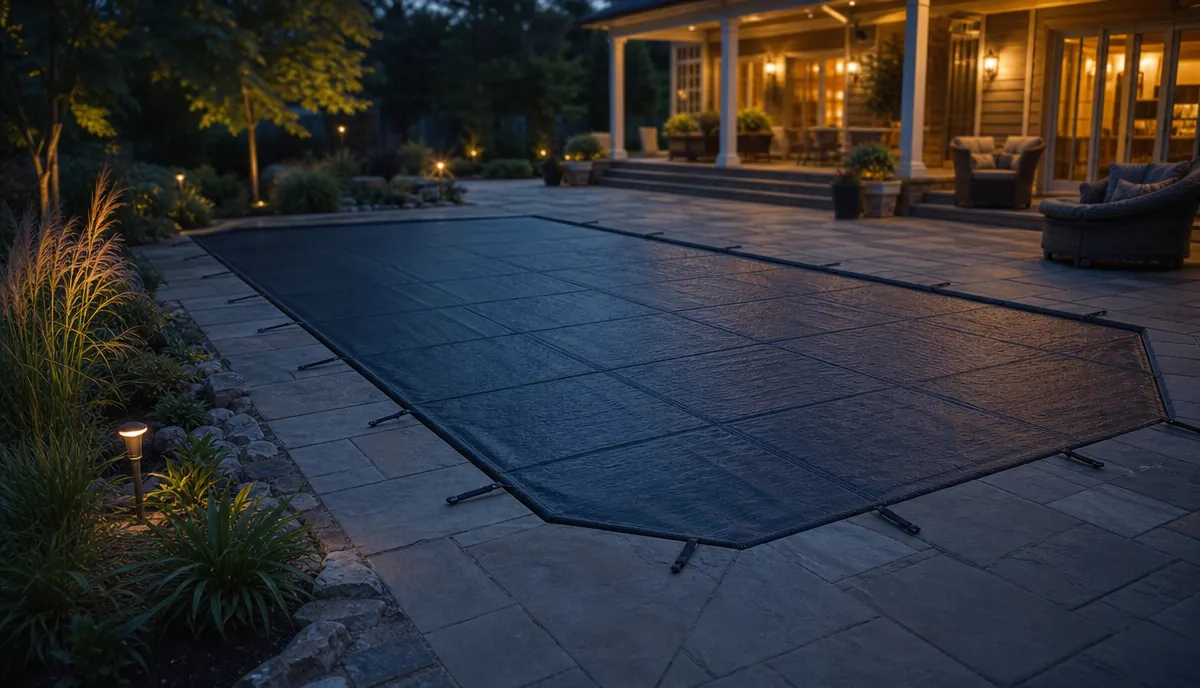
2. Whether the pool is covered when it is not in use. This is the one that surprises people. A cover over the water suppresses evaporation, which is the largest loss, and it does so overnight — which is when the pool is losing heat and nobody is enjoying it. It is the single biggest lever an owner controls, and it changes the sizing conversation rather than just the running one. See pool safety covers.
3. The temperature you actually want to hold, and for how long a season. A pool held comfortably from late May to early September is a different specification from one held warm into October.
4. Wind exposure and shelter. An open, elevated garden and a sheltered courtyard are different climates on the same street. This is a site observation, which is why it is made on site.
5. Whether you want fast recovery or steady holding. A pool that sits at temperature all season and a pool heated up for weekends are different duty cycles, and they favour different answers on the gas-versus-heat-pump question — which is on pool heaters.
6. Volume. Last, and it matters mainly for the first heat-up of the season — the one that follows the opening, once the system has been purged of air and the water balanced — and for recovery after a cool spell.
The Two Ways Sizing Goes Wrong, And What Each Feels Like
They fail differently, and neither failure looks like a sizing error from the outside.
Undersized: it never quite gets there when you want it
An undersized heater is fine in July and disappointing in the shoulders. It holds temperature on a warm still week and then falls behind on exactly the days you wanted it — a cool windy evening in late May, a run of cold nights in September.
The tell is that it runs almost continuously and still loses ground overnight. People diagnose that as a fault and it is a specification.
And it is the one you buy twice. The unit is not repairable into being bigger.
Oversized: the problem moves to the supply and the cycling
An oversized heater does not simply cost more up front. Two things follow it.
First, the supply question gets harder. A pool heater is usually the largest gas appliance on a domestic property, and going up in output can exceed what the existing gas line carries. We do not run or alter gas lines — that is a licensed gas fitter's work — and we do not do the electrical supply work either, which is the equivalent question on a heat pump. We will establish what the unit needs, read the supply pressure at the appliance, document what we found and hand that part over. Why that argues for settling it in winter is on the supply question.
Second, a badly oversized unit short-cycles — reaching its set point quickly, dropping out, and firing again. Cycling is harder on ignition components and controls than steady running is.
"Bigger to be safe" is therefore not automatically safe. It moves the risk from performance to supply and wear.
The Sizing Conversation That Is Actually Useful
Four things get established, and none of them needs the pool open.
Measure the water surface, properly, including the shallow shelf and any attached water feature that shares the same system.
And one boundary while we are on measurement: we do not service hot tubs or spas. If there is a separate spa in the garden, it is outside what we quote and outside what we size — the figure we work to is the pool's own surface.
Establish the target and the season. What temperature, from when to when.
Read the supply at the appliance rather than assuming from the meter or the panel. This is the step most often skipped, and it is the step that decides whether a second trade is involved.
Look at the pad and the access. A like-for-like swap on an existing pad is the simplest version; a different footprint means re-plumbing. Access matters too, because a heater is a bulky item and a gate narrower than the unit is a conversation before it is a quote. See pool heater installation.
Heater supply and installation are quote-required, because the unit depends on your pool and the installation depends on what is already there. The four separate costs — the unit, the installation, the supply upgrade and the running — are set out on the four costs.
One Thing Sizing Will Not Fix
A correctly sized heater on a scaled exchanger still underperforms.
Calcium comes out of solution on the hottest surface in the system, scale insulates, and the heater burns the same gas to move less heat into the water. The symptom is a heater that takes longer than it used to — which reads as undersized and is not. Where the unit is otherwise sound, the water side can be de-limed rather than replaced. See what kills an exchanger.
And one point of timing worth knowing: a unit that was drained and winterized at the close is already in the state a removal wants, which is part of why the swap is easier settled over the winter than in the second week of May.
So before anyone sizes a replacement, the existing unit gets diagnosed. A $150 service call covers up to the first hour on site, with parts and any further labour quoted first — and it is the honest first step rather than a quote for a new heater.
See pool heater replacement for what a swap involves.