

Two things before the list, because both are usually assumed the wrong way round.
We do not clean pools. No vacuuming, no brushing, no skimming — not on a weekly visit and not as an add-on. Our work is water chemistry, baskets, filtration and equipment. Most of our service customers run a robotic cleaner for the surfaces, and that combination is deliberate rather than a gap.
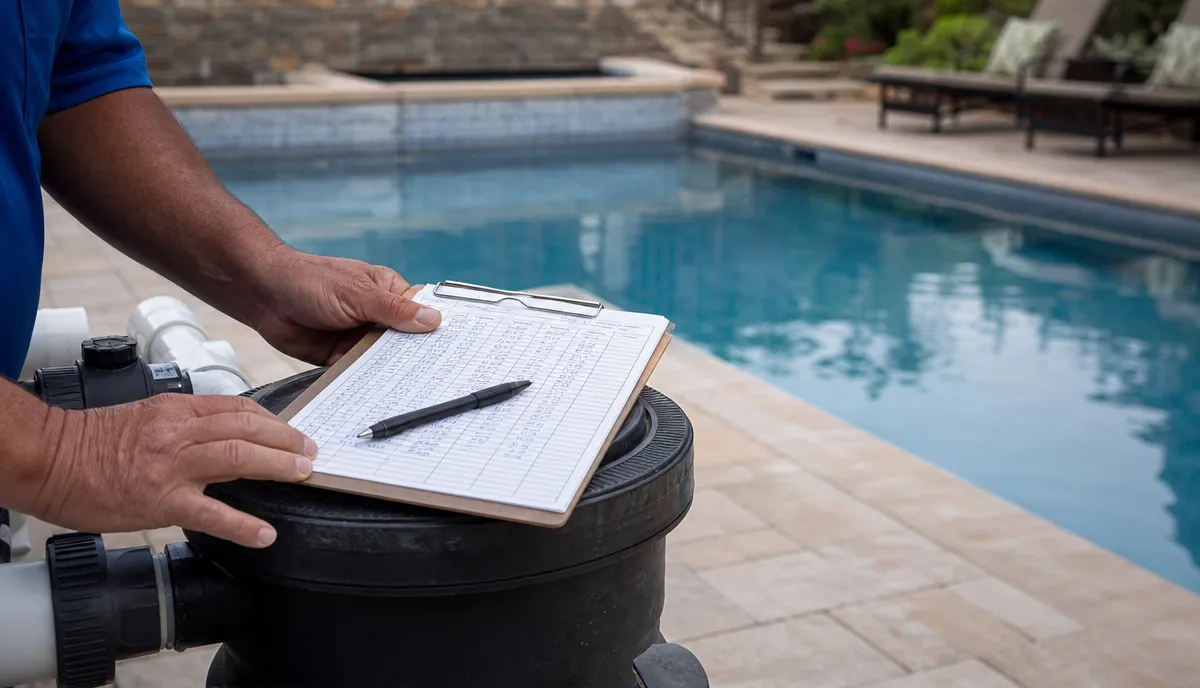
And the sheet is the deliverable, not the visit. Every visit leaves a written record of what was measured and what was done. That sounds like admin. It is the most valuable part of the arrangement, and the rest of this post is largely about why.
The Water Lines, And What Each One Is Actually For
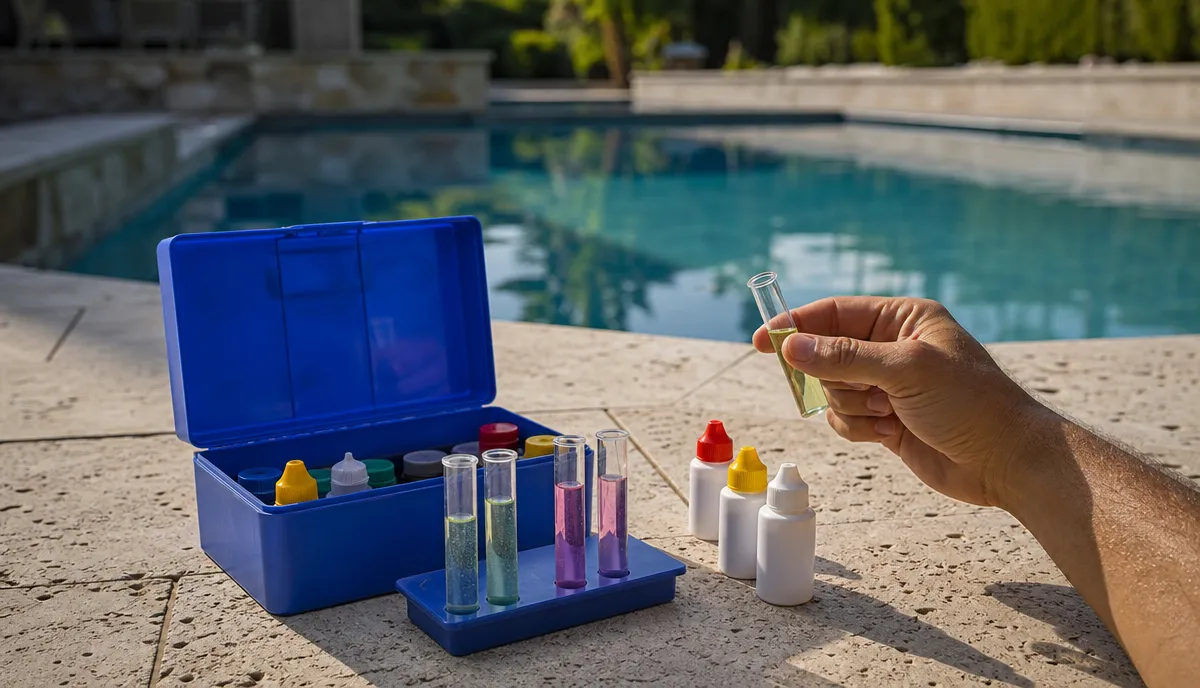
A full panel gets measured, by titration rather than by strip — a drop test resolves a number, a strip gives you a colour and an impression. Six readings, and each is answering a different question.
Free chlorine — how much sanitiser is available right now
The one everybody knows, and the one that means least on its own. A reading taken on a cool Tuesday morning and a reading taken after a hot weekend with eight people in the pool are not comparable numbers, which is why the trend matters more than the value.
Combined chlorine — whether the sanitiser is being overwhelmed
This is the line that tells you what the pool has been through. It is the difference between chlorine that is available and chlorine that has already reacted and is now doing nothing useful. When it starts appearing, the pool has had more load than its sanitiser could keep up with, and the answer is to shock rather than to add a little more.
It is also the line most home test kits do not read, which is why "my chlorine is fine but the water smells of chlorine" is such a common and such a misleading pair of observations.
pH — what everything else depends on
Sanitiser effectiveness, swimmer comfort and how aggressive the water is toward your equipment all move with pH. Out of range in one direction and the chlorine is much less effective than the reading suggests; out of range in the other and the water is working on the pump seals, the heater and anything metal.
Total alkalinity — how hard pH is to move
Alkalinity is the buffer. Get it right and pH stays where it is put. Get it wrong and pH swings around after every rain, every shock and every hot week, and you spend the season chasing it.
This is the reason a technician corrects alkalinity before pH and not the other way round. Sequence is most of the skill in this part of the job.
Calcium hardness — mostly about your equipment
On a vinyl-liner pool this is not about the shell. It is about what happens at the hottest surface in the system: calcium comes out of solution on the heat exchanger, scale insulates, and the heater then burns the same gas to move less heat into the water. Low hardness has its own problems on the metal side.
Stabiliser — why chlorine sometimes "stops working"
Stabiliser protects chlorine from the sun, and it accumulates because it does not leave the water the way chlorine does. Too little and a July afternoon burns the sanitiser off; too much and the chlorine that is there is held so tightly that it acts weaker than it reads.
A pool that needs more and more chlorine each week to hold the same reading is usually telling you about stabiliser, not about chlorine — and that is a trend, visible across sheets, not in a single test.
The Equipment Lines
The half of the visit that is somebody putting hands on the pad.
Baskets — skimmer and pump. Emptied and inspected, and the inspection matters as much as the emptying: a cracked pump basket lets debris through to the impeller, which is how a free job becomes a part.
Filter pressure, read and written down. The number on its own means nothing. The number against the same filter's clean pressure means everything — that difference is what says whether a cartridge needs cleaning or a sand bed needs to be backwashed, and it is the only reliable way to know. Filter media specifics are on pool filter repair.
The pump, by hand and by ear. Prime, the state of the water in the pot, whether it is holding it, any stain or drip under the motor end, and any noise that was not there last week. What each noise means is on what a noise means.
The heater, if there is one. That it fires, that it holds, and that it is not getting slower — because a heater that takes longer than it used to is usually scaling rather than failing.
The salt cell, if there is one. Output, and the state of the plates. See salt chlorine generators.
Water level. Low is not cosmetic. A pool below the skimmer mouth is a pump pulling air, and a pump pulling air is a pump on the way to running dry.
Why A Run Of Sheets Beats Any Single Visit
This is the part that is genuinely hard to see from the outside.
One reading is a snapshot. Six readings are a direction. And almost everything that costs real money on a pool announces itself as a direction first.
Three examples of the same thing:
Filter pressure that is a little higher each week and never quite comes back after a backwash is a sand bed that is channelling or a cartridge at the end of its life. Caught as a trend, it is a media change. Ignored, it is a whole system running on restricted flow all summer, which loads the pump.
A chlorine demand that keeps climbing is stabiliser accumulating, or a bather load the pool is not set up for, or something growing that has not yet gone visible. All three are cheaper on week three than week ten.
A pump that needs a moment longer to prime each visit is air getting in somewhere — a lid o-ring, a fitting, a level. On its own, unremarkable. Written down four weeks running, it is a specific and findable fault.
None of those is visible in a single visit, however carefully it is done. That is the honest argument for regularity over intensity, and it is also why we hand over the sheet rather than just the result.
What A Weekly Visit Does Not Do
Said plainly, because this is where assumptions live.
It is not a clean, as above. Surfaces are the robot's job or yours.
It is not leak detection. We do not offer it — if the evidence points at a buried line, that is a specialist service and not one of ours.
It is not a repair visit. If a check finds a failing part, that is a quote and a separate booking rather than something absorbed into the weekly rate. A $150 service call covers up to the first hour where something needs diagnosing rather than checking, with parts and further labour quoted first. See pool equipment repair.
And it does not do anything about the supply side. No gas line work and no electrical supply work — those are licensed trades and we hand that part over.
If Weekly Is More Than You Need
Not every pool needs a weekly visit, and saying so costs us nothing worth having.
A chemical and equipment check is from $72 per visit plus chemicals, which is the same panel, the same equipment pass and the same written sheet, taken at whatever interval actually suits the pool — weekly through the hot weeks, fortnightly in the shoulders, for some pools less than that.
The pools that need the most attention are the ones with the highest bather load and the ones with the most equipment on the pad. A quiet pool with a robot and a variable-speed pump is a different proposition from a busy family pool with a heater, a salt cell and automation.
See weekly pool service for what a visit includes and how it is priced, and pool maintenance for the range.
