
February is the only month that answers this question honestly.
In October both kinds look fine. They are on the pool, they are keeping leaves out, and the difference between them is a paragraph in a brochure. By the first week of February the cover has spent three months holding snow, shedding meltwater and being pulled at by wind — and whatever it actually is has shown itself.
So rather than compare the two products again, here is what to look at now, and what each observation tells you.
1. Is It Sagging Into The Water?
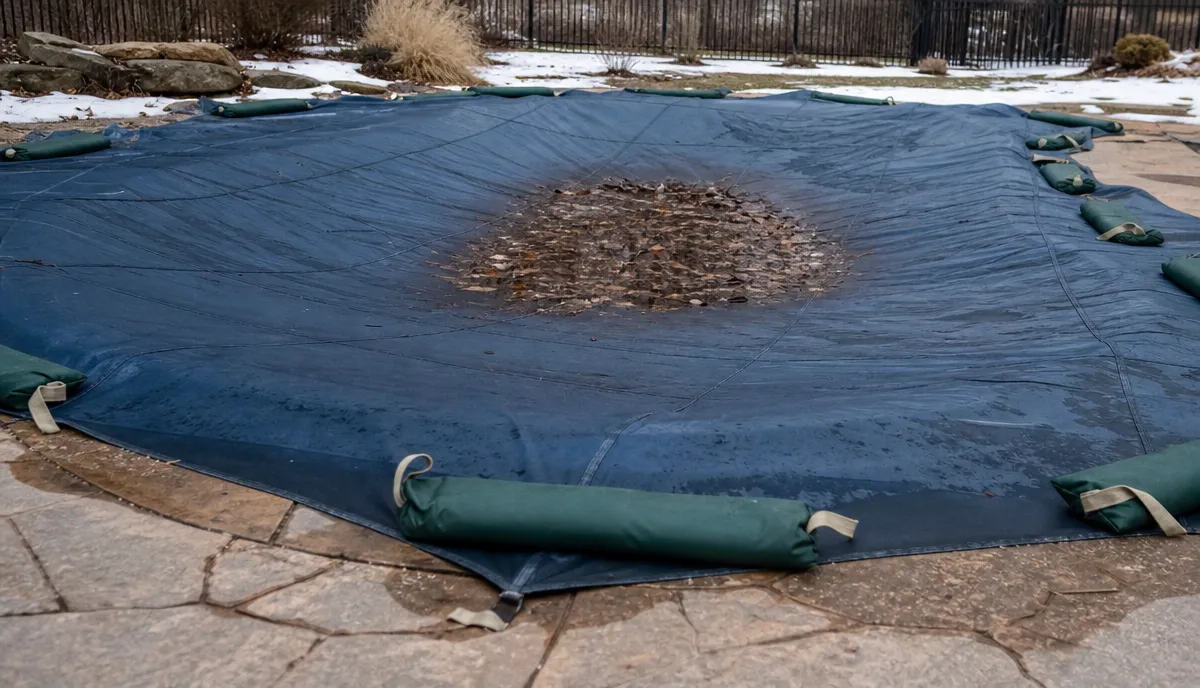
A laid-on winter cover held down with water bags will eventually sit on the surface. That is not a defect; it is how a cover with no anchoring and no tension behaves once it has weight on it.
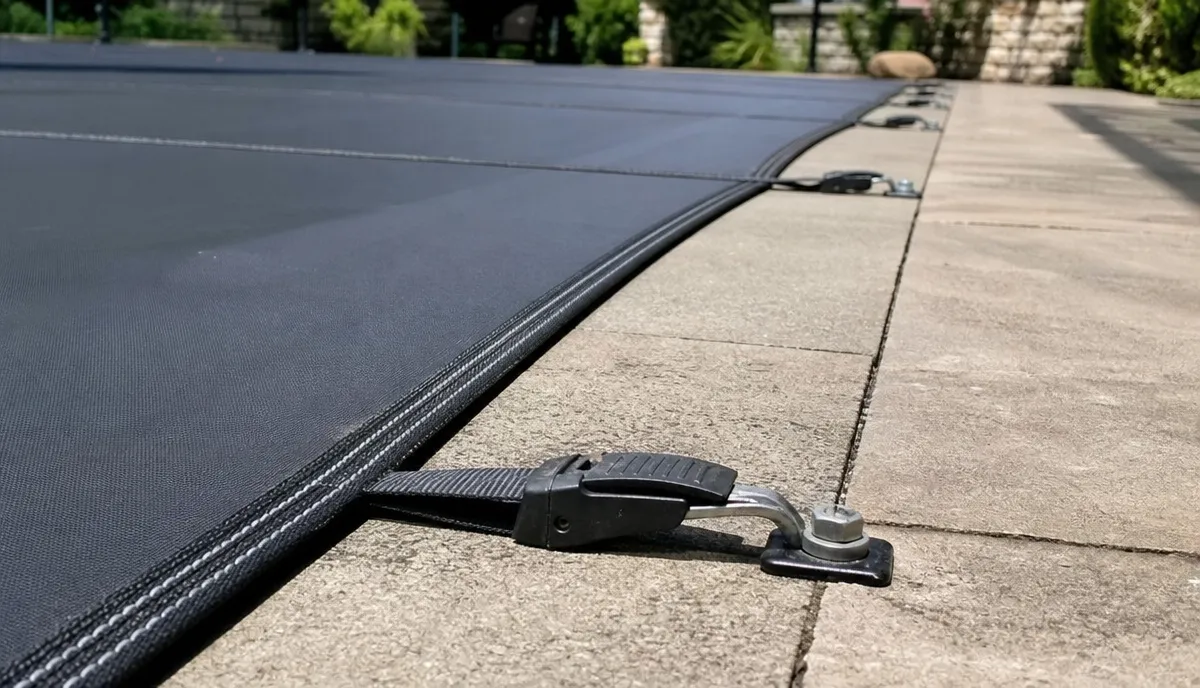
A safety cover is anchored into the deck and held by spring-tensioned straps, so the load transfers out through the straps rather than pressing the fabric down onto the water.
What sagging tells you: debris and meltwater are now collecting in a dish in the middle of your pool, and everything that lands there stays. It also means the cover is no longer covering the edges properly.
2. Have The Edges Lifted?
Wind gets under an edge — that is how it does its damage.
Water bags are weights, not fixings. They shift, they split in a freeze, and once one has moved the edge it was holding is open.
An anchored perimeter does not lift, because it is fastened at intervals all the way round.
What a lifted edge tells you: the wind has an entry point, and every gust from now until spring is working on the same weakness.
3. Is There Standing Water That Is Not Going Down?
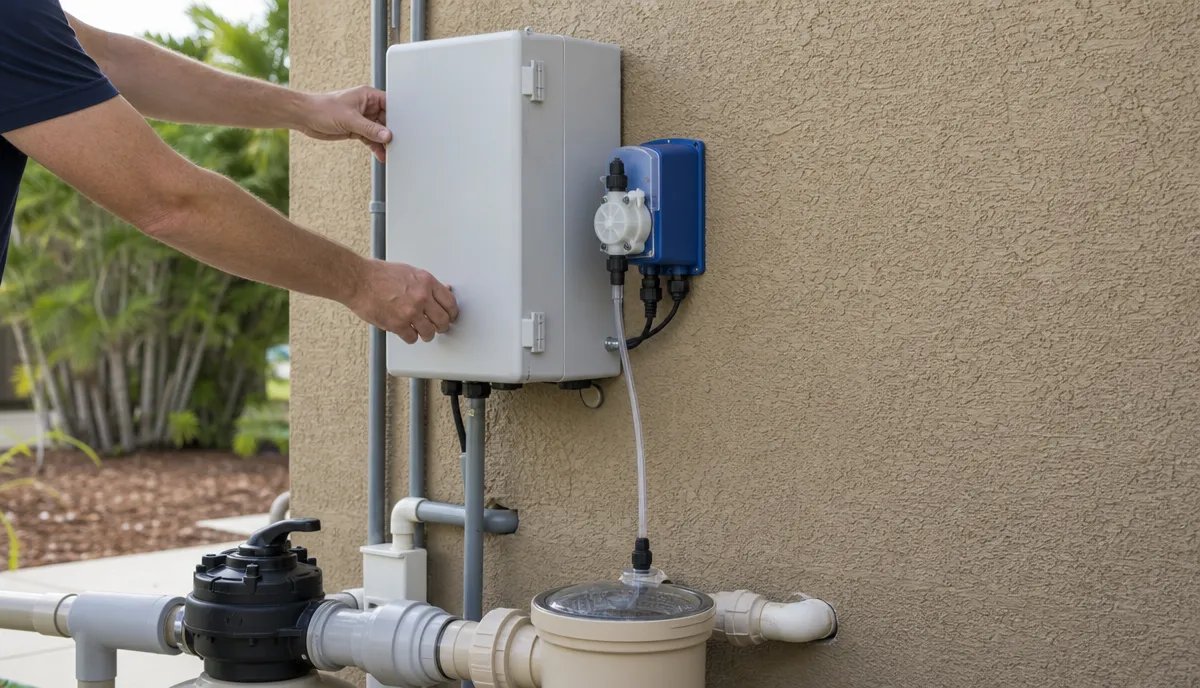
On a solid cover of either kind, meltwater collects on top and a small pump removes it.
The failure is silent: the intake blocks with leaf debris and the pump then runs, sounds busy, and moves nothing. Meanwhile water is a serious load, and snow on top of standing water is the heaviest combination there is. See snow and ice load.
A mesh cover has none of this — water drains through into the pool, so nothing stands and there is no pump to look after. That trade-off, in both directions, is the actual subject of the full comparison.
4. Could Something Walk Onto It?
The question the word "safety" is doing in the name.
A winter cover is not built to hold weight. Something that goes onto it goes into the water with it, and the cover closes over the top. That is true of a brand-new one in perfect condition.
A safety cover, anchored and fully fastened, is designed so the surface acts as a barrier. What any particular cover is rated for is the manufacturer's own statement in their own literature — we install Merlin and GLI and will show you what each says, rather than making a performance claim on their behalf.
What this one tells you: if you bought a cover because of children, pets or wildlife, February is when you find out whether you bought the product that does that job. The fundamentals are on what makes it a safety cover.
Whichever You Have, Do Not Go Out There
Not to reposition a pump, not to sweep snow, not to break ice, not carefully.
A cover carrying snow, water or ice is the least predictable version of itself, and snow hides where the edges are. A safety cover is a barrier designed to stop a person going into the pool — it is not a floor, and a winter cover is not even that.
Breaking ice on a cover is also the quickest way to put a tool through the fabric. If something needs doing out there, it is a job with two people and the right kit.
And In Six Weeks, The Real Inspection
The cover comes off in spring, and that is the only time in the year you can see the whole thing — spread out, dry, in daylight.
Almost every cover fault that causes trouble next October is visible then: a strap that has stretched, a spring that has lost tension, a grommet starting to pull at a corner, a seam beginning to separate, an anchor that will not turn. All repairable, and all much cheaper to find in April than to discover in October. See the spring inspection and safety cover repair and replacement.
If February has answered the question the wrong way — sagging, lifted edges, water sitting on it, and no real barrier — then the useful window is now, not September. A custom cover is made to order, and a measure taken in spring sits in a completely different queue from one taken in the second week of October.
One Thing Worth Repeating
A safety cover installed to the manufacturer's instructions and fully fastened is a barrier. It is not a reason to stop watching. No cover replaces supervision of children and pets around water, and a cover that is only half on is a hazard rather than a barrier.
We install custom safety covers only — measured on site, made by Merlin and GLI, no stock or standard sizes. Cover work is quote-required. See pool safety covers, and the buying guide for the six decisions in order.