

The three media filter differently and they want different habits. But before any of that, there is one number that matters more than which type you own — and almost nobody knows theirs.
The Number: Your Own Clean Baseline
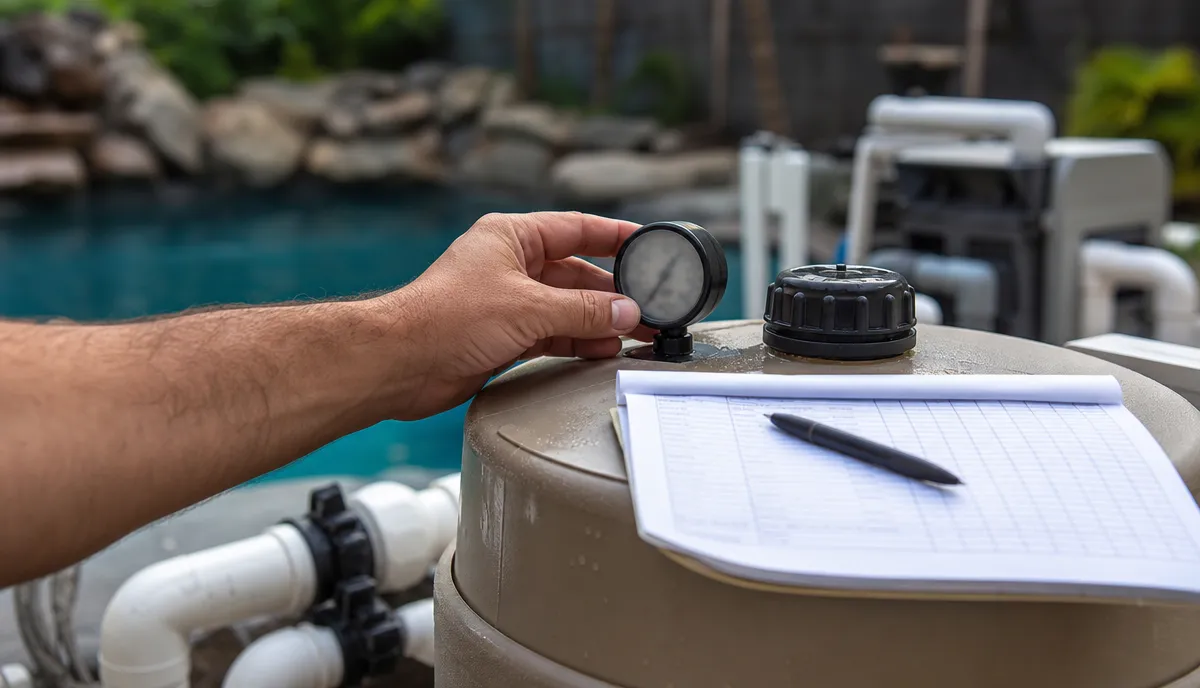
Straight after the filter is cleaned or backwashed, note the pressure. That reading is your baseline. It is specific to your pool, your plumbing and your pump, and it is the only pressure figure worth having.
There is no correct number to quote you, and anybody who gives you one is describing a different pool. What matters is the rise from your baseline.
And here is the diagnostic that comes free with it. After a clean, does the pressure return to that baseline?
If yes, the filter was simply loaded and is working as designed.
If it drops briefly and climbs straight back, the medium is coated rather than loaded — a film rather than a pile of debris — and no amount of backwashing will shift it. That is the signal for a proper clean rather than another rinse.
Organic debris coats. Dust loads. Which is why autumn is worse than pollen season, and why a heater that starts short-cycling in September is often telling you about your filter rather than about itself. See the autumn filter problem.
Sand
How it works: water passes down through a bed of sand and the debris is trapped between the grains.
How it is cleaned: backwashing — reversing the flow to lift the bed and send the debris out of the waste line. Simple, quick, and it uses water.
What it is good at: being forgiving. Sand is the least demanding of the three, and a backwash is a valve turn rather than a job.
What it is not good at: fine particles. Sand is the coarsest filtration of the three, so very fine debris passes through and the water is not as polished.
The maintenance habit: backwash on your baseline rather than on a schedule, and know that the bed itself does not last forever — channelling and hardening are real, and a filter that will not come back to baseline after a proper backwash may need the medium replaced rather than cleaned.
Cartridge
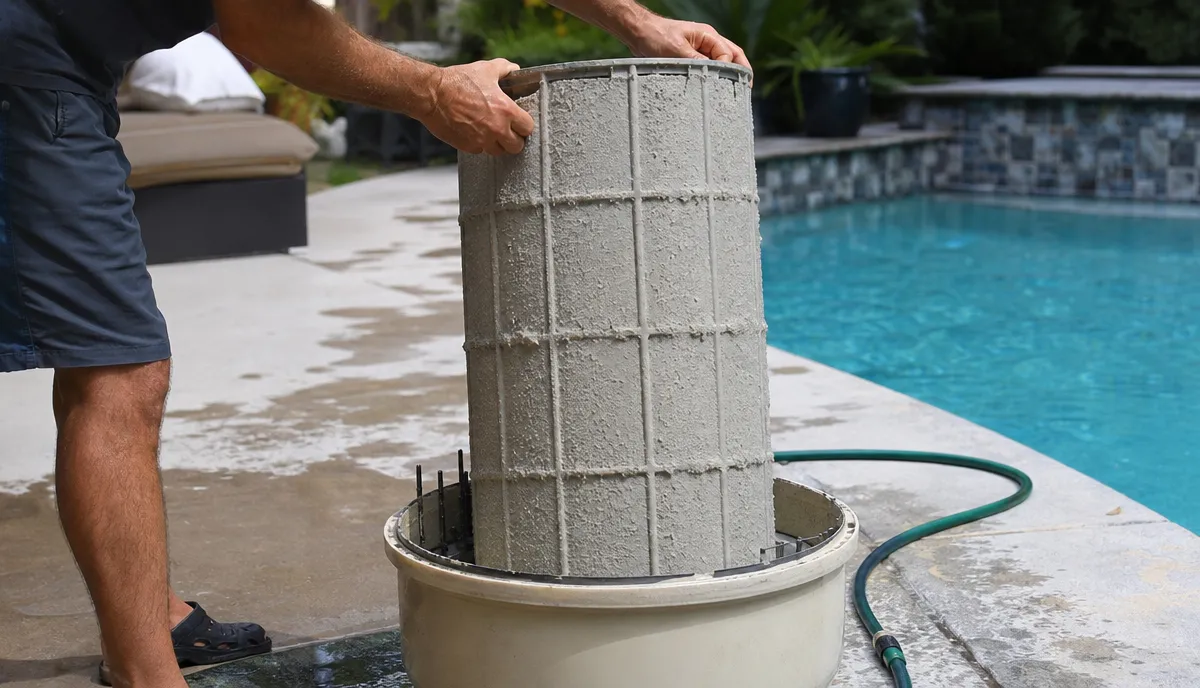
How it works: water passes through a pleated element and the debris is caught in the pleats.
How it is cleaned: the element comes out and gets rinsed — and periodically it needs a proper soak rather than a rinse.
What it is good at: finer filtration than sand, no backwash, and therefore no water sent to waste. That last point matters more than people expect if you are on a well or watching a water bill.
What it is not good at: being ignored. A pleated element that has been rinsed and never soaked accumulates a film in the pleats — sun cream, oils, fine organics — and that film is exactly the "comes down and climbs back" case above.
The maintenance habit: rinse regularly, soak periodically. On-site rinsing or swapping cartridge elements, up to once a month, is included in a regular service visit. A proper offsite clean is $125 — soaking in cleaning solution and pressure washing, which is what actually removes a film rather than moving it around.
DE (Diatomaceous Earth)
How it works: a powder is added to coat a set of internal grids, and that coating does the filtering. It is the finest of the three by a clear margin.
How it is cleaned: backwashed like sand, then recharged — the coating has to be replaced after every backwash, because the backwash removes it.
What it is good at: water clarity. If polished water matters to you, DE is the one.
What it is not good at: being casual. It needs recharging every time, the grids themselves need periodic cleaning, and there is a handling consideration.
On the handling: dry DE powder is a respiratory hazard, and we are not going to publish a charging procedure for a homeowner to follow. It is a straightforward part of a service visit for someone doing it with the right precautions, and that is where we would rather leave it.
Which One Should You Have?
Usually: the one you already have. Changing filter type is a real job, and the maintenance difference between a well-kept filter of any type and a neglected one dwarfs the difference between the types.
When a change genuinely makes sense: if the existing filter is finished anyway, if water clarity has never been good enough on sand, or if backwash water is a problem on your site.
Filter replacement is quote-required, because the size depends on the pool and the plumbing rather than on what is there — and an undersized filter is the one that never comes back to baseline no matter how well you look after it.
Three Things That Are Not The Filter
Worth ruling out before condemning one.
A packed pump basket or a clogged skimmer. Those starve the pump upstream, and the symptom is weak returns rather than high pressure.
A variable-speed pump running at a different speed than you think. Filter pressure is a function of flow, so a speed change moves the reading. If your baseline was taken at one speed and you are reading at another, you are comparing two different things — worth noting the speed alongside the pressure. See variable-speed pool pumps.
A gauge that has failed. Pressure gauges are cheap, they die, and a gauge reading nothing or reading nonsense sends people chasing a filter that is fine.
The Habit Worth Having
Note the pressure after every clean, and note the pump speed with it. Two numbers, thirty seconds, and it turns "the filter seems high" into a measurement.
A chemical and equipment check is from $72 per visit plus chemicals and includes backwashing as needed, on-site rinsing or swapping cartridge elements up to once a month, and reading the pressure against your baseline rather than against a number off a chart — with a written sheet every visit, which is where a filter that is no longer returning to baseline actually becomes visible.
See pool filter repair, pool equipment repair and pool maintenance.
