

Automation work is mostly dry work. It happens on the equipment pad, in an enclosure, with the water level down and nothing running — which makes the closed season a better window than most people assume.
With one important exception, and it decides how you sequence the job.
The Part That Needs Water
A controller is not finished when it is wired. It is finished when it is commissioned — when each schedule has been proved to actually drive each piece of equipment, at the speeds and flows they need, in the order they need them.
That takes a running pool. You cannot confirm that the pump reaches the flow the heater's switch will accept, or that the salt cell energises, with the system drained and plugged.
So the sensible shape of an off-season automation job is: install over the winter, commission at the opening. The awkward, disruptive part happens when nobody is waiting on the pool, and the last hour happens on the day the pool comes back anyway.
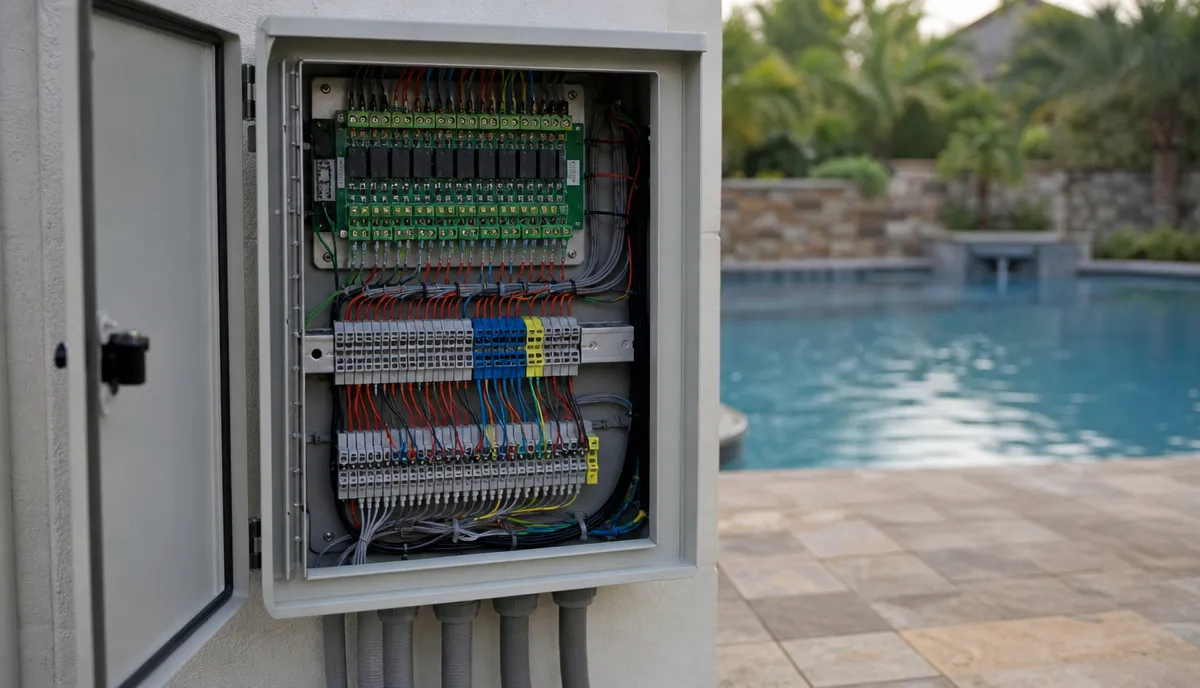
Four Jobs That Suit the Closed Season
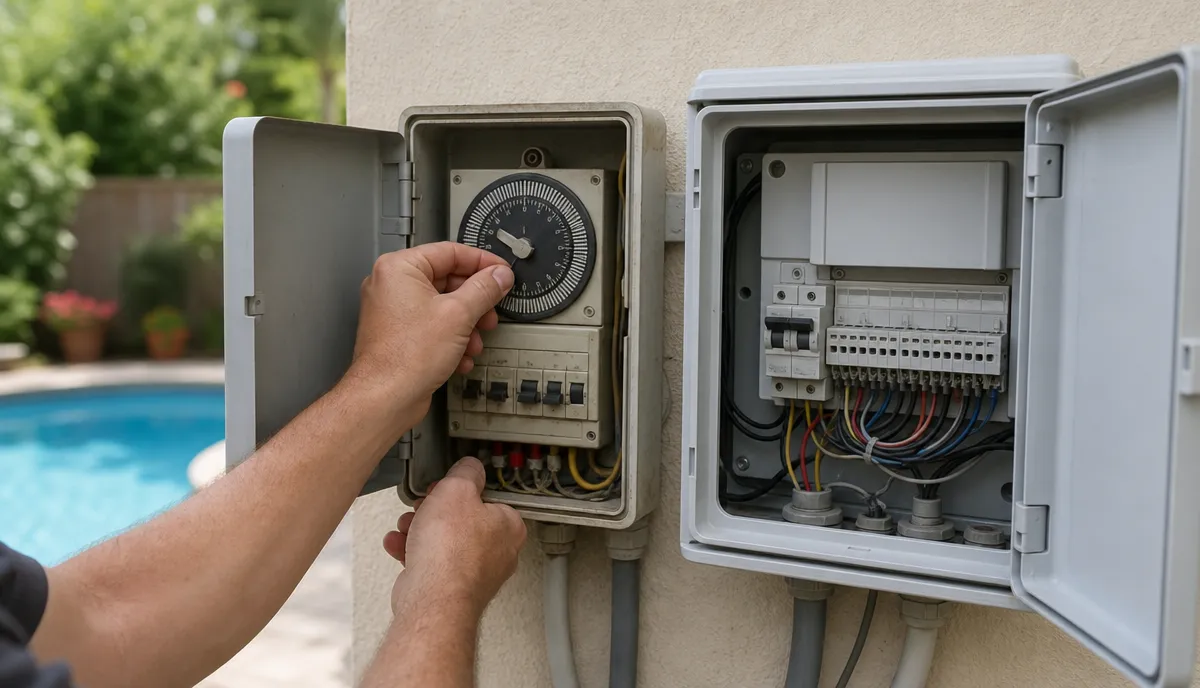
1. Replacing a mechanical timeclock
A timeclock switches a circuit on and off. That is the entirety of what it does — it has no idea what the pump is doing, whether the heater wants flow, or whether the salt cell is producing.
It is also the thing that quietly loses its schedule after a power cut, often without anyone noticing for a week.
Usually the timeclock comes out rather than staying. Two schedulers working against each other is worse than one.
2. Getting a variable-speed pump to coexist with a heater or a salt cell
The most common reason people want automation, and they usually arrive at it by accident.
A gas heater has a minimum flow its switch will accept. A salt cell needs flow to make chlorine at all. Meanwhile filtering costs least when the pump runs slowly. A single fixed speed cannot serve all three, so people end up choosing: fast enough to keep the heater happy, which throws away most of the pump's saving, or slow enough to be economical, which produces a heater that will not fire and a salt pool that filters beautifully and sanitises not at all.
A controller resolves it by running a speed per job. See variable-speed pool pumps.
3. Putting a remote equipment pad on the record
On a larger property the pad is often set away from both the house and the pool — quieter, tidier, and completely unobserved.
A controller that logs what happened and when turns an intermittent fault into something diagnosable. A heater that works when you press the button and fails on a timer is close to impossible to diagnose by visiting: a technician who watches it fire has learned nothing about the Tuesday it did not. See the remote pad case and intermittent lockout.
4. Repairing a controller you already have
Not everything is an upgrade. A system that has lost its schedule, has a probe reading wrongly, or throws intermittent faults with no pattern is often a repair rather than a replacement.
One thing worth knowing: intermittent controller faults that come and go with no pattern are frequently a corroded bond or ground connection rather than the board. A pad sitting in the weather corrodes, and the symptom looks like electronics failing. See pool automation repair and upgrades.
The Question That Comes Before All Four
Compatibility, and it decides whether the project is worth starting.
Some equipment can be read and set by a controller, and some can only be switched by it. A heater with no communication capability can be turned on and off, but it cannot be set from the controller — so you get partial automation, and somebody still walks out to the pad. That is a worse outcome than either full automation or none, because it looks solved.
Which controller suits depends mostly on what is already there. We install, repair and upgrade Pentair IntelliCenter, Jandy iAquaLink and TCX, and Hayward OmniLogic — named as equipment we service. We are not an authorised dealer, service centre or certified installer for any manufacturer; see brands we service.
Two other things a winter survey settles, both better answered with time than in April:
The wiring and the signal path, especially on a pad well away from the house. We do not do electrical supply work — a new circuit, a supply change or anything involving the pool's bonding is a licensed electrician's job. We will tell you what the system needs and hand that part over.
Whether the pad has room. Controllers, relays and their enclosure take space, and an old pad laid out tightly around the equipment of its day sometimes needs re-plumbing to accept one.
And When We Would Say Don't Bother
A simple pad beside the pool with a pump and a filter and nothing else. There is very little to coordinate, and a timeclock does the job. Automation earns its place when equipment has to agree with each other.
When the actual problem is the plumbing or the heater sizing. Automating around a limitation makes it tidier and no cheaper.
And a residential controller does not automate your chemistry, which is the most common misunderstanding about it. It schedules equipment. Continuous sensing and dosing is a commercial class of equipment. The full version of what automation does and does not do is on the automation guide.
Automation is quote-required — the controller, the relay and actuator count, what is already compatible, the wiring and the pad layout move it too much for a published figure to mean anything. A $150 service call covers up to the first hour of diagnosis on an existing system.