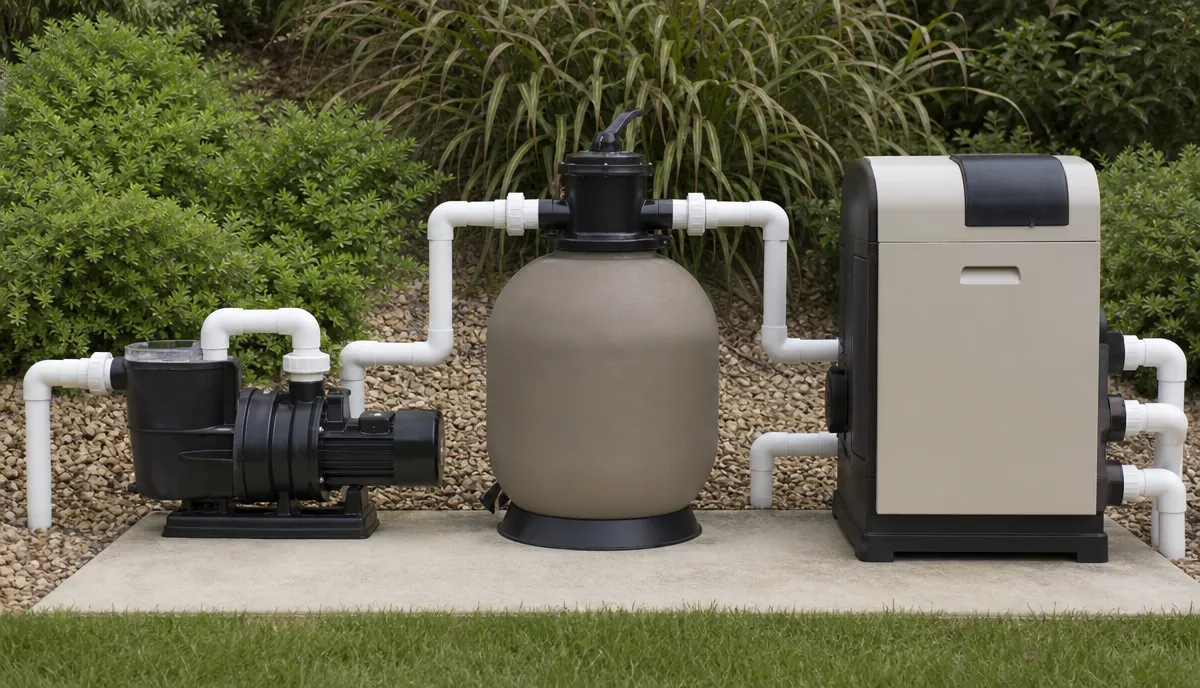

One distinction makes sense of everything else on this subject.
Automation moves equipment. It does not measure water.
Which means the app can tell you the pump is running and cannot tell you the pool is healthy. That sounds like a quibble. It is the single most common misunderstanding we meet on a pad with a controller on it, and it costs people real money, because a green screen gets read as a clean bill of health.
What A Phone Genuinely Does
These are the functions that are actuation — the controller is switching or driving something, and the phone is a remote for it.
Pump speed and run time. The largest practical win, particularly on a variable-speed pump: filtration hours where you want them, a higher speed only when something needs the flow, and no walking out to a timer. See variable-speed pool pumps.
Heater call. Asking for heat on the drive home, or holding a temperature for a weekend and standing down after it.
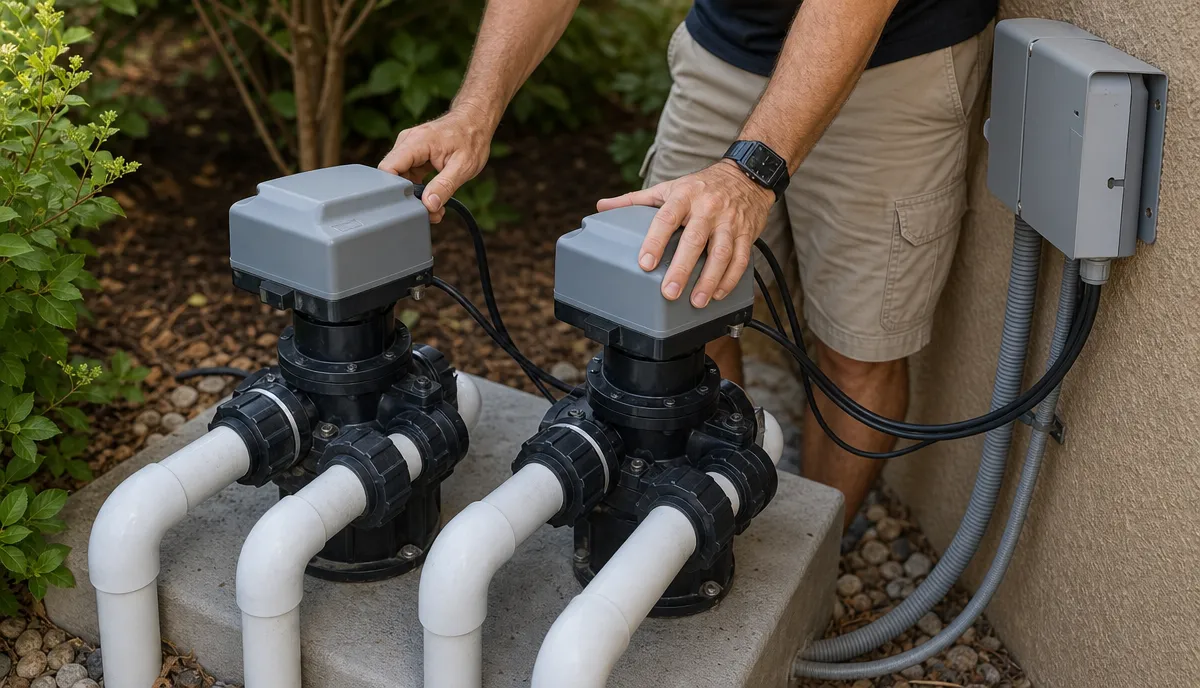
Valves. Where actuators are fitted, changing what the system is doing — a spillover feature on, a return prioritised — without turning a handle.
Lights. Colour and scene, which is the function most people use most and the one that matters least.
A salt cell's output. Turning the generator's production up or down. Note the wording: that is still actuation. The cell makes chlorine when told to; it is not reading the pool.
Alerts on equipment state. A pump that did not start, a heater that locked out, a controller that lost power. These are genuinely valuable, and they are alerts about machines.
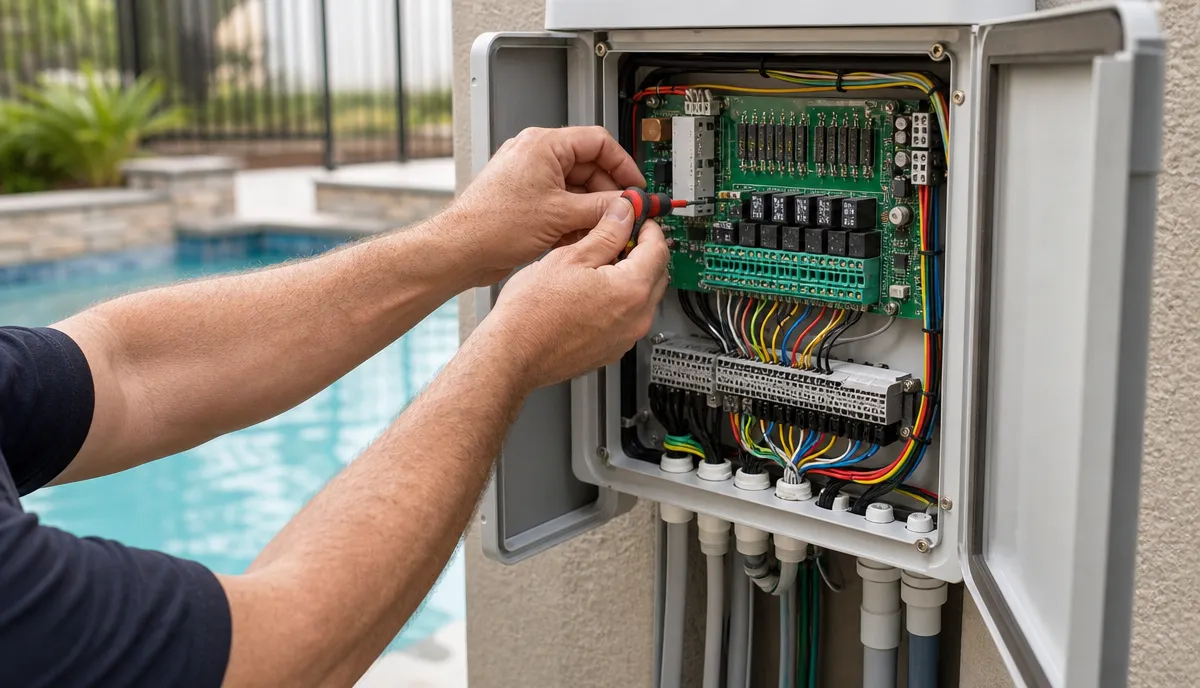
What It Does Not Do
Being specific, because the gap is where the disappointments live.
It does not measure your water. No mainstream domestic control system reads a full panel. Some sense one or two properties; most sense none. Free chlorine against combined chlorine, alkalinity as distinct from pH, stabiliser, calcium hardness — an app is silent on all of it, and those are the readings that decide whether the water is actually right.
So the pool can be green on the screen and green in the water. Filtration running perfectly on a pool with nothing in it to sanitise with looks identical, from a phone, to a pool in good order.
It does not clean anything, and neither do we — we do not vacuum, brush or skim pools. Surfaces are a robot's job or yours; a controller may switch a booster pump for a pressure-side cleaner, which is switching, not cleaning.
It does not empty a basket. The most frequent cause of poor flow on a domestic pool is still a full basket, and no amount of scheduling touches it.
It does not find a leak. We do not offer leak detection, and a controller will not either — a pool losing water reports nothing unusual to an app.
And it is not a safety device. Automation does not supervise a pool. No cover, controller or alarm replaces watching children and pets around water.
The Part Worth Understanding Before You Buy
Which of your functions survives the internet going down?
On the systems we work on, the schedule lives in the controller rather than in the cloud. The panel at the pad holds the times and the speeds, and it keeps running them whether your router is up or not. That is the right architecture and it is why a power cut or an outage does not stop a pool filtering.
What the connection actually provides is you — remote control, remote visibility and alerts. Lose it and the pool carries on doing what it was told last; you simply cannot see it or change it until it is back.
Where that gets interesting is any function that depends on a sensor or a rule. A heater call driven by a water-temperature sensor, a freeze-protect routine, a rule that reacts to a reading: those depend on the sensing part working, and sensors are the components that drift and fail quietly. A failed sensor does not usually announce itself; it reports a plausible number.
So the question worth asking of any system, before it is fitted, is a short one: which of these functions is a schedule in the panel, which is a rule reacting to a sensor, and which needs my phone to be connected? The answers are what determine how the pool behaves on the week you are away.
What Automation Is Genuinely Good At
Not a hedge — the honest list, now that the limits are on the table.
Removing the failure mode where nobody sets the timer. A pool that runs the hours it should, all season, without anyone remembering.
Making a variable-speed pump worth what it cost. The savings on those pumps come from running slowly for long hours rather than fast for short ones, and that is a scheduling problem — which is exactly what a controller is for.
Telling you a machine stopped. A pump that failed to start on a Friday, found on Friday rather than on Sunday, is often the difference between a pool that needs balancing and a pool that needs recovering.
Freeze protection, where it is fitted and working. In this climate that is not a luxury feature.
And taking the fiddly out of a multi-function pad. A heater, a salt cell, a booster and actuated valves are a lot of handles and timers; one interface for them is a real improvement in a way coloured lights are not.
What It Does Not Replace
The measured panel, and a person putting a hand on the equipment.
A chemical and equipment check is from $72 per visit plus chemicals, and it does the two things a controller cannot: it titrates a full panel, and it puts somebody's hand on the pump and eyes on the filter pressure. A run of those sheets shows a direction — a demand that keeps climbing, a filter pressure that never quite returns after a backwash — and no app on the market is watching for either.
Where a panel itself is misbehaving — a controller that has lost its schedule, an actuator that no longer drives, a sensor reporting something implausible — a $150 service call covers up to the first hour of diagnosis on site, with parts and any further labour quoted first.
One boundary, plainly: we do not do electrical supply work. A controller sits on a supply and a bonded pad, and anything at the breaker panel or on the supply wiring is a licensed electrician's job. We will say which side of that line a problem is on before we start.
Automation is quote-required, because what it costs depends entirely on what is already on your pad and what you want it to reach. See pool automation, pool automation installation and pool automation repair and upgrades.
The component-by-component picture — panels, actuators, sensors, what talks to what — is on the automation guide. Which upgrades are worth doing while the pool is closed is on off-season upgrades.