

Everybody arrives at this question with the wrong variable.
They describe the damage — how long the tear is, where it is, whether it is on the floor or the wall — and expect that to decide it.
It mostly does not. What decides it is the condition of the vinyl around the damage, because a patch needs sound material to bond to. A small tear in brittle vinyl is a replacement. A long tear in vinyl that is still flexible and properly seated is often a patch.
Which is worth sitting with for a moment, because it is the opposite of the intuition.
Why The Surrounding Vinyl Is The Deciding Factor
A patch is a bond, and a bond is only as good as what it is bonded to.
Vinyl in good condition is flexible. It moves with the water, it moves with temperature, and it moves when somebody pushes off the wall. A patch on flexible vinyl moves with it.
Vinyl that has gone brittle does not move — it cracks. So a patch on brittle vinyl transfers every bit of that movement to the edge of the patch, and the material fails again just outside where you repaired it. Sometimes within weeks. That is not a bad patch; it is a patch on the wrong liner.
Which is why the useful question is not "how big is it" but "what is the vinyl like".
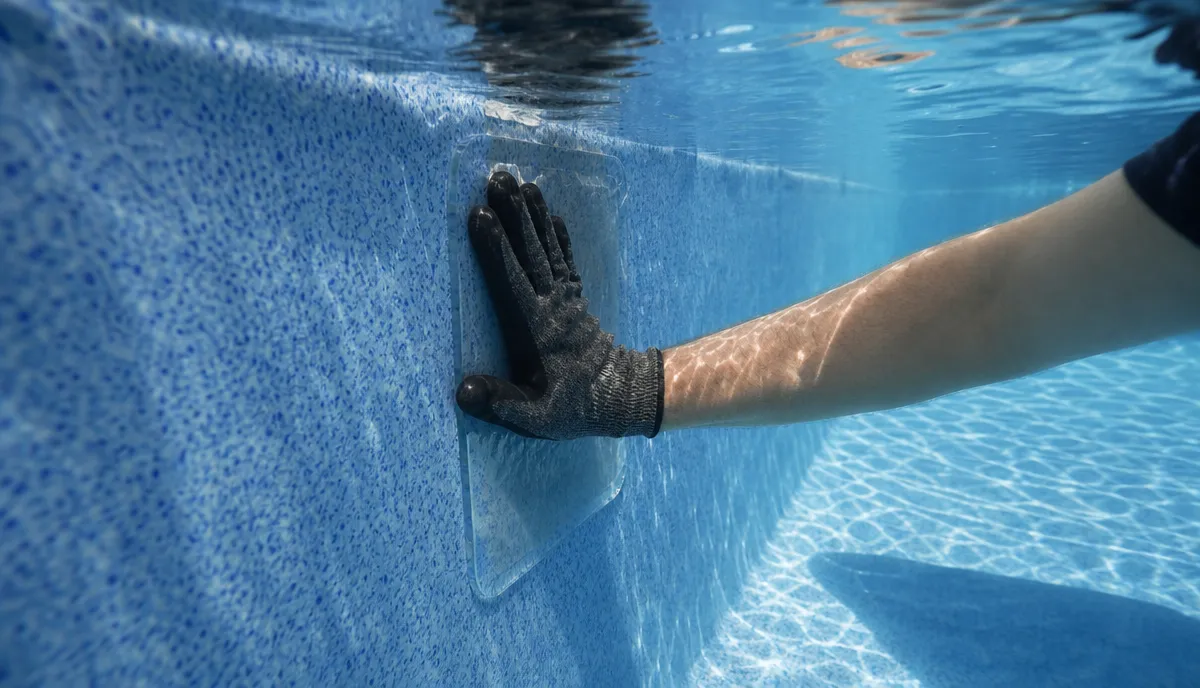
The Test You Can Run Yourself
Two minutes, no tools, and it is genuinely informative.
Press the vinyl above the waterline with a thumb. Sound vinyl gives, then comes back. Vinyl at the end of its life feels stiff and papery, and does not spring back the same way.
Look at the corners and the steps. These go first, because they are the most worked parts of the liner and the most exposed. Chalkiness, a whitened look, or a surface that feels dry rather than slick is the material telling you where it is.
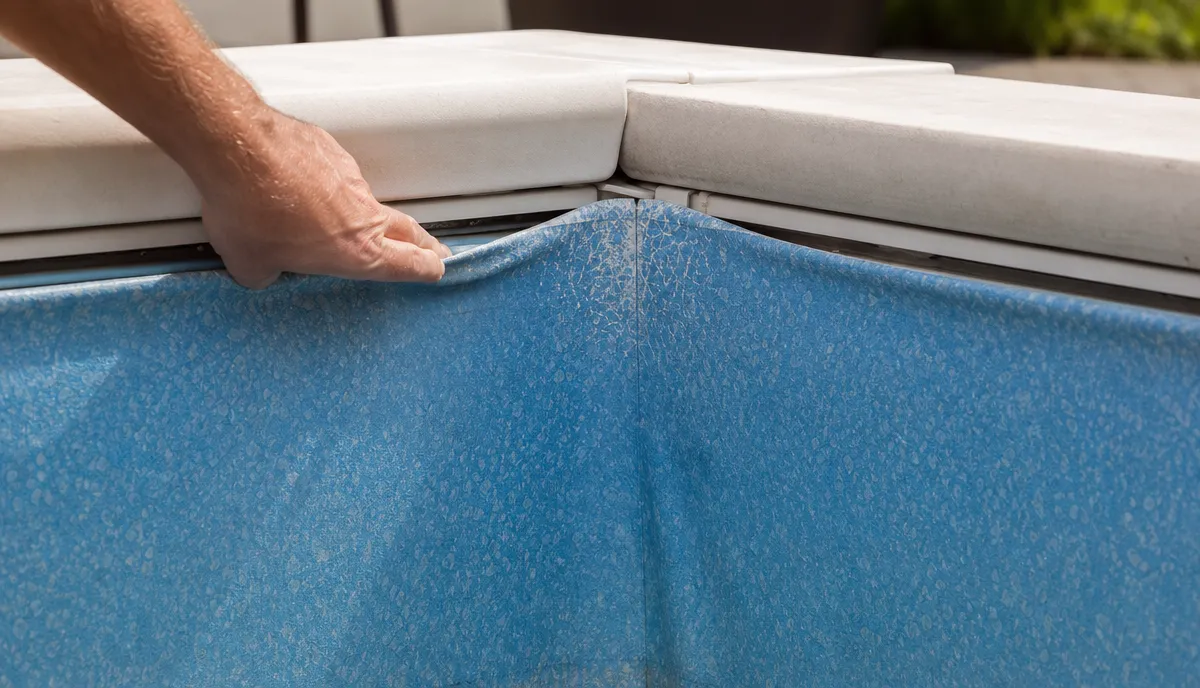
Check the bead in its track. Vinyl shrinks as it ages. A liner pulling out of its track along a run — not just at one corner — has shrunk beyond what an adjustment fixes, and that is a replacement conversation whatever the damage looks like.
And look at the waterline. A hard line, staining that will not come off, or vinyl that has lost its pattern along that band is age rather than dirt.
How to read all of this properly — six things in order of visibility — is on the lifespan guide.
What Patches Well
Being specific, because "it depends" is not useful.
A puncture or a short tear in flexible, well-seated vinyl. The straightforward case, and most of what we patch.
Damage below the waterline, which is the majority. We patch underwater wherever we can, and that is worth explaining: it is not a shortcut, it is risk management. Emptying a vinyl-liner pool is the riskiest thing that happens to it — the liner is no longer being held against the walls by thousands of gallons of water, it can dry and shrink and stiffen, and groundwater outside the shell is no longer balanced by water inside it. A repair that does not require draining is a repair that avoids all of that.
A seam that has started to separate over a short length, where the surrounding material is sound.
Damage around a fitting, in some cases, depending on what the fitting is and what state the vinyl is in around it.
What Does Not Patch
A tear in brittle vinyl, however small. As above — the patch holds and the material next to it does not.
Vinyl pulling out of its track over a long run. Shrinkage, and it does not reverse.
Damage on a liner that is already several patches old. Each patch is fine; a liner needing a steady stream of them is telling you what the material is doing generally.
Anything where the problem is behind the liner rather than in it. A hollow under the floor, washed-out floor material, a wall panel that has moved — a new patch over a moving substrate fails, and so does a new liner if the substrate is not dealt with first. That is only visible with the old liner out, which is the honest unknown in every replacement quote. See planning a replacement.
Before Either: Is It Actually The Liner?
Two free checks, and both are worth doing before anyone quotes anything.
When does the water go? A liner tear loses water whether the pump is running or not. A pressure-side plumbing failure usually loses more while it runs. That difference is the first thing to observe, and it costs nothing but attention.
Where is the ground wet? We do not offer leak detection — so a soft patch, settling, or persistently wet ground near the pad or the returns points at a buried line, and that case is not one for us. Better you hear that now than after a visit. The full diagnostic is on liner or plumbing.
And a third, which surprises people: a pool can lose a real amount of water to evaporation in a hot, windy week with no cover on it. Before anyone hunts a tear, that is worth ruling out.
What Each One Costs
Liner patching is from $195, usually done underwater, and that figure is for patching a liner — nothing else on this site is priced at $195.
Liner replacement is quote-required, because the size, the shape, the condition of what is behind the vinyl and the access to the garden move it too much for a published number to mean anything. A liner is also made to order and measured on site, because a pool that has been in the ground for decades is rarely the shape its original drawings said.
Where it needs diagnosing before it can be quoted — including whether you are losing water through the liner, through the plumbing or to evaporation — a $150 service call covers up to the first hour on site, with parts and further labour quoted first. See pool equipment repair.
The Honest Summary
Patch if the vinyl around the damage is sound. It is quicker, it costs less, and — the part that matters most — it does not require draining your pool.
Replace if the vinyl has gone, whatever the damage looks like. A patch on a finished liner is money spent on a delay.
And if you are between the two, the deciding question is how many seasons you want out of it. A sound liner with one tear has years in it. A brittle liner with one tear is a replacement you are choosing when to do.
See pool liner repair, pool liner replacement and pool liners for the full picture.
