

The question we get is "can I give you the dimensions over the phone", and the answer is genuinely no — for a reason worth explaining.
A safety cover is not a sheet that covers a pool. It is a fabric panel anchored into your deck. So the thing being measured is not the pool. It is the anchor line, and everything that gets in the way of it.
Which is why your pool's length and width are the smaller half of the job.
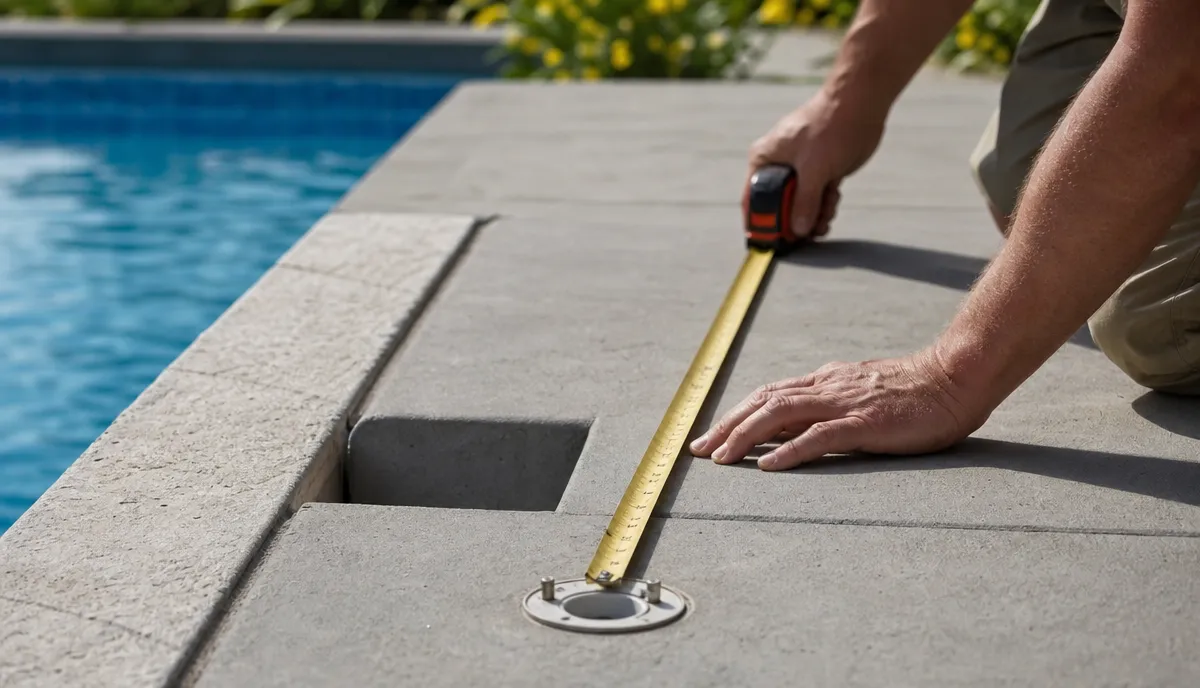
What The Measure Actually Records
The perimeter where the anchors will go, which follows the deck rather than the water, and which is not simply the pool's shape offset by a fixed distance.
Every obstruction inside or beside that line. This is the part that surprises people, and it is most of the specification:
Steps and a shallow shelf, because the cover has to be cut around them or over them and that is a decision with consequences.
A raised wall or bond beam on one or more sides, which changes where the anchor line can sit and how the tension works.
Handrails, ladder sockets, a diving board or its stanchion, a slide. Each is either removed for the winter or cut around, and cutting around is a permanent feature of that cover.
Light niches and deck fittings.
Deck width, side by side. A deck edge that is generous on three sides and narrow on the fourth is a common finding, and the narrow side is what constrains the layout.
Anything growing. A mature tree close to the deck has a root plate under it, and a root plate under an anchor is a problem that gets worse each year.
And the deck material and its condition. Anchors go into concrete, and concrete that is spalling, cracked or heaving at the edge is a conversation before it is a measurement.
Why Your Pool Is Not The Shape Its Drawings Say
Worth its own note, because it is the reason nobody can look this up.
A pool that has been in the ground for decades has moved. Ohio ground moves. Deck sections get re-poured, coping gets replaced along one side, a corner settles a little. None of it is dramatic and all of it is real at the tolerance a cover is made to.
So a cover made from the original plans fits the pool that was built, not the pool that is there. A cover that is even slightly out is a cover that will not tension properly, and one that does not tension properly is a cover that sags, collects water and works at its own seams all winter.
That is the whole argument for a measure, and it is also why we do not sell stock covers.
We Do Not Sell Stock Or Standard-Size Covers
Stated plainly, because it is a scope boundary rather than a preference.
We do not sell or fit stock covers, standard sizes or off-the-shelf covers of any kind. Every cover we install is measured on site and made to that measurement, by Merlin or GLI — those are the makers whose covers we install, and what any particular cover is rated for is their own statement in their own literature, which we will show you rather than make a performance claim on their behalf.
A safety cover installed to the manufacturer's instructions and fully fastened is a barrier. It is not a reason to stop watching — no cover replaces supervision of children and pets around water, and a cover that is only half on is a hazard rather than a barrier.
About Lead Times: What We Will And Will Not Tell You
We are not going to print a number of weeks on a web page, and here is the honest reason.
It moves with the season by a large factor, and a figure published in February is misleading in September. We would rather not stand behind a number we cannot stand behind. What we will do is give you the current position when you ask, for your pool, at that moment.
What actually drives it, in order:
1. When in the year you ask. This is the largest single factor by some distance, and it is why the same cover is a different wait in April and in October. The reason is on what February tells you — everyone discovers their cover has failed at the same time.
2. How complicated the shape is. A rectangle with a step is not the same order as a freeform pool with a raised wall, a diving board and a narrow side.
3. Whether anything needs doing to the deck first. Concrete work is a different trade's schedule, and it has to happen before anchors go in.
4. The fabric and the options you choose. Which is a decision to make deliberately rather than under time pressure — the six decisions, in order, are on the buying guide, and the mesh-or-solid question is on mesh or solid.
5. Whether the measure has been taken yet. Which is the one part of this you control, and the reason the next section exists.
The Sequence That Works
And the one that does not: deciding in the first week of October.
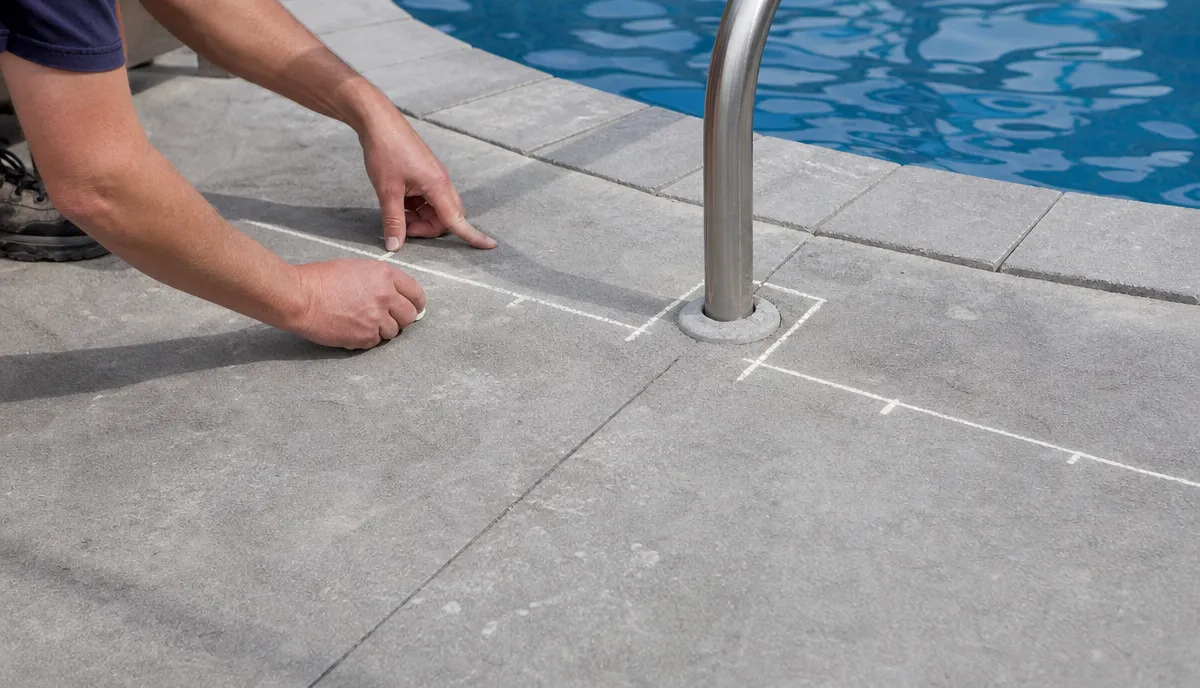
Get the measure taken early. It does not need the pool open, it does not need warm weather, and it does not need the cover off — it needs the deck visible and dry-ish, which rules out mid-winter and rules in almost everything else.
Then make the fabric decision without a clock running. This is where people compromise when they are late, and it is the decision they live with for years.
Then have it made and fitted on a date that suits, rather than on the only date available.
A measure taken in spring sits in a completely different queue from one taken in the second week of October. That point belongs to what February tells you, and it is the practical case for looking at your cover in February rather than in September.
If Your Existing Cover Might Be Repairable
Worth checking before you order anything, because a replacement is the larger of the two options.
Straps that have stretched, a spring that has lost tension, a grommet pulling at a corner, a seam beginning to separate, an anchor that will not turn — all of those are repairs on a cover whose fabric is otherwise sound.
What is not repairable is fabric that has gone. A cover that has thinned, lost its coating, or is tearing away from its seams in more than one place is at the end of its life whatever the hardware is doing.
And a cover that never fitted properly is not a repair either. If it has always sagged, always lifted at one edge, or has never tensioned evenly, it is the wrong cover for that pool and hardware will not fix it.
See safety cover repair and replacement.
What Happens On The Day
Anchors go into the deck on the layout from the measure, the cover is fitted to them, and the tension is set and checked all the way round.
Every anchor is left in working order and you are shown how to raise and lower them — which matters more than it sounds, because a seized anchor in October is what stops a closing being finished. That, and the rest of your own half of a close, is on the closing checklist.
Cover supply and installation are quote-required, because the size, the shape, the obstructions, the deck and the access move the figure too much for a published number to mean anything. See pool safety covers and safety cover installation.
