

Two things make early season different from the rest of the year, and neither is about doses.
The first is that order matters more than quantity. Three of the six readings on a panel govern the others, and they do it in one direction only — so a pool corrected in the wrong sequence has to be corrected again.
The second is that cold water lies. A cool pool in the first weeks has low chlorine demand and slow biological activity, so the readings look better than the water is. The first genuinely warm week is when that gets found out, which is why "it was fine at the opening" is the most common sentence in early June.
One thing this post will not do is print target ranges. A range without a tested pool and a known stabiliser level is a number people misuse — and stabiliser in particular changes what a "correct" chlorine reading even means. What is useful is the order and the reason for it.
The Sequence, And Why It Is That Way
1. Total alkalinity comes before pH
Because alkalinity moves pH, and pH does not move alkalinity.
Alkalinity is the buffer — the water's resistance to having its pH shifted. Set it correctly and pH stays where it is put. Leave it wrong and pH swings after every rain, every shock and every warm week, and you spend the season chasing a reading that will not settle.
So a pool with both out is an alkalinity job first. Correct pH first and the alkalinity correction will drag pH back out again, and you have paid twice for one result.
2. Then pH
Because pH governs what everything else is capable of doing.
Out of range one way and the chlorine present is much less effective than its number suggests — the reading is honest and the sanitiser is not doing the work you think you are paying for. Out of range the other way and the water is aggressive toward your equipment: pump seals, the heater's water side, anything metal on the pad.
This is the reading most home strips get closest to and most people trust the most, and it is genuinely important — it is just second in line.
3. Stabiliser before chasing chlorine
This is the step almost always skipped, and it is the reason chlorine "stops working".
Stabiliser protects chlorine from sunlight, and it does not leave the water the way chlorine does — so it accumulates season over season, particularly on pools sanitised with stabilised product. Too little and a bright afternoon burns the sanitiser off. Too much and the chlorine that is present is held so tightly that it behaves weaker than it reads.
Which produces a pool that needs more and more chlorine to hold the same number. People treat that as a chlorine problem and add more of the thing making it worse.
So stabiliser gets established before anyone judges a chlorine reading. It is the context the chlorine number is read in.
4. Then sanitiser, and the load it is carrying
Free chlorine is what is available. Combined chlorine is what has already reacted and is now doing nothing useful.
The second one is the more informative reading in early season, because water that stood under a cover since October has been accumulating things to react with. When combined chlorine shows up, the answer is to shock rather than to nudge — a pool that is behind on sanitiser does not catch up on small additions.
Most home kits do not read it at all, which is why "my chlorine is fine but the water smells strongly of chlorine" is such a common and such a misleading pair of observations. That smell is the reacted product, not the sanitiser.
5. Calcium hardness, mostly for the equipment's sake
On a vinyl-liner pool this is not about the shell.
It is about the hottest surface in the system. Calcium comes out of solution on the heat exchanger, scale insulates, and the heater then burns the same gas to move less heat into the water. Low hardness has its own problems on the metal side of the pad.
It moves slowly, which is why it is late in the sequence rather than unimportant.
6. Salt, if the pool has a cell
A salt pool is a chlorine pool with its own generator, so everything above still applies — the cell simply changes where the chlorine comes from. What is specific to the cell is its output and the state of its plates. See salt chlorine generators, and salt or chlorine if you are still deciding.
Why Cold Water Is Misleading
Worth its own section, because it produces a specific and avoidable disappointment.
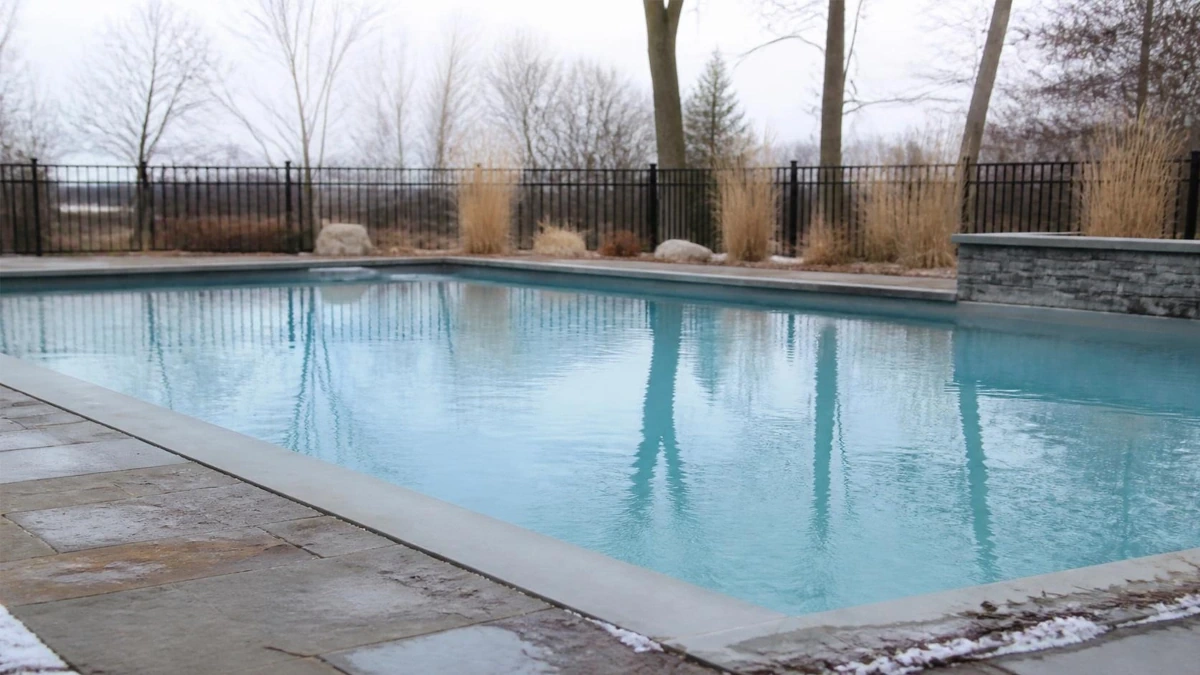
Chlorine demand rises with temperature and with what is living in the water. A cool pool in the first weeks is quiet: little grows, sanitiser is consumed slowly, and a reading holds for days.
So an early panel can look settled on water that is not. Nothing has yet been asked of it.
The first hot week asks. Demand climbs, whatever was present starts multiplying, and a pool that read fine on the 20th of May goes cloudy in the second week of June — usually with the owner certain nothing has changed. Nothing did change. The weather did.
Which is the practical argument for measuring more often in the first month than later, not less. The readings are moving fastest exactly when they look most stable.
Three Things That Are Not Chemistry Problems
Because they present as chemistry and are not.
Poor circulation. Water that is not moving cannot be treated. A loaded filter, a part-closed valve or a pump not holding prime will make good chemistry look like bad chemistry, and no dose fixes it. See pool filter repair.
Filtration that is not running long enough. Sanitiser handles what is dissolved; the filter removes what is suspended. A pool with correct numbers and short run times can still be cloudy.
Surfaces. We do not vacuum, brush or skim pools — not as an opening and not as a weekly service. Debris left on the floor is a continuing demand on the sanitiser, and it is the robot's job or yours. Our work is water chemistry, baskets, filtration and equipment.
What We Actually Do About It
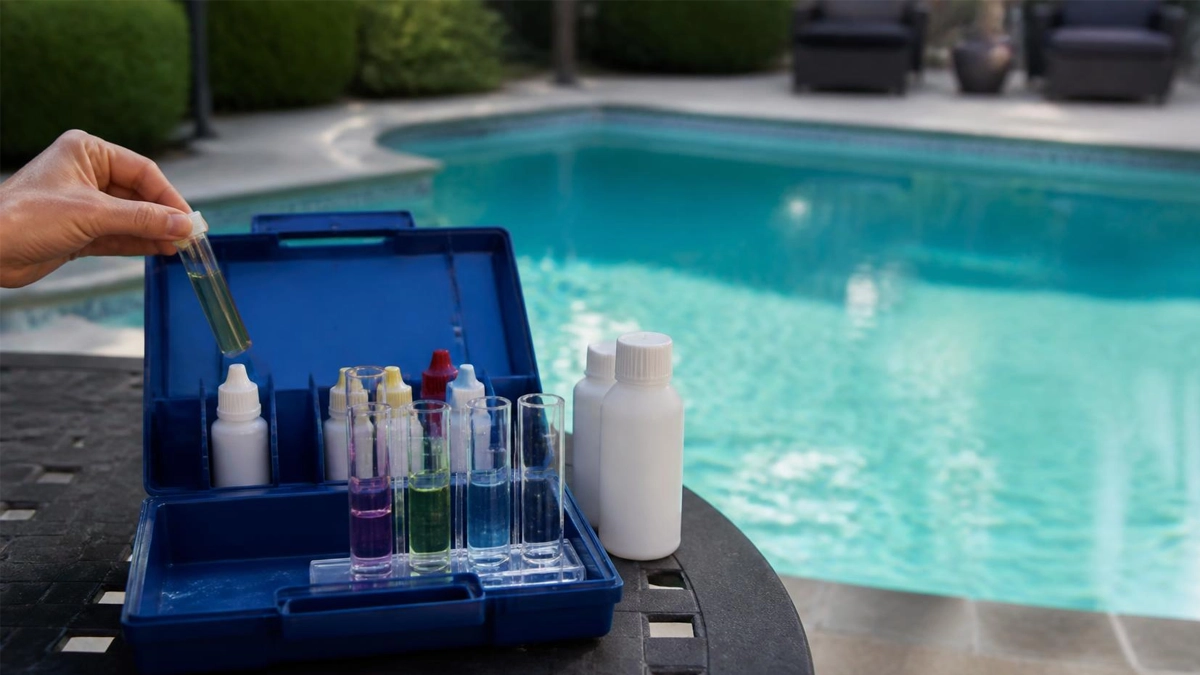
An opening brings the water back from a measurement rather than a colour. We titrate a full panel — a drop test resolves a number, a strip gives a colour and an impression — and on water that has been standing since October that difference decides whether you are balancing a pool or chasing it for a fortnight. Openings start from $495 plus chemicals; see pool opening service and what a professional opening includes.
Then the first month is where regularity pays. A chemical and equipment check is from $72 per visit plus chemicals, with a written sheet every visit — and in early season the sheet is doing something specific: it turns six weeks of readings into a direction, which is the only way to see a demand that is climbing before the water goes cloudy.
Where something is genuinely wrong rather than unbalanced — water that will not clear whatever the numbers say — a $150 service call covers up to the first hour of diagnosis on site, with parts and further labour quoted first.
See weekly pool service for the regular version.
