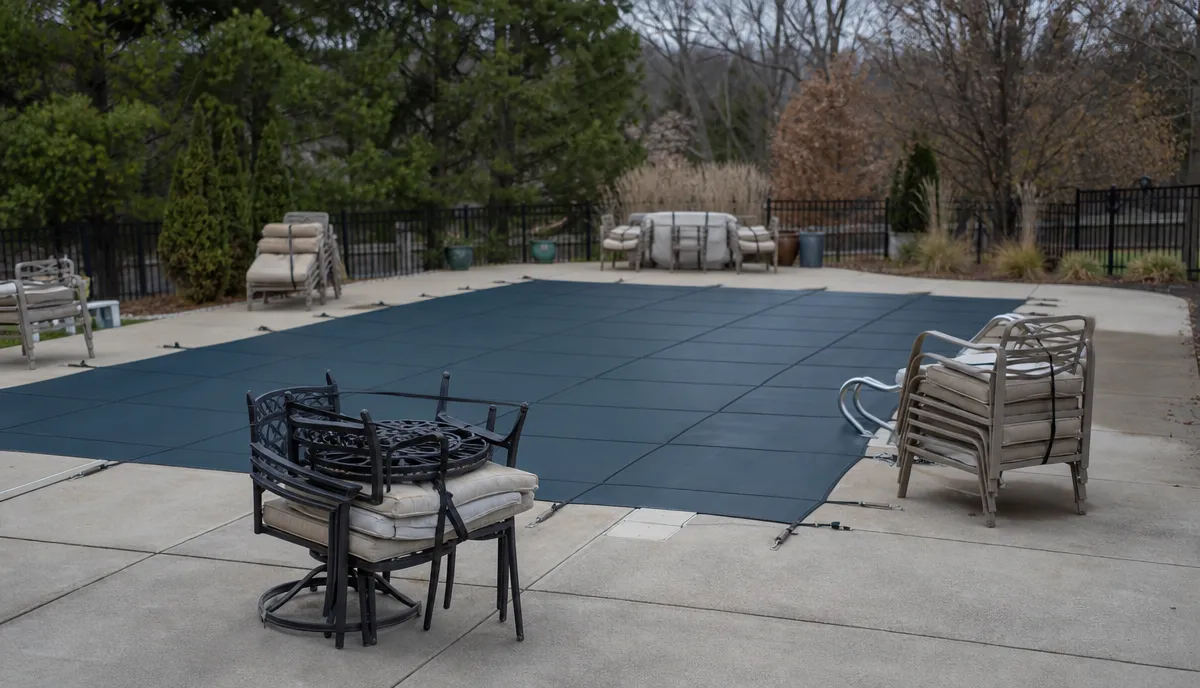

Custom in-ground pool safety covers for Beachwood — for houses, and for seasonal amenity pools where a cover is genuinely the right answer. Family-owned since 2012.
If you are responsible for a commercial, HOA, hotel or semi-public pool, the most useful sentence on this page is this one: a safety cover is not a compliance instrument.
We make and fit covers. We do not advise on code compliance, and nothing we install should be treated as satisfying a barrier, fencing or access-control requirement.
Your regulatory obligations stay yours. Whatever your authority requires by way of enclosure, signage, access control and supervision is between you and them, and the answer differs by jurisdiction and by what kind of facility you are running. The sensible order of operations is to ask your authority first and then decide what to buy.
We would rather lose a cover sale than have one read as a compliance box ticked.
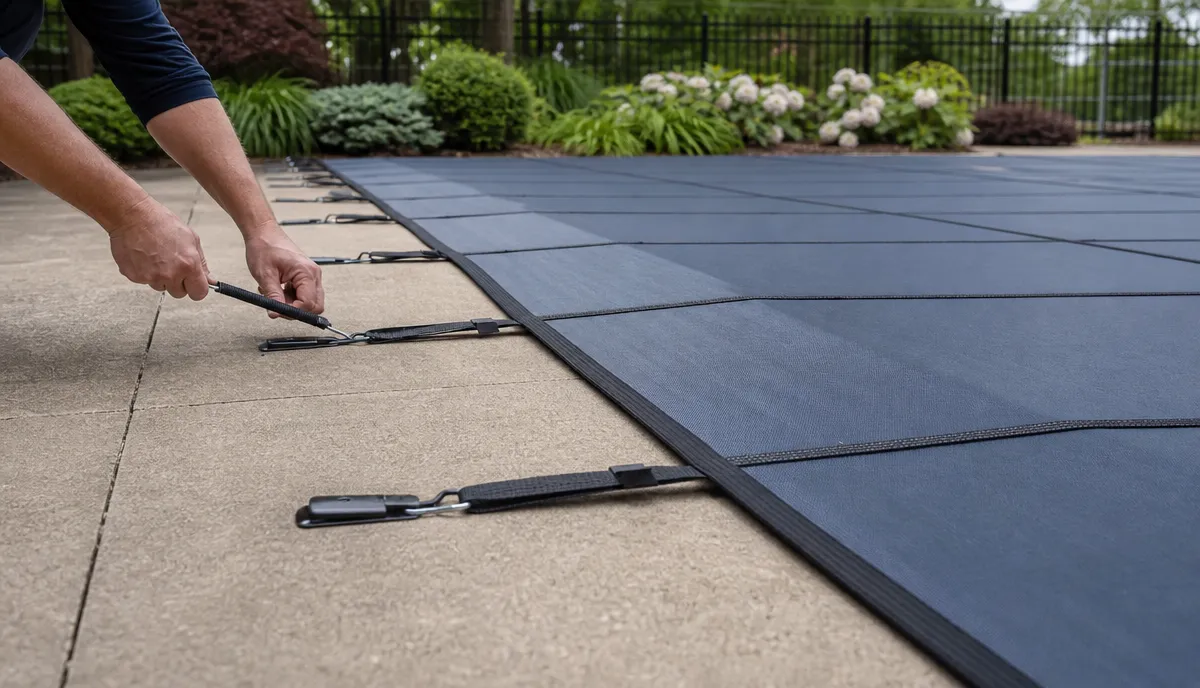
A cover spring being hooked to its deck anchor with the installation tool
What it does well:
An apartment community, a club, a small hotel pool that closes for the winter — is a good candidate, and for the same reasons a domestic pool is.
And it is a scheduled, documented job rather than an open item. Cover on with the close, cover off with the opening, both on the calendar. See pool closing service — closings start from $495 plus chemicals for a domestic pool; commercial work is quoted.
An indoor pool. It does not close, there is no winter, and the problems it has are about air rather than frost. That whole subject is on our Beachwood pool service page.
A pool that stays open year-round outdoors, which is unusual here but not unheard of.
A facility whose actual problem is access control. If people are getting to the water when they should not, the answer is a fence, a gate, a lock and a policy — not a fabric cover. A cover that gets partly unfastened by someone determined to swim is worse than no cover, because it looks like a barrier and is not one.
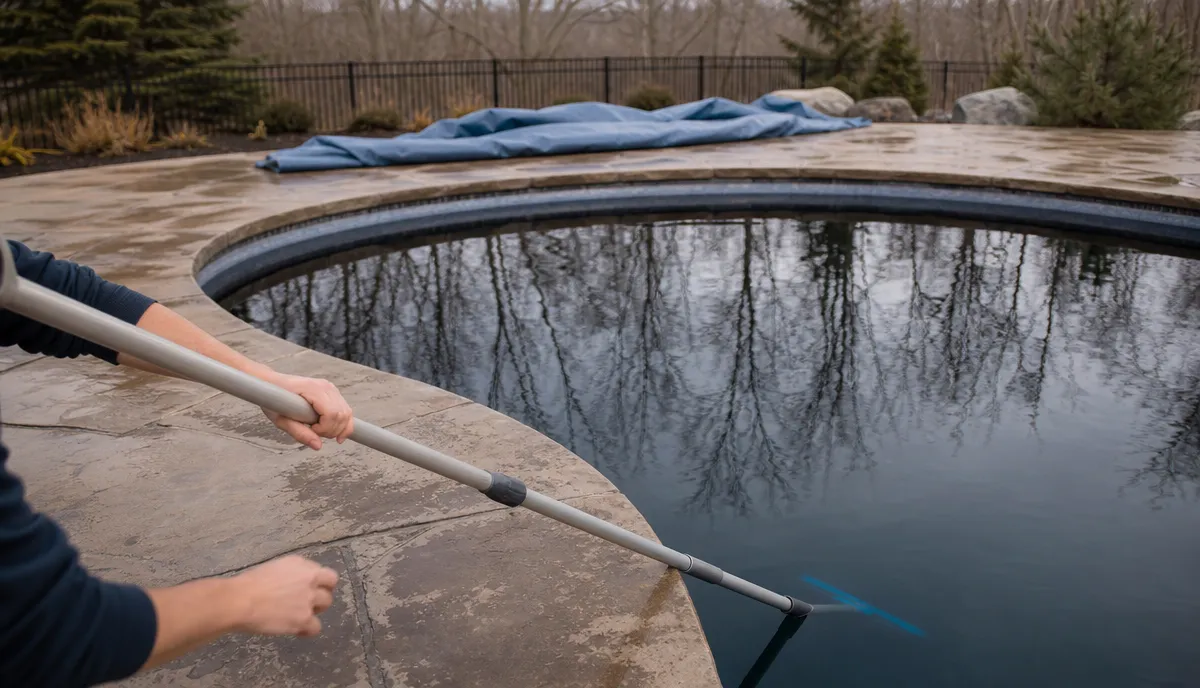
A pool where nobody will be responsible for the cover
On a commercial site that is a real question: a solid cover needs its cover pump watched, and a cover left half-fastened after somebody had a look is a hazard. If there is no owner for that task, say so before buying, not after.
A safety cover installed to the manufacturer's instructions and fully fastened is a barrier. It is not a reason to stop watching. No cover replaces supervision of children and pets around water, and a cover that is only half on is a hazard rather than a barrier. On a shared facility that sentence carries more weight rather than less.
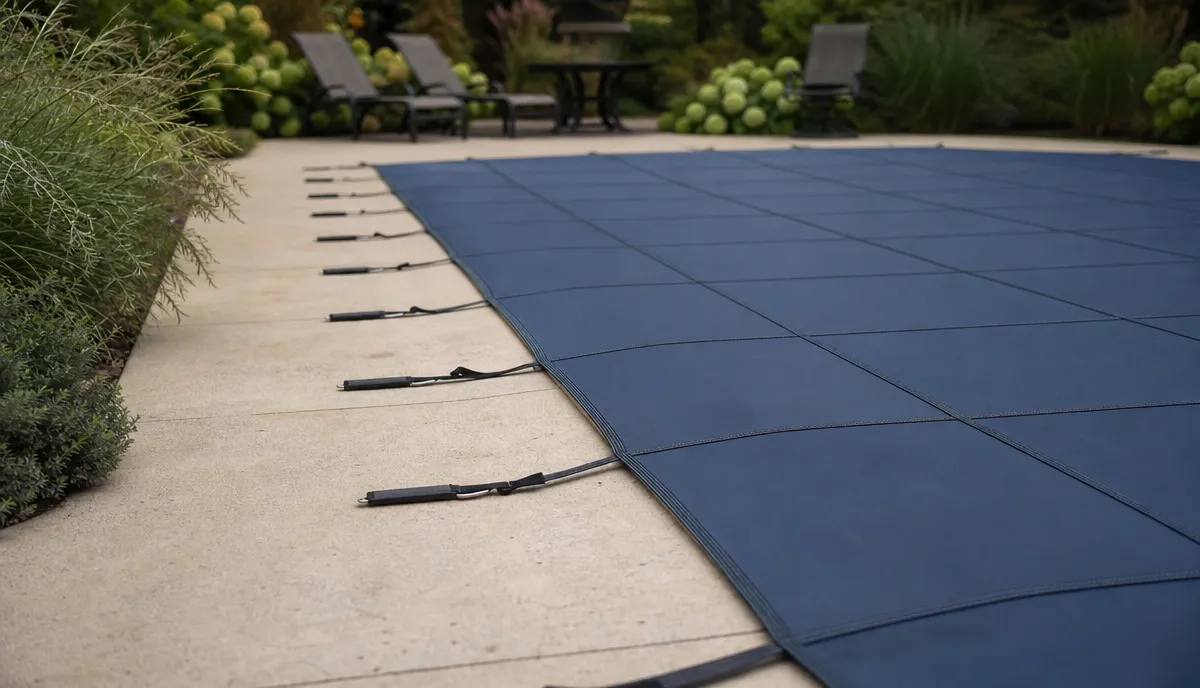
A safety cover anchored and tensioned around a pool perimeter
The same two visits as any custom cover — a measure, then a fit — and the process is set out on our covers in Twinsburg page. For anchors and deck types, safety cover installation.
Three things that differ on a commercial site:
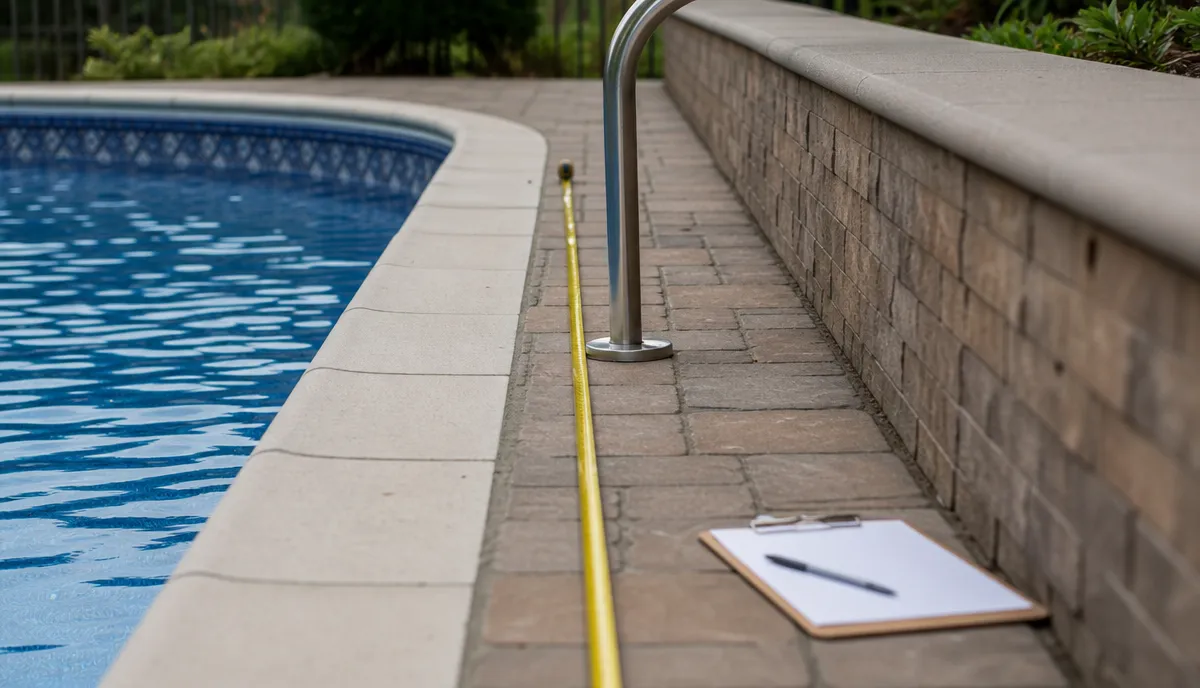
A cover measure being taken around obstructions
“Matt and his team are fantastic to work with. Easy to schedule, quality work is done right the first time. Highly recommend.”
Tell us what kind of facility it is and we will tell you honestly whether a cover is the right purchase.
Beachwood is in Cuyahoga County, about 11 miles from our base, and about 7.5 miles from Lake Erie — near-lake, so the season runs later here than inland and the cover goes on later than it does in Hudson or Stow.
Everything we install is made to your pool by Merlin or GLI, measured on site. We do not sell or fit stock or standard sizes. See the pool safety covers hub for the mesh-or-solid decision.
For commercial service more broadly see commercial pool maintenance. The list of towns is on service areas.
That is not a question we will answer, and you should be wary of anyone who does. We make and fit covers; we do not advise on code compliance, and your regulatory obligations stay yours. Requirements differ by jurisdiction and by facility type, so ask your authority first and decide what to buy second.
Yes, where a cover is genuinely the right answer — typically a seasonal outdoor amenity pool that closes for the winter. It protects the water and surfaces through five months of disuse, keeps landscaping debris out, carries snow, and turns the off-season into a scheduled job rather than an open item. Commercial work is quoted rather than priced from a list.
No. An indoor pool does not close, so there is no winter to cover it through — its persistent problems are about air rather than frost, chloramines in particular. That is a different service conversation and it is covered on our Beachwood pool service page.
It is the wrong tool. Access control is a fence, a gate, a lock and a policy. A fabric cover that gets partly unfastened by someone determined to swim is worse than no cover at all, because it looks like a barrier and is not behaving as one.
Three things, mostly practical. The deck is larger and busier, with more furniture and fixings inside the anchor line. The anchors have to be genuinely flush, because a public deck with hardware standing proud is a trip hazard. And both the measure and the fit need the pool area available and the water at the right level, which means coordinating with whoever runs the site.
Somebody has to, and it is worth settling before you buy. A solid cover needs its cover pump kept working, and a cover left half-fastened after someone has taken a look is a hazard. On a managed site, if there is no owner for that task, that is an argument about the purchase rather than a detail to sort out later.